
1: Why the IT Services Franchise Market is a Golden Opportunity for Entrepreneurs
I'll never forget that fall afternoon in 2022. My old friend David called me, and I could hear the exhaustion and confusion in his voice. David is a brilliant IT Director who has been with the same mid-sized manufacturing company for nearly 15 years. "Man," he said, "I feel stuck. I spend my days putting out other people's fires, working 60-hour weeks to build my boss's dream, but my own career ceiling feels like it's made of glass. I can see through it, but I just can't break it. I want to start my own thing, but the thought of starting from scratch... that uncertainty terrifies me. What do I do?"
David's story probably hits close to home for you. Maybe you have years of tech experience, or perhaps you've honed your skills in a corporate management role. You have a burning desire to be your own boss, to control your time and your financial future, but the risk packed into the phrase "starting a business from scratch" keeps you up at night. You're afraid of product development, terrified of marketing, and haunted by the idea of building a brand nobody has ever heard of.
This is the exact problem this article is here to solve. We're not going to explore another dizzying list of startup ideas. Instead, we're going to walk down a proven, less risky path: IT Services Franchising.
In my view, an IT services franchise is an "entrepreneurial launchpad" tailor-made for ambitious professionals like David, and like you. Why do I say that? Imagine not having to invent a business model from thin air. Imagine not spending years building brand credibility. Imagine not having to face every unknown technological and market challenge completely alone. With a franchise, you get to stand on the shoulders of a giant, using their proven systems, their recognized brand, and their powerful support network to build your own local empire.
And right now, in 2025, the timing couldn't be better. The IT services market is in the middle of an unprecedented boom. Just think about it:
Cybersecurity is no longer optional: With ransomware and data breaches becoming daily news, every single small business with even one computer needs professional cybersecurity. It's not just for big corporations anymore.
Cloud and remote work are the new normal: This means a massive number of small and medium-sized businesses (SMBs) need expert IT support to manage their cloud data and keep their remote teams productive and secure.
AI is reshaping business: Companies need IT experts to help them understand and implement AI tools to boost efficiency, or risk being left behind.
According to the authoritative research firm Gartner, worldwide IT services spending is projected to grow by 8.7% in 2024, reaching a staggering $1.5 trillion. This is a massive, and still growing, pie. An IT franchise is one of the most effective ways for you to quickly cut yourself a slice.
This article is the ultimate guide I've prepared for explorers like you and David. As a site operator and business consultant, I'm going to share my years of observation and research with complete transparency. We won't just tell you what the best IT franchise brands are. More importantly, I will walk you through a breakdown of the real costs, teach you how to evaluate which brand is right for you, and give you a crystal-clear action plan. My goal is that by the time you finish reading, you will no longer feel confused, but will instead be armed with clarity and the confidence to take action.
By the way, what happened to David? He eventually chose the franchise path. Later in this article, I'll share the mistakes he made and the keys to his success. His story could very well be your future.
2: How Much Does an IT Franchise Really Cost? A Full Breakdown
"How much does it cost to franchise a McDonald's?" The search volume for this question on Google is astronomical. It reveals the single most pressing anxiety for every potential franchisee: money. Before we can talk about any exciting business prospects, we have to get real about the numbers. But I have good news: compared to restaurant chains that can easily run into the millions, the entry barrier for an IT services franchise is often far more accessible, and its cost structure is fundamentally different.
In my experience, simply asking "how much does it cost?" isn't enough. A savvy investor asks, "Where is the money going? What are the fixed costs versus the ongoing expenses? How much working capital do I need to survive the first six tough months?" This is the kind of thinking that leads to smart decisions.
Years ago, a client excitedly told me he was ready to buy a franchise because the "franchise fee was only $50,000, it's a bargain!" I had to be the one to pour some cold water on his plans. I explained that the Initial Franchise Fee is just the price of admission; it's nowhere near your total investment. What truly determines your success or failure is your comprehensive understanding of the Total Initial Investment.
Let's dissect this and see where your money will actually flow in a typical IT services franchise. I've put together a table using two of the most well-known brands in the industry, CMIT Solutions and TeamLogic IT, to give you a tangible feel for the numbers. This data is derived from their public Franchise Disclosure Documents (FDDs) and is the most reliable reference we can get.
| Item | CMIT Solutions (Est. Range) | TeamLogic IT (Est. Range) | Notes |
|---|---|---|---|
| Initial Franchise Fee | $50,000 | $49,500 | The one-time fee for brand rights, training, and support systems. |
| Travel and Training Expenses | $2,500 - $5,500 | $2,000 - $5,000 | Cost to travel to headquarters for mandatory initial training. |
| Real Estate/Office Rent (3 months) | $1,500 - $7,500 | $3,000 - $9,000 | Most IT franchises allow a home office initially, but some require a small office. |
| Equipment and Software | $5,000 - $15,000 | $10,000 - $20,000 | Includes computers, servers, diagnostic tools, and franchisor-specified software. |
| Insurance and Licenses | $1,500 - $3,000 | $2,000 - $4,000 | Professional Liability (E&O) Insurance is a must-have. |
| Professional Fees (Lawyer, Accountant) | $2,500 - $7,500 | $3,000 - $7,500 | For reviewing the FDD and setting up your company. Do not skip this. |
| Initial Marketing Fund | $15,000 - $25,000 | $20,000 - $25,000 | For your grand opening and local marketing to build initial awareness. |
| Additional Funds/Working Capital (3-6 months) | $25,000 - $40,000 | $20,000 - $30,000 | This is your lifeline! Covers all expenses before you turn a profit. |
| Total Estimated Initial Investment | $103,000 - $153,500 | $109,500 - $150,000 | This is the realistic range of capital you need to have ready. |
2-1: Beyond the Obvious: Hidden Costs and Working Capital Explained
Now, let's talk about the two items on that table that are most often overlooked and most fatal to a new business: the Initial Marketing Fund and Working Capital.
I've seen too many new franchisees make the same mistake: they spend all their money on the franchise fee and office setup, only to realize on opening day that they have no budget left for marketing. It's like building a beautiful store but having no money to tell anyone it exists. In the B2B world, clients don't just walk in the door. You need to attend Chamber of Commerce events, run LinkedIn ads, and host small tech workshops. This "Initial Marketing Fund" is the ammunition for your first battle.
And Working Capital... I prefer to call it your "Survival Fund." The sales cycle for IT services is much longer than for selling a hamburger. It might take you 30, 60, or even 90 days to land your first Managed Services contract, and the payments for that contract will likely come in monthly. During that time, you still have to pay rent, pay yourself a salary (if you can), and pay monthly fees for various software. Working capital is the money that allows you to survive those first few months of zero revenue, maintain a professional appearance, and continue your marketing efforts. Underestimating working capital is the number one reason for franchise failure. Period.
So, how do you know how much you'll need? It's not a number you can just guess. It requires you to build a detailed financial forecast based on your local market. Sounds complicated, right?
Don't worry, this is exactly why our website exists. We developed an ROI Calculator. You can take the numbers from the table above, combine them with your own projections, and plug them into the calculator. It will help you simulate your cash flow for the next 1-3 years, giving you a much more scientific estimate of how much "Survival Fund" you'll need. This is infinitely more valuable than any vague advice.
(Use the Free ROI Calculator Now & Project Your IT Franchise Profitability)
Remember my advice: when it comes to your finances, hope for the best, but plan for the worst. Always have more capital ready than the franchisor's "minimum investment" figure. This conservative financial strategy will help you weather the entrepreneurial storm and stand firm when others might falter.
3: The Top IT Franchise Brands for 2025: A Head-to-Head Look
Okay, now that we have a clear-eyed view of the costs, we can move on to the most exciting part: choosing your brand. This is like choosing a business partner. You need to get to know their personality, their strengths, and their weaknesses to see who you're most compatible with.
There are quite a few IT franchise brands out there, but only a handful have achieved significant scale, a great reputation, and a mature system. I'm not going to overwhelm you with a long list of 20 brands. Instead, I'm going to focus on a few of the most representative industry leaders and conduct a deep, head-to-head comparison. This will give you a much clearer understanding of their different philosophies and market positions.


3-1: CMIT Solutions
Brand Snapshot: As one of the largest IT service providers for SMBs in North America, CMIT Solutions has over 250 locations. Their tagline, "We are the small business IT department," perfectly captures their market focus.
Core Services: They offer comprehensive Managed Services, including day-to-day IT support, cybersecurity, data backup and recovery, and cloud solutions. Their model is built on signing long-term service contracts with clients, which provides stable, recurring revenue.
Ideal Franchisee Persona: CMIT places a very high value on a franchisee's business background and sales ability. They have a saying that they are looking for "salespeople," not "technicians." Their philosophy is that technology can be hired, but the ability to develop a market and build client relationships is a skill the owner must possess. If you're transitioning from a role like sales director, project manager, or business owner, you are their ideal candidate.
Investment Range: As shown in our table, the total investment is approximately $103,000 - $153,500.
My Take (Pro/Con):
Pro: Exceptional brand recognition and market coverage. Their mature operating systems and marketing support can get you up and running faster. Their national client network can sometimes even generate local business leads for you.
Con: As a mature system, it can be less flexible. You'll need to strictly adhere to the corporate operating standards and technology stack. Also, in some popular metro areas, the best territories may already be taken.
Want a deeper dive into every detail of CMIT Solutions? Check out our full CMIT Solutions Brand Review Page, which we've prepared for you.
3-2: TeamLogic IT
Brand Snapshot: TeamLogic IT is another award-winning heavyweight in the industry. Their positioning is slightly more upscale, emphasizing the delivery of "strategic" IT advice to businesses, not just "break-fix" support. Their franchisees are often positioned as "Technology Advisors" or "vCIOs" (virtual Chief Information Officers).
Core Services: In addition to standard managed services, TeamLogic IT has a deeper focus on cloud migration, business continuity planning, and IT strategy consulting. They encourage their franchisees to become long-term strategic technology partners for their clients.
Ideal Franchisee Persona: TeamLogic IT also welcomes applicants with strong business backgrounds, but they have a higher expectation for a franchisee's ability to understand and leverage technology to solve business problems. If you're not only a great communicator but also have a genuine passion for how technology drives business growth, TeamLogic IT's philosophy might be a better fit.
Investment Range: The total investment is around $109,500 - $150,000, very comparable to CMIT.
My Take (Pro/Con):
Pro: A powerful brand reputation for professionalism, which can help you land higher-value clients. The corporate training is very strong on the strategic side of the business.
Con: The demands on the franchisee's all-around capabilities are higher. If you have absolutely no technology background, the learning curve might be steeper.
3-3: Other Noteworthy Brands
Of course, the market isn't just a two-horse race. To give you a broader perspective, here are two other distinctive brands:
Computer Troubleshooters: This is a global brand with a longer history, positioned more as the "problem solver" for both SMBs and home users. Its investment threshold is often lower and its model more flexible, making it suitable for entrepreneurs who want to start on a smaller scale.
NerdsToGo: The name itself is memorable, and their marketing is outstandingly creative and visible. They serve both business and residential customers, giving them a wider service scope. If you prefer a more vibrant, retail-oriented brand, NerdsToGo is worth a look.
Reading this, are you starting to feel a bit of "analysis paralysis"? CMIT has the scale, TeamLogic has the professional prestige, and the others have their own unique appeal... which one is my destiny?
Slow down. This is precisely why we developed the Opportunity Comparison tool. You can plug the core data from these brands-investment level, royalty fees, market position, training support-into the tool for a side-by-side comparison. The tool acts like an impartial referee, laying out all the information clearly to help you make the most rational decision.
Remember, there is no single "best" brand. There is only one brand that is "best for you." Your background, your personality, your financial situation, and your local market environment all come together to determine your optimal choice.
4: The Litmus Test - Are YOU the Right Fit?
So far, we've talked about money and brands-all external factors. Now, it's time for the most important and profound exploration of all: looking inward at yourself. Buying a franchise is like buying yourself a job as CEO. But are you the right person for that job?
In all my years of business consulting, I've seen too many failures rooted not in a bad brand or a weak market, but in the franchisee themselves simply being in the "wrong race." A top-tier programmer can be a terrible salesperson. A brilliant sales director might have zero patience for tedious daily operations. Therefore, before you invest a single dollar, taking the time to calmly and honestly assess yourself is the most valuable investment you can make.
4-1: The IT Franchisee Success Persona: More Than Just Tech Skills
Let me tell you a secret that might just blow your mind: in the IT services franchise industry, the most successful franchisees are often not the most technical people.
Remember my friend David from the beginning? He's a technical genius who can solve almost any complex IT problem. When he first decided to pursue a franchise, he made a classic "tech expert" mistake. He spent countless hours researching the tech stacks of various brands, comparing which firewall was more advanced and whose backup solution was more robust. But then I asked him a simple question: "David, how many sales calls did you make this month? How many networking events did you attend?" He went silent.
I told him that as a franchise owner, your job is no longer to "solve tech problems." Your job is to "acquire clients whose tech problems you can solve." You need to become the Chief Relationship Officer. You need to get out into your local business community, have coffee with other business owners, listen to their business pains, and then explain how your IT services can help them save money, make money, or avoid risk. You need to hire, train, and manage your technical team to execute the services. But you, the owner, must spend 80% of your time "outside the office."
This is a massive identity shift. Many entrepreneurs from a technical background find this transition extremely uncomfortable. They'd rather be in a server room than at a networking mixer where they don't know anyone. This is what I mean by being in the "wrong race."
So, what does a successful IT franchisee look like? Based on my observations, they usually have a combination of these traits:
A Natural Relationship Builder: They enjoy talking to people, are great listeners, and can quickly earn trust.
A Tenacious Sales Mindset: They aren't afraid of rejection and see every "No" as one step closer to a "Yes."
An Excellent Manager: They know how to hire people smarter than themselves, how to delegate, and how to set goals and measure performance.
Financial Acumen: They can read a financial statement, are obsessed with cash flow, and know if every dollar is being spent wisely.
A Passion for, but not an Obsession with, Technology: They understand tech trends and can explain complex concepts in simple terms to clients, but they don't get lost in the weeds.
Reading this, you might feel a little uneasy. "Oh no, that doesn't sound exactly like me..." Don't worry. Very few people are masters of everything. The key is to recognize your weaknesses and have a plan to compensate for them. For example, if you're not a natural salesperson, you need to heavily scrutinize how strong a franchisor's sales training and marketing support really are. Or, you might consider bringing on a partner who excels at sales.
To help you assess yourself more scientifically and objectively, our team developed a very special tool: the Entrepreneur Assessment. This isn't just another personality test. It analyzes you across multiple dimensions-your risk tolerance, management style, sales inclination, and more-to generate a personalized report on your entrepreneurial potential and blind spots. This report will tell you what kind of challenges a person with your profile might face and how you can prepare for them in advance.
It's like getting a full diagnostic on your car before a long road trip. Knowing your strengths and weaknesses will help you go farther and have a smoother ride.
(Take My Free Entrepreneur Assessment & Discover My Entrepreneurial DNA)
5: How to Start Your IT Franchise Journey in 6 Steps
Okay, after analyzing the costs, comparing the brands, and assessing yourself, you feel ready. Your blood is pumping with entrepreneurial excitement, and you can't wait to start this journey.
But wait. Passion is the engine, but you still need a map. Without one, you're likely to spin your wheels or drive off in the wrong direction. Here, I've drawn out a clear, 6-step action map for you. This map is a summary of my learnings from countless success and failure stories. It will help you avoid the common pitfalls and ensure every step you take is solid and effective.
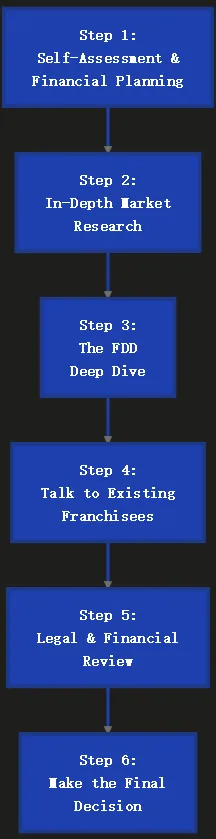
Step 1: Self-Assessment & Financial Planning
We've already discussed this in detail. In this step, you need to honestly answer, "Am I really cut out for this?" and use our Entrepreneur Assessment tool to help you. At the same time, you need to clearly calculate your net worth and the liquid capital you have available for investment. Remember, don't invest your entire life savings. Always keep at least 6-12 months of personal living expenses in reserve.
Step 2: In-Depth Market Research
Before you contact a single franchise brand, research your own backyard.
How big is your local market? How many SMBs are in your city? What are their primary industries (e.g., law firms, dental clinics, manufacturing plants)?
Who are your competitors? Google "IT support near [your city]." See who shows up. Are they independent IT companies or other franchise brands? What do their websites look like? What are their customer reviews?
What can you offer that's different? Find an underserved niche. Maybe there are plenty of IT companies in town, but none that specialize in healthcare compliance (HIPAA). That could be your opening.
Step 3: How to Read a Franchise Disclosure Document (FDD) Like a Pro
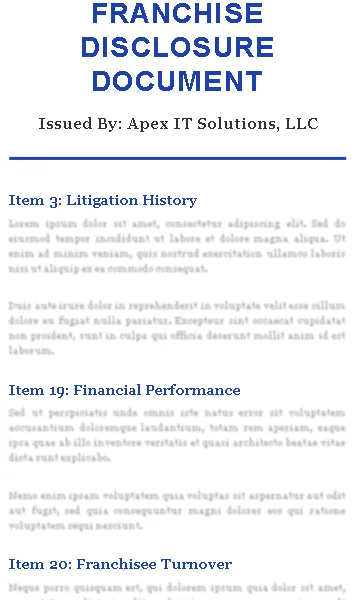
Once you start talking to franchise brands, they will give you a document that's several hundred pages long. This is the FDD (Franchise Disclosure Document). It's a legal document required by the Federal Trade Commission (FTC). Most people get a headache just looking at it, but in my opinion, it's a gold mine! It contains all the secrets the franchisor doesn't want you to easily find. You must learn to read it like an expert.
Don't read it cover to cover. You need to focus on these key "Items":
Item 3: Litigation: This section lists all of the franchisor's past major lawsuits. You need to pay special attention to one question: Are there a significant number of lawsuits filed by franchisees against the franchisor? If so, that's a massive red flag. It indicates a serious conflict in the system.
Item 6: Other Fees: This lists every fee you might have to pay beyond the franchise fee and royalties, such as software fees, training fees, and penalties. Read this carefully to avoid surprise expenses down the road.
Item 19: Financial Performance Representations: This is the most enticing and most dangerous section. The franchisor might present earnings or profit data from existing franchisees here. You need to ask: Is this the average of all franchisees, or did they only pick the top performers? Is the data Gross Revenue or Net Profit? The difference is night and day. If a brand provides no Item 19 at all, be extra cautious.
Item 20: Outlets and Franchisee Information: This is the section I value most. It tells you how many units opened, closed, were transferred, or were terminated by the franchisor over the past three years. Calculate the "churn rate." If a system with 200 units had 30 closures or transfers last year, that's a 15% churn rate, which could signal serious problems. This table also provides the contact information for all current and recently departed franchisees.
Step 4: Speak with Existing Franchisees
Item 20 of the FDD gives you a priceless contact list. You must, must, must make at least 10 phone calls. And don't just call the "star players" the franchisor recommends. You need to intentionally pick franchisees who have just opened in the last 1-2 years, and people who have left the system.
Ask them tough questions:
"How long did it really take you to become profitable? Was it longer or shorter than what the FDD suggests?"
"The marketing support from corporate... how effective is it in reality?"
"What has been your single biggest challenge, and how did the franchisor help you solve it?"
"If you could go back in time, would you still choose to buy this franchise?"
Their answers are more real than any marketing brochure.
Step 5: Legal and Financial Review
Never sign a franchise agreement on your own. Hire a specialized Franchise Attorney to review the FDD and franchise agreement for you. Their fee (usually a few thousand dollars) is the best money you will spend in this entire process. They can spot the "traps" hidden in the legal jargon. At the same time, take your business plan and the FDD to your accountant for a financial review.
Step 6: Making the Final Decision
After completing all the steps above, you now have all the information. Go back to the beginning, combine it with your self-assessment, financial situation, and market research, and make your final decision.
This process looks long and complicated, doesn't it? It is. But it will reduce your risk of failure by 90%. To simplify your work, we developed the Business Plan Generator. You can plug the information you've gathered at each step into our generator. It will help you organize these scattered pieces of information into a professional, logical business plan. This plan will not only help you apply for a loan but, more importantly, will serve as your operational guide for the years to come.
6: My Personal Viewpoint & The Unspoken Truth
Okay, up to this point, I've been acting as an objective consultant, analyzing data and breaking down processes for you. But here, I want to take off the "expert" hat and speak to you as a friend, as a fellow website operator who has been through the entrepreneurial trenches.
In my view, the essence of an IT services franchise is not a tech business; it's a trust business. Your clients are handing you the digital keys to their kingdom. They aren't buying the brand of firewall you sell or your technical certifications. They are buying you. They are buying the peace of mind you provide.
Why do I stress this so much? Because it determines whether you become a "senior-level tech freelancer" making $100,000 a year or an "entrepreneur" building a million-dollar business.
I've seen too many franchisees who are technically brilliant and provide great service, but their business never grows. Why? Because they position themselves as "the repairman." A client's computer breaks, and they call him. A server goes down, and they call him. He's busy, and he makes some money, but he's always passively reacting to problems. His income has a ceiling because there are only 24 hours in a day.
The truly successful entrepreneurs, from day one, position themselves as "business advisors." They don't talk to clients about CPU models; they talk about "how we can use your IT systems to increase your company's sales by 10%." They don't sell "data backup"; they sell "the peace of mind that you can be back up and running 30 minutes after a disaster." By providing strategic value, they build deep trust with their clients. This trust leads to higher-value, higher-loyalty, long-term contracts-what we call Managed Recurring Revenue (MRR). This is the soul and magic of the IT franchise model.
So, my first and most important piece of advice to you is this: Forget that you are an "IT expert." Remember that you are a "business problem solver." Your value isn't measured by how many lines of code you can configure, but by how much business value you can create for your clients.
My second piece of advice is to have a healthy fear of the "pitfalls." My friend David fell into a big one early on. He was very confident in his sales ability and, against the franchisor's advice, spent a large chunk of his marketing budget sponsoring a local golf tournament, hoping to network with high-end clients. The result? He collected a stack of business cards but didn't convert a single one into a real client. In that social setting, people wanted to relax, not talk shop. He later realized that his most effective clients came from the weekly Chamber of Commerce breakfast meetings he consistently attended, and from a mutual referral relationship he built with a local business attorney.
The lesson here is: Do not try to outsmart the proven marketing model of your franchisor, at least not in your first year. The methods they tell you to use-canvassing office parks, making cold calls, attending networking events-might sound "old-school," but they are the effective paths proven by the real-world dollars of countless franchisees before you. Execute their plan rigorously. Once you have a stable client base and positive cash flow, then you can start experimenting with your own ideas.
Finally, I want to talk about "the choice." So many people get stuck between CMIT and TeamLogic, as if they're choosing between a Mercedes and a BMW. In my opinion, both of these brands are excellent and can make you successful. The more critical questions are whether the battlefield you choose (your local market) is fertile enough, and whether you, as the general, can lead your troops (your team) to victory. Instead of spending three months agonizing over the subtle differences between Brand A and Brand B, spend two months deeply researching your local market and one month talking to 10 real franchisees. The value you'll get from the latter is far greater than the former.
So, if you ask for my final recommendation, I won't recommend a specific brand. I will recommend a mindset: Begin with the end in mind, think deeply, verify cautiously, and act boldly. That is more important than any brand you choose.
7: Your Next Move: From Information to Action
We've been on a long journey together, from understanding costs and comparing brands to looking inward and planning the future. I hope what you're feeling now isn't confusion, but a sense of clarity and control over the road ahead.
Information itself has no value. Only information that is put into action has power. To help you take action immediately, I've summarized the three things you need to do next:
Conduct a thorough financial and personal inventory. Open your bank accounts and honestly calculate your net worth and available investment capital. Then, click the link below to complete our Entrepreneur Assessment and get to know yourself on a deeper level. This is the foundation for all your decisions.
Choose 2-3 brands you're most interested in and begin your detective work. Go to their websites, request their information packets, and get your hands on their FDD. Read it as I taught you, focusing on Items 3, 19, and 20.
Start the conversation. Pick 10 franchisees from the list in Item 20 and call them. Have your list of questions ready. Their real-world experience is your most valuable asset.
These three steps will transform you from a spectator into a participant.
8: Investment Risk and Disclaimer
Disclaimer: The information provided in this article is for informational and educational purposes only and should not be considered financial or legal advice. Buying a franchise involves significant risk, including the potential loss of your investment. We are not a franchise broker or seller. All data, such as investment figures and fees, are based on publicly available information and may change. It is crucial to conduct your own thorough due diligence, review the official Franchise Disclosure Document (FDD) with a qualified franchise attorney, and consult with a financial advisor before making any investment decision.
9: Further Reading
If you'd like to continue exploring more about franchising and business opportunities, I highly recommend you read a few other articles on our site:
10. About the Author
I am Qaolase, the founder and lead writer of this site. I'm not some financial titan with countless credentials-I'm just like you, an ordinary entrepreneur driven by curiosity and passion for the business world. Over the past decade, I've immersed myself in the realm of business opportunities and franchising, analyzing hundreds of brands and helping friends like David and countless online readers avoid investment pitfalls to find their own paths. My motivation for creating this site is simple: to share the most valuable business insights in the most authentic and accessible language, helping you navigate fewer detours on your entrepreneurial journey.
11. Join the Conversation
Now, I want to hand the microphone over to you.
What has been the biggest point of confusion in your exploration process?
What questions do you still have about IT franchising that I haven't covered?
Do you have a similar "pitfall" story you'd be willing to share?
Please leave your thoughts, questions, or stories in the comments section below. I promise to personally reply to every single comment within 48 hours. Let's build this into a community of entrepreneurs full of real experiences and mutual support.
Sources:
Federal Trade Commission (FTC). "A Consumer's Guide to Buying a Franchise
Please be respectful and constructive in your comments. Spam and inappropriate content will be removed.