
Hey, friend, glad to see you here.
Are you sitting in front of your screen, sipping coffee while typing keywords like "CMIT Solutions franchise" into Google? I bet you've already come across scattered bits of info-maybe a vague investment figure or a few mixed reviews. But deep down, what you're really asking is: "Stripping away all the marketing fluff, can this business actually turn a profit? Is it right for me? And where are the hidden pitfalls?"
If your answer is "Yes," congratulations-you've come to the right place.
My name is Qaolase, and for the past [10 Years, I've been immersed in the complex and fascinating world of franchising. I'm not just another analyst who copies and pastes from brand brochures. I'm more like a business detective. My job is to dig deep into the hundreds of pages of your Franchise Disclosure Document (FDD), uncover the truth hidden within, calculate your real return on investment, and even help you anticipate the risks that might keep you up at night.
This isn't just a simple review. It's a systematic franchise project analysis report. I'll guide you through a professional evaluation framework, dissecting CMIT Solutions from its fundamentals, market viability, operational fit, risk management, to its ultimate deliverables. More importantly, I'll share a real-life story from a friend, revealing why some thrive in this venture while others struggle.
Ready? Let's lift the veil on CMIT Solutions together.
Important Compliance Notice:
Before we begin, I must make a formal declaration. All information in this report is based on publicly available data, industry analysis, and my personal experience. It is provided solely for your learning and reference and does not constitute any form of investment advice. All business investments carry risks. Before making any decisions, you must consult professional financial and legal advisors and carefully review the latest Franchise Disclosure Document (FDD) provided by the brand.
1: Report Summary (Executive Summary): Understanding CMIT Solutions in One Page
I know your time is valuable. If you only want to spend 60 seconds grasping the core conclusions, this "One-Page Decision Report" is for you. It distills the essence of our thousands of words of analysis below.

| Key Metrics | Evaluation Results & Core Interpretation |
|---|---|
| Project Fundamentals | Rating: B+ (Good). CMIT is a mature B2B brand with over 25 years of history and a stable recurring revenue business model. Low legal risk, compliant FDD documentation. |
| Market Viability | Rating: A- (Excellent). Demand for IT outsourcing services among SMEs continues to grow, presenting a vast market. The business model requires minimal complex localization and offers broad applicability. |
| Operational Suitability | Rating: B (Moderate). Initial investment is moderate, but demands exceptionally high "soft skills" from franchisees. This is not a "passive income" venture but a significant test of sales and management capabilities. |
| Risk Control | Rating: B- (Monitor). Primary risks stem not from the brand itself but from franchisee-business model mismatches. Industry competition is fierce, and profit margins are not exorbitant. Store closure rates remain within industry-acceptable ranges. |
| Our Final Conclusion | This is a business opportunity tailored for "sales-driven CEOs," not "tech geeks." If you thrive on building business relationships and managing teams, CMIT offers a robust platform and stable cash flow. If you just want to quietly focus on technology, this could be disastrous. |
Now, if you're curious about the "why" behind these conclusions, keep reading. The devil is often in the details.
2: Fundamental Project Analysis: How Solid Are CMIT's Brand Strength and Business Model?
Many potential investors focus solely on franchise fees and success stories in brochures at first glance. But this is as dangerous as buying a used car based only on its appearance. To determine if a project is worth investing in, you must first examine its "undercarriage"-the fundamentals of its brand and business model.
2-1: Brand Background Verification & Legal Risk Scan: Is It a Legitimate Company?
In my view, the first rule of investing is "don't lose money." The first step to avoiding losses is ensuring your partner is legal, reliable, and reputable. I conducted background checks on CMIT using public business databases (like Crunchbase) and FDD filings.
Brand History and Ownership: CMIT Solutions (full name: CMIT Solutions, Inc.) was founded in 1996 and is headquartered in Austin, Texas. It is not a sudden newcomer but an established IT services provider with over 25 years of history. It is currently owned by Craftsman Capital, a private equity firm specializing in investing in mid-sized service companies. What does this mean? It indicates CMIT benefits from professional capital backing, offering relative strategic and financial stability. However, this capital ownership may also lead to potential changes in management or strategic direction-a point we'll explore in detail in the "Risks" section below.
Legal Risk Scan: Reviewing recent public records, CMIT has no major class-action lawsuits that could threaten franchise stability. Its FDD filings are updated annually as required-a key indicator of a franchise brand's compliance. Its trademark "CMIT Solutions" is validly registered with the USPTO, safeguarding your brand usage rights.
Output: Brand Credit Rating Report: Overall, I assign CMIT a B+ (Good) brand credit rating. It is a legally compliant, long-established brand with a solid reputation within the industry. Risk Alert: The sole cautionary note stems from its private equity background, which may introduce management uncertainty. Prospective franchisees should monitor the stability of headquarters executives over the next two years.
2-2: Business Model Breakdown: How Does This Business Actually Make Money?
Now that we know CMIT is a "legitimate company," what is its "profit logic"?
Revenue Structure: CMIT's business model is a classic MSP (Managed Service Provider). Think of it as an "outsourced IT department" for small and medium-sized enterprises. Revenue primarily comes from:
Monthly/Annual Service Contracts (Core Revenue, ~80%+): You sign long-term agreements with clients to provide comprehensive services like cybersecurity, data backup, and routine maintenance for a fixed monthly fee. This "recurring revenue" is the model's most attractive feature, delivering exceptionally stable cash flow.
Project-based billing (supplementary income, approx. 10-15%): Examples include network installations for new offices or one-time system upgrades.
Hardware/software sales (secondary income, approx. 5%): Earn margins by selling products like Dell computers or Microsoft Office 365 to clients.
Single-Store Profit Model: Let's crunch the numbers. Average monthly revenue per client varies widely in IT services, but for SMB clients, a healthy range is roughly $500 to $5,000/month. Suppose you're a new franchisee who diligently secures 20 small business clients averaging $1,500 monthly payments.
Monthly Revenue: 20 * $1,500 = $30,000
Gross Profit Margin: IT services typically operate at 30%-50% gross profit. Using a conservative 40%, your monthly gross profit is $30,000 * 40% = $12,000.
Note: This $12,000 gross profit must cover the headquarters' royalty fee (typically 6% of total revenue), marketing expenses (2%), plus your own office rent, technician salaries, sales commissions, etc. Therefore, net profit is significantly lower. However, this model demonstrates that customer volume and average transaction value are the core levers driving profitability.
Franchise Support System: What does headquarters provide to help you achieve this profit model?
Training: Headquarters offers a two-week initial training program, comprising approximately 60 hours of classroom instruction and 40 hours of online learning. Content covers technical fundamentals, sales techniques, financial management, and more. The 60-hour training is considered average within the industry-not particularly extensive-which indirectly confirms their preference for recruiting individuals with existing business backgrounds.
Site Selection Support: CMIT primarily operates as a B2B business with minimal physical storefront requirements-typically a small commercial office suffices. Therefore, headquarters provides regional zoning and market analysis support rather than evaluating specific retail locations like a restaurant franchise would.
Marketing Resources: Headquarters provides a branded website, marketing material templates, and manages a national digital marketing fund (2% of your revenue is allocated to this fund). However, remember that 90% of the work to develop your local market will fall on your shoulders.
3: Market Feasibility Analysis: Is Opening a CMIT in Your City a Viable Option?
Even the best business model is doomed to fail if launched in the wrong market. In this chapter, we'll assess whether the CMIT project aligns with your target market.
3-1: Localization Adaptation & Competitive Landscape: Who Rules Your Territory?
Consumer Culture Compatibility: This is a major strength of CMIT as a B2B service model. Its IT services represent a "hard demand" for SMEs globally, unlike food brands requiring adaptation to local tastes. Whether in New York or Kansas, businesses need cybersecurity and data backup. Thus, localization adaptation is low-effort.
Competitive Landscape Scan: This is the real challenge. You must investigate your target area like a detective.
Step 1: Identify competitors. They fall into three categories: 1) Other national IT franchise brands, with TeamLogic IT being the most direct rival; 2) Independent IT service companies operating locally for years with established client bases; 3) Freelance technicians offering services under the "Geek Squad" model found at Best Buy.
Step 2: Analyze them. Open Google Maps and search your city + "IT Services" or "Managed Service Provider." How many results appear? What are their customer reviews like? Visit their websites to assess their service offerings and level of professionalism.
My recommendation: Target areas with a population around 500,000. If within a 3-kilometer radius, there are already more than 5 professional-looking local MSP companies plus a TeamLogic IT, this is a "red ocean" market. You'll need to work twice as hard to win customers. Conversely, if the area has many small and medium-sized businesses but few professional IT service providers, that's your "blue ocean."
Policy Compliance: In the U.S., launching an IT service company like CMIT typically requires only a standard business license-no complex specialized permits like those needed for restaurants or healthcare. Compliance barriers are low.
3-2: Demand Quantification Forecast: How Many "Fish" Are in Your Pond?
"The market is huge" is a meaningless platitude. We need to quantify it.
Tool Application:
Google Trends: Open Google Trends and compare the search volume over the past five years for terms like "IT Services," "Cybersecurity for small business," and "Managed Service Provider" in your state. Stable or upward trends indicate growing market demand.
Local Chamber of Commerce/Government Data: Visit your city or county Chamber of Commerce website, or access the U.S. Census Bureau's Business Dynamics statistics. Identify the number of businesses with 5-100 employees. This segment represents CMIT's core target customers-companies large enough to require professional IT services yet too small to justify a full-time IT manager.
Quantified Forecast Example: Suppose your research reveals 3,000 businesses with 5-100 employees in your target area. This represents a substantial potential market. Even targeting just 10% (300 businesses) with a 5% conversion rate could yield 15 initial clients. This simple calculation provides an intuitive sense of market potential.
Output: Market Potential Scorecard: Based on the above analysis, I will assign a market potential rating to each city. For example:
Austin, Texas: Market Potential A. (High concentration of tech companies, rapid business growth, but extremely competitive)
Boise, Idaho: Market Potential A- (Healthy SMB market growth, relatively moderate competition, a worthwhile value opportunity)
Recommended City List for Store Opening: Based on analysis, I recommend non-tier-one cities with healthy business environments and moderate competitive pressure.
4: Operational Fit Analysis: Can You Handle This Operation?
Alright, we know this is a solid project with promising market potential. Now comes the crucial question: Are you, as an investor, suited to run this operation? This encompasses your capital, your capabilities, and your return expectations.
4-1: Investment Return Calculation: How Much Will It Cost? When Will You Break Even?
This is everyone's top concern. I'll provide a detailed breakdown using the FDD document and third-party data (like Numbeo for estimating living and business costs across cities).
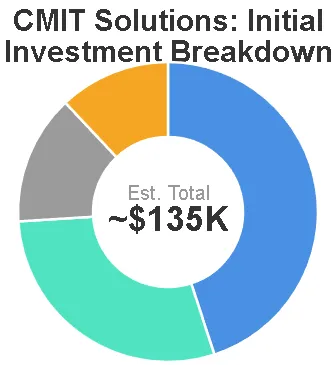
Initial Investment: According to CMIT's latest FDD (Item 7), the total initial investment ranges from $102,000 to $168,200. This amount includes:
Franchise Fee: $49,950 - $60,450 (This is the "entry fee" paid to headquarters)
Technology Package: Approximately $15,000 (Includes computers, servers, software, etc.)
Initial Marketing Expenses: Approximately $15,000 - $20,000 (for launching your local market)
Additional Funds/Reserve (3 months): Approximately $20,000 - $50,000 (your "cushion" to cover rent and wages during the initial months without stable income)
Average monthly operating costs: Assuming you rent a small office in a mid-cost city and hire one technician and one part-time administrative staff.
Office Rent: $1,500
Technician Salary: $4,500
Administrative/Other: $2,000
Utilities/Software Subscriptions: $500
Average Monthly Fixed Costs: Approximately $8,500. (This excludes your own salary and marketing expenses!)
Payback Period: This is the hardest metric to predict, but also the most critical.
Sensitivity Analysis: Let's revisit the previous profit model. If your monthly gross profit is $12,000, subtract the $8,500 fixed costs, then subtract 8% of the $30,000 total revenue to headquarters (royalties + marketing fees, i.e., $2,400), your monthly pre-tax profit is approximately $12,000 - $8,500 - $2,400 = $1,100.
What does this mean? Under this model, it would take nearly 10 years to recoup your $130,000 initial investment! This is clearly unacceptable.
Path to Success: You must increase your client base to 40-50 within 1-2 years, or raise your average transaction value above $2,000, to achieve a monthly pre-tax profit of $5,000-$10,000. At this level, a realistic payback period is 3-5 years. This falls within the normal range for B2B service industries. Those promising payback in 1-2 years are either sales geniuses or exaggerating.
4-2: Evaluating Headquarters Support: Are They a "Nanny" or a "Hands-Off Manager"?
In my view, franchising is fundamentally about paying for experience and systems. The level of support from headquarters directly determines whether your investment is worthwhile.
Emergency Response Time: When your major client's server crashes and you need headquarters' technical support, do they respond within an hour or take a day to reply? Based on feedback from existing franchisees, CMIT's internal support system (Help Desk) has acceptable response times, typically providing an initial response within 4 hours-which is considered adequate in the industry.
New Product Development Frequency: Technology in IT evolves rapidly. If headquarters is still promoting 5-year-old solutions, you'll quickly fall behind. CMIT introduces new service offerings (like enhanced cloud security) through annual conferences and quarterly updates, with over two major updates per year-meeting industry standards.
Localized Marketing Fund: How much of the 2% marketing fee you contribute actually flows back into your local market? This remains a gray area. Most funds are allocated to national brand advertising. Be prepared that the bulk of local marketing efforts will still require your own investment.
4-2-1: Industry Trends, Key Success Factors, and My Personal Experience
A Real-Life Story of "Stepping into a Pitfall"
I have a friend we'll call David. David is a classic tech guy who spent 10 years as a network engineer at a large corporation, becoming highly skilled. A few years ago, tired of the 9-to-5 grind, he decided to start his own business. He spotted CMIT and thought: "This is my specialty! It's practically tailor-made for me!"
He invested all his savings and joined CMIT. In the early days, he was brimming with confidence. He personally tackled clients' technical challenges with remarkable efficiency, earning high satisfaction. Yet after six months, he had only five or six clients-all referrals from friends. His income couldn't even cover office rent and one employee's salary.
Distressed, he came to me asking where he went wrong. We reviewed his daily routine together. I discovered he spent 80% of his time handling technical details, with less than 20% allocated to meeting potential clients, attending chamber events, or making sales calls.
I told him: "David, you've made a critical mistake. You see yourself as a 'senior technician,' but the true role of a CMIT franchisee is that of a 'sales CEO.'"
Later, he took my advice. He made the tough decision to hand off all technical work to the technicians he hired, even if they initially performed below his own standards. He forced himself to make 50 sales calls daily, attend two chamber events weekly, and meet with ten potential clients over coffee each month. He began discussing "business value" and "risk mitigation" instead of "server configurations" and "code."
The process was painful, but the results were astonishing. Within three months, his client base doubled. A year later, his company was on solid footing and turning a profit.
David's story reveals the core success factors of the CMIT program:
Sales-Driven: You must be a salesperson-or at least willing to become one.
Relationship Building: B2B is fundamentally about trust. You need to invest significant time in building your network.
Empowerment and Management: You must trust your team, delegate technical issues, and focus on acquiring clients and managing the company.
Industry Trend Insights: Currently, Cybersecurity and AI-driven automated operations are the two biggest trends in IT services. When communicating with headquarters, prioritize understanding their strategic focus and support levels in these areas. This will determine your competitiveness over the next five years.
5: Risk Control Matrix: How to Avoid Fatal Pitfalls?
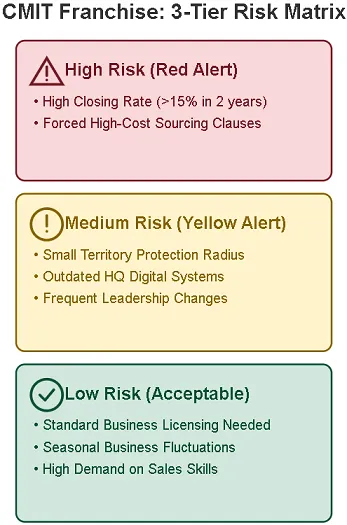
All investments carry risk. A seasoned investor doesn't seek zero-risk projects but learns to identify and manage risks. I've developed a three-tier risk response system for you.
5-1: High-Risk Items (Red Alert, Immediate Rejection)
Brand's store closure rate > 15% over the past 2 years: Item 20 of the FDD discloses franchisee changes (new openings, terminations, transfers, etc.). If the calculated annual average closure rate (terminations/total stores) is excessively high, it indicates serious issues with the business model or headquarters support. Based on my research, CMIT's closure rate ranges between 5%-10%, placing it at an industry average level and not crossing the high-risk threshold.
Contract contains mandatory high-price procurement clauses: If the contract forces you to purchase hardware or software from headquarters or designated suppliers at prices significantly above market rates, this will severely erode your profits. CMIT is relatively compliant in this regard, allowing procurement from multiple channels.
5-2: Medium-Risk Items (Yellow Alert, Requires Negotiation or Close Monitoring)
Excessively small territorial protection radius: CMIT typically grants an exclusive territory based on population or business count. You must carefully evaluate whether this territory allocation is reasonable. If another CMIT franchise opens in a neighboring area soon, direct competition will arise between you.
Outdated Headquarters Digital Systems: Are the CRM (Customer Relationship Management) and project management tools provided by headquarters efficient? Outdated systems significantly increase your management costs. You should prioritize experiencing their systems during the "Discovery Day" session.
Frequent Leadership Turnover at Headquarters: As mentioned earlier, private equity ownership may contribute to this issue. Inquire with headquarters about the stability of the core management team over the past two years, particularly the VP responsible for franchisee support and marketing.
5-3: Low-Risk Items (Green Alert: Acceptable but Requires Preparation)
Seasonal Fluctuations: B2B businesses typically experience slower periods at year-end (budget depletion) and during summer (decision-makers on vacation). You should maintain at least three months of operational reserves to manage cash flow fluctuations.
High demands on sales capabilities: This is arguably the project's greatest "risk," but I classify it as low-risk because it's a "known" risk. As long as you maintain a clear understanding of your own capabilities, it can be managed.
6: Deliverables: Your Custom Decision Toolkit
After all this analysis, I want to provide you with some actionable insights you can use right away.
One-Page Decision Report: This is the radar chart and summary table we started with. You can print it out as your core reference for decision-making.
Competitor Comparison Chart: CMIT Solutions vs. TeamLogic IT
| Comparison Dimension | CMIT Solutions | TeamLogic IT | Comment |
|---|---|---|---|
| Initial Investment | $102k - $168k | $108k - $167k | Very close; comparable investment thresholds. |
| Franchise Fee | ~$50k - $60k | ~$50k | Similar. |
| Royalty Rate | 6% | 7% | CMIT holds a slight advantage. |
| Brand History | 1996 | 2005 | CMIT boasts a longer history. |
| Number of Locations | ~250+ | ~270+ | TeamLogic IT operates at a slightly larger scale. |
| Core Differentiator | Emphasizes comprehensive IT solutions | Focuses on "technology-driven business solutions" | Positioning differs slightly, yet business overlaps significantly. |
Localization Implementation Checklist (120-Day Pre-Opening Countdown)
30 Days Before Signing: Thoroughly review the FDD, consult legal counsel, interview at least 5 current franchisees.
Days 1-30 After Signing: Attend headquarters training, establish business entity, open bank account.
Days 31-60: Lease office space, begin hiring core technical staff.
Days 61-90: Office renovation, technical equipment installation, launch local market pre-launch marketing.
Days 91-120: Employee training, host grand opening event, commence full-scale sales!
7: Frequently Asked Questions (FAQ)
Q1: I have absolutely no IT background. Can I really join CMIT?
A: Yes, but you must be passionate about and excel in sales, networking, and management. Like David's story, your role is CEO, not CTO. You need to hire professionals to handle specialized tasks. If you're an introvert who only enjoys working with computers, please reconsider immediately.
Q2: How much can I actually earn? Can I reach $10,000 in monthly profit?
A: It's possible, but certainly not overnight. To achieve a pre-tax monthly profit of $10,000, you'll likely need a stable client base of 40-50 small to medium-sized businesses. This typically requires 2-3 years of relentless effort and exceptional sales skills. Don't believe any promises of "easy money."
Q3: What are the main reasons for failure when joining CMIT?
A: Based on my observations and analysis, the two primary causes are: 1) Role mismatch: Technicians attempting to handle sales themselves, resulting in poor performance in both areas. 2) Insufficient sales capability: Underestimating the difficulty and cycle of B2B sales, exhausting cash flow before developing a sufficient client base.
Q4: Does headquarters provide many customer leads? Can I just wait for clients to come to me?
A: No. Headquarters may generate some sales leads through national advertising, but neither quality nor quantity is guaranteed. 95% of clients require you to actively develop through local networking, cold calling, social events, etc. This business has no room for "sit-and-wait" operators.
Q5: What are the advantages of joining CMIT over starting an independent IT services company?
A: That's an excellent question. The advantages are: 1) Brand endorsement: The CMIT brand provides initial credibility. 2) Systems and processes: You don't need to figure out quoting, contracts, or project management from scratch. 3) Peer Network: You gain access to valuable insights and lessons from over 200 fellow franchisees. Essentially, your franchise fee purchases a proven business system and a valuable "alumni network."
8: My Personal Perspective
Alright, after all that, let me sum up my thoughts in plain terms.
In my view, CMIT Solutions is a solid yet unassuming business opportunity. Unlike trendy food brands, it lacks overnight viral potential. But it offers what business owners crave most: stable, predictable recurring revenue. It's like installing a "ballast" for your business-keeping you steadier than others through economic storms.
However, this "ballast" is heavy-not everyone can handle it. I've seen too many tech-savvy friends fail in this venture, while those with sales backgrounds thrive. So don't ask "Is CMIT good?"-ask "Am I suited for CMIT?"
At its core, this project is a sales and relationship management business disguised as IT. Your battlefield isn't in server rooms, but at chamber of commerce breakfast meetings, in LinkedIn message boxes, and at coffee tables with potential clients. Your core product isn't technical solutions-it's "trust."
My actionable advice:
Self-assessment: Grab a piece of paper and honestly list the three things from the past five years that gave you the most sense of accomplishment. If they all involve technical challenges, proceed with caution. If they involve securing major deals, building partnerships, or managing teams, your DNA may align with CMIT.
Verify, verify, verify: Don't just take my word-or the brand's word-for it. Once you obtain the FDD, immediately contact former and current franchisees listed in Item 20. Ask them the toughest questions: "What do you regret most?" "What decisions would you make differently if you could start over?", "What are your actual profits?".
Prepare for a long-term commitment: Be ready for at least 6-12 months with no income, and be prepared to work over 60 hours per week for the first two years. Success won't come easily.
Finally, investing in a franchise is like entering a marriage. You must deeply understand your partner (the franchisor), appreciate its strengths, and embrace its flaws. May this in-depth report serve as your most valuable "pre-marital investigation report" before embarking on this journey.
9. Author Bio
I am Qaolase, the founder and lead writer of this site. I'm not some financial titan with countless credentials-I'm just like you, an ordinary entrepreneur driven by curiosity and passion for the business world. Over the past decade, I've immersed myself in the realm of business opportunities and franchising, analyzing hundreds of brands and helping friends like David and countless online readers avoid investment pitfalls to find their own paths. My motivation for creating this site is simple: to share the most valuable business insights in the most authentic and accessible language, helping you navigate fewer detours on your entrepreneurial journey.
Engage with Us
Did this article address your questions about CMIT Solutions? Have you had unique experiences or "pitfall" stories with this brand to share? Or are there other franchises you're curious about that you'd like me to investigate?
Leave your comments below-I guarantee a response within 48 hours. Your insights matter to our entire community!
Continue Reading
If you're interested in IT services or B2B franchising, you might also enjoy these articles on our site:
References:
Please be respectful and constructive in your comments. Spam and inappropriate content will be removed.