
Have you ever had this experience? On a lazy weekend afternoon, you open your food delivery app, staring at the endless array of choices on the screen, yet your fingers instinctively type "Wingstop" into the search bar. Or, while driving home, the mere whiff of that unique aroma-a blend of spices and fried chicken-wafting through the air makes you want to turn around and dash into the store.
This is the magic of Wingstop. It's not just chicken wings; it's a cultural icon, an irresistible "flavor experience."
My name is Qaolase, and for over a decade, I've been immersed in the worlds of business analysis and franchising. I've helped countless investors and entrepreneurs like you navigate the complex landscape of business opportunities to find the one that truly belongs to them. I recall in 2019, one of my clients-let's call him Alex-held about $800,000 in capital, wavering between several well-known restaurant brands. His question was blunt: "Chris, skip the fluff. Just tell me: How much does it cost to invest in Wingstop? And how much can I actually make?"
Alex's question is likely the biggest one on your mind right now.
That's why this article is written for you. It's not just a list of information. It's a systematic franchise project analysis report. In the following sections, we'll address these core questions together:
Investment Question: How much money do you need in your bank account from day one to officially open a Wingstop?
Profitability: Under ideal and realistic scenarios, how much annual profit can you, as the owner, expect to pocket?
Qualifications: Are you the "right fit" Wingstop is seeking?
Risks: What hidden pitfalls lie ahead that others won't warn you about? How can we avoid them?
Important Compliance Notice (Disclaimer):
Before we begin, please remember: All financial data and projections provided herein are based on publicly available information (such as the FDD), industry averages, and our professional analytical models. They are for reference and educational purposes only. Actual costs, revenues, and profits may vary significantly depending on location, management quality, and market conditions. We are an independent third-party analysis platform with no affiliation to Wingstop Inc. Before making any investment decisions, you must conduct your own due diligence and consult professional financial and legal advisors. All risks arising from reliance on this information are solely your responsibility.
Now, let's lift the veil on Wingstop franchising.
Part One: The Full Breakdown: Wingstop Franchise Cost
"How much is a Wingstop franchise?" This is hands-down the most frequently asked question on Google. Many are baffled by the broad range provided by the official source-$398,459 to $975,551 (per 2023 FDD data). Why such a huge gap? Don't worry, that's exactly what I'm here to help you figure out. This isn't just about numbers-it's the foundation of your future business.
1.1 Official Data Overview: Decoding Core FDD Costs
First, let's dissect Wingstop's Franchise Disclosure Document (FDD) like pros. This legal document, mandatory for every franchisee, holds the secrets to all costs.
Initial Franchise Fee: $20,000. This is your "entry ticket" to join the Wingstop family.
Development Fee: $10,000. Wingstop prefers partners committed to opening multiple locations. This fee applies per location you pledge to develop.
Royalty Fee: 6% of gross sales. This is the ongoing fee for using the Wingstop brand and operating system.
National Marketing Royalty Fee: 5% of gross sales. This money goes into a large fund pool for national brand-building activities like TV ads and social media promotions.
These are just the "above-the-table" fees. What truly makes a huge difference in the total investment are the "hidden" variables.
1.2 Cost Scenario Analysis: How Much Will Your Store Actually Cost?
To give you a clearer picture, I've created three distinct store scenarios based on my experience. Forget the broad range-see which one aligns closest with your vision.
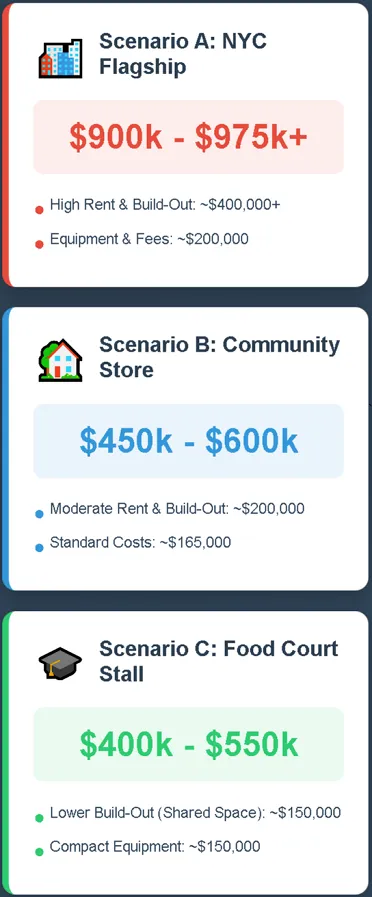
Scenario A: The "Ambitious" Flagship Store in Manhattan, New York
Estimated Total Investment: $900,000 - $975,000+
Cost Breakdown Analysis:
Rent & Renovation: This is the largest expense. In prime Manhattan real estate, a 1,500–2,000 sq ft space can easily exceed $400,000 upfront for lease deposits and high-standard renovations (Wingstop enforces strict storefront standards).
Equipment: A full suite of professional kitchen gear-including high-efficiency fryers, ventilation systems, POS systems-costs approximately $150,000.
Licenses & Professional Fees: In New York, obtaining various permits (food, fire, building) is a lengthy and costly process, with legal and consulting fees adding another significant expense, estimated at $50,000.
Initial Labor Costs: Before opening, you'll need to hire and train staff, and wages during this period must be factored in.
Scenario B: The "Steady and Solid" Community Store in Des Moines, Iowa
Estimated Total Investment: $450,000 - $600,000
Cost Breakdown Analysis:
Rent & Renovation: In a secondary city, rental pressure is significantly reduced. For the same floor space, initial lease and renovation costs can be kept under $200,000. Opt for a street-front shop in an established neighborhood for more cost-effective rent.
Equipment: Equipment costs are relatively fixed, but you can secure better quotes by sourcing locally.
Licensing: The process is relatively straightforward and less expensive, estimated at $15,000.
Localization Advantages: Labor costs and initial inventory expenses are lower than in tier-one cities.
Scenario C: "Small but Beautiful" Food Court Stall in a College Town (Non-Traditional Store)
Estimated Total Investment: $400,000 - $550,000
Cost Breakdown Analysis:
Model Advantages: Typically smaller footprint (approx. 500-800 sq ft), with food courts providing shared facilities that significantly reduce renovation and construction costs.
Rental Structure: Likely fixed rent + revenue share model, easing initial financial pressure.
Customer Flow Assurance: University towns attract a stable, targeted young demographic, reducing marketing expenses.
Simplified Operations: Focus primarily on takeout and delivery, eliminating dine-in management costs.
See how scenario analysis instantly brings those cold numbers to life?
1.3 Hidden Costs & Working Capital: Your Essential "Emergency Fund."
I've seen too many newcomers fall into this trap. They factor every penny into their initial investment but forget to set aside working capital for the first 3-6 months after opening. The FDD recommends preparing around $40,000, but based on my experience, I'd advise setting aside at least $80,000 - $120,000.
This money is your "safety net" to cover:
Initial operating losses (almost inevitable).
Unexpected equipment repairs.
Unplanned marketing campaigns.
And, your own living expenses and those of your family.
Want to know the approximate total investment range based on your city's rent and labor costs? Stop guessing! Use our website's custom ROI Calculator now. Enter a few key figures to get a preliminary estimate closer to your actual situation. This is your first step from dreaming to reality.
Part Two: Profit Potential & Returns (The Big Question: How Much Does a Wingstop Franchise Owner Make?)
Alright, with the basics covered, let's dive into the most exciting part: making money. Behind the question "How much does a Wingstop franchise owner make?" lies the desire to understand the return on investment.
2.1 Average Sales (AOV) Isn't Everything: Diving into the Core of Profitability
You'll see a striking figure in many reports: Wingstop's Average Unit Volume (AUV) is exceptionally high, consistently exceeding $1.6 million annually in recent years-and often even higher. This is an impressive achievement, but remember my advice: Sales are the surface, net profit is the substance.
To help you see the "substance," I've constructed a simplified Profit & Loss (P&L) statement based on $1.6M annual sales.
| Item | Percentage | Amount (Based on $1.6 M Annual Sales) | Description |
|---|---|---|---|
| Annual Revenue | 100 % | $1,600,000 | Total sales income. |
| Cost of Goods Sold (COGS) | ≈ 35 % | $560,000 | Raw materials: chicken wings, sauces, beverages, etc. |
| Labor Costs | ≈ 25 % | $400,000 | Wages, benefits, payroll taxes; driven by staffing efficiency. |
| Rent | ≈ 8 % | $128,000 | Assumes ≈ $10,600 per month; location sets the cap. |
| Royalty | 6 % | $96,000 | Fixed franchise royalty. |
| Marketing | 5 % | $80,000 | Fixed brand / advertising fund. |
| Other Operating Expenses | ≈ 5 % | $80,000 | Utilities, insurance, maintenance, POS, internet, misc. |
| Pre-Tax Net Profit (EBITDA) | ≈ 16 % | $256,000 | Owner's cash profit before interest, taxes, depreciation & amortization. |
This model shows that a well-run Wingstop location can achieve a net profit margin of 15%-20%. This means a store with $1.6 million in annual sales could generate $240,000 to $320,000 in pre-tax profit each year.
Is this figure appealing? Absolutely. But it's equally fragile. If your food costs spiral out of control to 40%, your profits get swallowed up by $80,000. If labor management becomes chaotic and costs jump to 30%, you lose another $80,000. That's why I say: Operations reign supreme.
2.2 Your Return on Investment (ROI) Forecast
ROI is another core metric. Assuming your total investment is $600,000 and annual net profit is $250,000, the theoretical static ROI period is 2.4 years.
But reality is dynamic. Key factors affecting your payback period include:
Initial ramp-up speed: How effective is your local marketing?
Cost control capability: Can you keep all expenses within the projected range?
Competitive landscape: Has a strong competitor opened within 3 kilometers?
Theoretical models are cool, but what about your specific situation? Based on your projected investment and desired profit margin, how many years will your payback period be? Try our ROI Calculator. Adjust variables like sales growth rate and profit margin to see how they impact your final return. It's like a business sandbox, letting you simulate the future before committing your investment.
Part Three: Are You the Right Fit? Franchisee Requirements
Wingstop isn't just looking for "investors"; they seek "brand ambassadors" and "operational partners." Money is merely one of the entry requirements.
3.1 Mandatory Requirements: Financial Thresholds and Experience Background
These are non-negotiable criteria.
Net Worth: $1,200,000. This demonstrates sufficient financial strength to withstand risks.
Liquid Capital: $600,000. This represents readily available cash or equivalents to cover initial investment and sustain early operations.
Multi-Unit Experience: This is highly valued by Wingstop. They expect you to manage not just one location, but three or more outlets within a single territory.
I once worked with a client who met all financial requirements but was rejected in the first round due to zero food service or retail management experience. Wingstop's rationale is straightforward: they seek partners who can hit the ground running and scale operations, not novices requiring hand-holding.
3.2 Soft Skills: The Entrepreneurial Traits Wingstop Seeks
Beyond capital and experience, Wingstop looks for deeper qualities. In my view, these traits matter more than financial figures.
Passion for the Brand: Do you genuinely love Wingstop? Would you proudly recommend it to friends?
Obsessive Attention to Detail: Can you tolerate even a speck of grease on the kitchen floor? Do you care if every wing is evenly coated in sauce? The success of a restaurant hinges on these details.
Learning and Adaptability: Are you willing to embrace headquarters' training and systems, rather than stubbornly clinging to your own ways?
People Management Skills: Can you motivate your staff to fight for your business?
Tools:
now, you might be asking yourself: "Do I possess these traits?" That's perfectly normal. To help you better understand yourself, we've developed the Entrepreneur Assessment tool. It's not a test-it's a mirror. Through a series of questions, it helps you evaluate your risk tolerance, management style, and entrepreneurial potential. Spend five minutes, and you might gain a whole new perspective on yourself.
Part Four: Finding & Securing Your Wingstop Franchise Opportunity
If you're confident you're prepared both in "hardware" and "software", the next step is to find and seize the opportunity.
4.1 How to Find Wingstop Franchise Opportunities
The most direct approach is to visit Wingstop's official franchise website. There, you can explore the available territory map and submit your preliminary expression of interest.
4.2 Buying an Existing Store (Wingstop Franchise for Sale) vs. Opening a New Location
This is a common decision.
Buying an Existing Store:
Pros: Immediate cash flow, existing staff and customer base, relatively lower risk.
Cons: Typically higher price (includes goodwill value), may inherit legacy issues (e.g., outdated equipment, poor employee culture).
Opening a New Location:
Pros: Everything is new; you can build the team and culture from scratch according to your vision and enjoy the growth dividends of the initial launch phase.
Cons: Requires going through the entire site selection, renovation, and hiring process; greater uncertainty during the initial launch phase.
My recommendation is that if you are entering the system for the first time, purchasing an existing location that is operating well and has transparent finances is a more prudent choice.
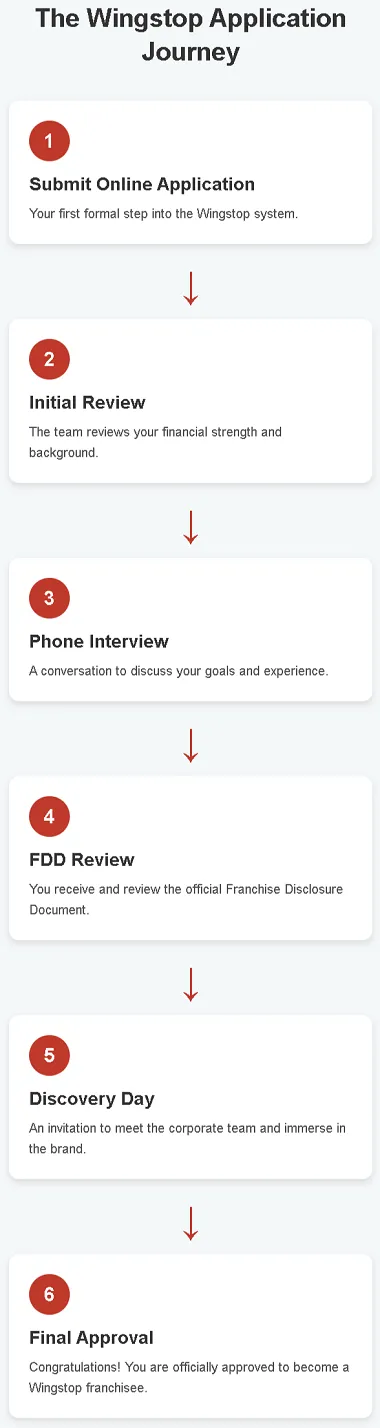
4.3 Complete Application Guide: From Forms to Interviews
Prepare outstanding application materials: Your application form is your first resume. Ensure financial statements are clear and accurate, and highlight your management experience and passion for the brand in your personal statement.
Standing Out in Interviews: Having coached numerous clients for franchise interviews, my core advice is: Don't just talk about money. Discuss your understanding of the local market, outline your plans for localized marketing, and explain how you'll build a strong team. Wingstop seeks a genuine "businessperson," not a cold "investor."
Tool:
While Wingstop is excellent, is it truly the best fit for you? Perhaps you're still considering other brands like Popeyes or emerging fast-food chains. Don't make decisions based on gut feelings. Use our Opportunity Comparison tool to compare key metrics (like investment amount, royalty fees, market support) across different brands side-by-side in a single table, enabling the most rational choice.
Part Five: Deep Insights Beyond the Competition (The Insider's View: What Other Sites Don't Tell You)
Now, let's discuss the "inside scoop" you won't find in the FDD or on most websites.
5.1 Challenges and Risks You Must Face (Risk Control Matrix)
I categorize risks into three tiers-this is my "Risk Control Matrix."
High-Risk Items (Immediate Vigilance):
Mandatory Purchase of High-Cost Supplies: While Wingstop boasts a robust supply chain, be alert for contract clauses requiring mandatory high-priced purchases of non-core materials (e.g., cleaning supplies).
Brand Reputation Crisis: Closely monitor the brand's public relations. Any nationwide negative publicity could impact your location.
Medium-Risk Items (Requiring Close Attention):
Insufficient Territory Protection: Wingstop's territory protection policies are generally reasonable, but you must carefully review the contract to ensure your "turf" is sufficiently large to avoid imminent internal competition.
Supply Chain Volatility: Chicken wing price fluctuations represent one of the industry's greatest risks. The 2021 "wing crisis" left many owners sweating bullets. Maintain sufficient working capital to weather such cost swings.
Low-Risk Items (Acceptable Challenges):
Labor Shortages: This plagues the entire food service industry. Develop strategies to retain staff through competitive compensation, benefits, and a strong company culture.
Local Market Competition: Your rivals aren't just other wing shops-they include all fast-food brands vying for consumers' stomachs.
5.2 Keys to Success: Location, Local Marketing, and Operational Efficiency
I've seen too many failures, often not due to weak branding but because these three areas were neglected.
The Art of Site Selection: Don't worship "prime locations." One client opened in an expensive downtown area, only to be crushed by high rent. Another chose a residential neighborhood with low rent but high delivery demand, achieving remarkable success. Visibility, convenience, and target customer density-finding the balance among these three is the key to optimal location.
The Wisdom of Local Marketing: National advertising builds brand awareness, but what truly brings customers through your door is localized marketing. Partnering with local sports clubs, running events in neighborhood Facebook groups, launching lunch specials for nearby offices... These "small moves" can yield massive results.
The Pursuit of Operational Efficiency: How fast is your order fulfillment? What's your inventory waste rate? Is your staffing schedule optimized? A mere 5% improvement in operational efficiency could translate to a 20% increase in net profit.
5.3 Your Exit Strategy: Planning for the Future
From the moment you sign the contract, you should have a clear plan for exiting in 5-10 years. Will you pass it on to the next generation? Sell to another franchisee? Or have the headquarters buy it back? A well-defined exit strategy allows you to operate with greater confidence and secure a better valuation when you eventually sell.
Part Six: Launch Your Action Plan (Your Action Plan: From Dream to Reality)
By reaching this point, you've transitioned from an "observer" to a "prospective insider." Now is the time to translate knowledge into action.
6.1 Why Do You Need a Business Plan?
Externally, a business plan serves as your "stepping stone" to demonstrate professionalism to Wingstop and financial institutions. Internally, it serves as your "roadmap" for the next 3-5 years of operations. It forces you to address all critical questions: market analysis, competitive strategy, financial projections, risk management...
6.2 How to Build a Plan That Convinces Both Investors and Wingstop?
A solid business plan should include:
Executive Summary: Clearly outline your project's highlights in one page.
Market Analysis: Your deep insights into the local market.
Operations Plan: How you will manage the store.
Marketing Plan: How you will attract customers.
Financial Projections: Profit & Loss statements, Cash Flow statements, and Balance Sheets for the next three years.
I know, this sounds complicated. Many people get stuck right here.
Tool:
Don't worry-we've paved the way for you. Our Business Plan Generator isn't just a blank template. It's an interactive wizard that guides you step-by-step through filling in all necessary information, helps you organize your thoughts, and ultimately generates a professionally structured, comprehensive business plan. This saves you significant time and effort, ensuring your application stands out among competitors.
Part 7: FAQ: Your Top 5 Questions
1. Can I be a hands-off owner, investing without managing?
Answer: Strongly discouraged. Wingstop places significant emphasis on owner involvement. Even if you hire a general manager, you must remain deeply engaged in the store's management and development. In my experience, "semi-absent" owners are a common reason for franchise failure.
2. Is Wingstop's training support sufficient?
Answer: Yes. Wingstop provides comprehensive training spanning several weeks, covering everything from kitchen operations to front-of-house management. But remember, training is just the beginning-the real learning happens during daily operations.
3. What are the most common mistakes new franchisees make?
Answer: Underestimating the importance of working capital and neglecting localized marketing. Many assume Wingstop's brand alone will attract steady customers, but in competitive markets, "even the best wine needs a sign out front."
4. If my financial situation doesn't quite meet the requirements yet, are there any workarounds?
Answer: You could consider applying with one or more partners to combine your financial strength. Additionally, SBA loans (Small Business Administration loans) in the U.S. are a common financing option specifically designed to support small businesses and franchise projects.
5. How digitally advanced is Wingstop? Is it very traditional?
Answer: Quite the opposite. Wingstop is an industry leader in digitalization. Its online orders and delivery business account for a very high proportion (over 60%), and it has a highly developed app and loyalty program. This was a key reason it maintained strong growth even during the pandemic.
Part 8: My Personal Perspective and Final Thoughts
After writing all this, I want to step out of my analyst role and share some heartfelt thoughts with you. In my view, Wingstop is a "top-tier" franchise opportunity. It boasts a strong brand, memorable products, and a business model repeatedly validated by the market. For investors with solid financial resources and some management experience, it's undoubtedly an option worth serious consideration.
However, being a "top performer" also means it's quite "picky." It won't readily entrust its brand to someone unprepared. I've seen too many people swept away by the alluring profit figures, forgetting to ask themselves if they're truly ready to handle the daily grind of operations, or if they possess the resilience to withstand pressures like rising costs and staff turnover.
Joining Wingstop isn't buying a lottery ticket hoping for overnight riches. It's more like building a marriage-requiring you to invest all your passion, wisdom, and energy to grow alongside the brand, ultimately reaping the rewards of a fulfilling partnership.
Action Recommendations:
Self-Assessment: Honestly use our Entrepreneur Assessment tool to see if your inner drive aligns with this industry.
Financial Simulation: Don't just read articles-use our ROI Calculator to input your own numbers and run a personalized financial model.
Field Visit: Visit several local Wingstop locations during both peak and off-peak hours. Observe their operations, feel the atmosphere, and chat with staff. Real-world insights outweigh any report.
Final Risk Warning
We reiterate that the restaurant industry is highly competitive and demanding. Even a strong brand like Wingstop cannot guarantee 100% success. Prepare for the worst to achieve the best.
Part 9: Continue Reading:
Part 10: About the Author
I am Qaolase, the founder and lead writer of this site. I'm not some financial titan with countless credentials-I'm just like you, an ordinary entrepreneur driven by curiosity and passion for the business world. Over the past decade, I've immersed myself in the realm of business opportunities and franchising, analyzing hundreds of brands and helping friends like David and countless online readers avoid investment pitfalls to find their own paths. My motivation for creating this site is simple: to share the most valuable business insights in the most authentic and accessible language, helping you navigate fewer detours on your entrepreneurial journey.
Engage with Us:
After reading this in-depth report, what are your thoughts? Are you considering franchising with Wingstop? What challenges have you encountered during your research? Share your insights in the comments below-I guarantee a response within 48 hours. Or, is there a brand you'd like me to research in depth? Let me know!
References:
QSR Magazine. (2023). The QSR 50.
Please be respectful and constructive in your comments. Spam and inappropriate content will be removed.