
Hey, friend.
It's great to see you here. If you're reading this, I bet there's a spark burning inside you-a dream about entrepreneurship, about being your own boss. And the word "franchising" might feel like a giant signpost pointing toward a shortcut that looks paved with roses.
But honestly, is this path really as smooth as it seems?
My name is Qaolase, and like you, I'm a website operator-just an ordinary person with curiosity and passion for the business world. Over the years, I've researched hundreds of business opportunities and witnessed countless friends' entrepreneurial journeys, some successful, some not. My goal in creating this site is to share what I've seen, learned, and even the pitfalls I've stumbled into myself.
This isn't just another cold, copy-pasted list of pros and cons. I want to have a heart-to-heart with you and give you a real framework for making decisions.
After reading this article, you'll have clear answers to these core questions:
What are the real, deep-seated advantages of joining a franchise?
Beyond the franchise fee, what "hidden" drawbacks and costs should I be wary of?
Am I truly suited to be a franchisee? (We'll use tools to help you analyze this)
When evaluating a franchise opportunity, how can I scientifically calculate its profitability?
When presented with legal documents (FDD), what should I focus on?
What clear path do I need from idea to action?
Ready? Let's cut through the fog and see the real face of franchising.
Compliance Disclaimer
Please note this article is for informational and educational purposes only and does not constitute professional financial, legal, or investment advice. All business investments, including franchising, involve significant risks. Conduct thorough due diligence and consult qualified professionals before making any investment decisions.
If you're unfamiliar with the fundamentals of franchising, I strongly recommend starting with our foundational guide: What is Franchising? A Guide to Fees, Formats & Finding a Business.
1: The Core Advantages: Why Franchising is So Attractive
When discussing franchising benefits, many immediately think "it saves hassle." That's certainly one of the core reasons. But I want to take you deeper to explore where these benefits of franchising truly lie, and why franchises are attractive to business owners because they offer a structured path to success.
So, what are the advantages of operating a franchise? Let's break them down one by one.
1-1: Benefit 1: A Proven Blueprint for Business
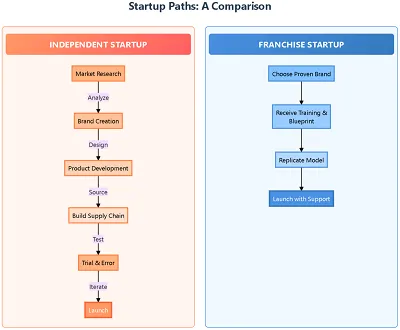
This is arguably the most compelling aspect of franchising. You're not fumbling in the dark-you're handed a detailed "treasure map."
Picture this scenario: You want to open a coffee shop. Starting from scratch, you'd need to figure out: What should the brand be called? How to design the logo? Where to source coffee beans? Which brand of coffee machine to use? How to price the menu? How to decorate the store to attract customers? How to run marketing campaigns? ... Each question is enough to overwhelm you.
But by joining an established coffee brand, like Starbucks or Luckin (just for example), you get a complete, packaged solution. The brand is ready-made, with extensive name recognition; the operations manual is as thick as a dictionary, detailing every aspect from employee training and coffee preparation to customer service; the supply chain is stable, eliminating the need to negotiate with coffee bean suppliers yourself; even the store design style is standardized.
I recall a few years ago, my friend Alex had always dreamed of owning his own small shop. He was tired of the nine-to-five office grind and craved something truly his own. Then he spotted an emerging frozen yogurt franchise brand. The headquarters' brochure was irresistible: "90% success rate, recoup investment in 3 months!" Alex was thrilled, convinced he'd found the "treasure map" he'd been waiting for. The brand's popularity was skyrocketing, with social media flooded with beautiful images, making success seem within reach. That's the power of branding-it gave Alex a strong sense of security and confidence, making him feel his entrepreneurial risks were significantly reduced.
According to historical data analysis by the U.S. Small Business Administration (SBA), franchises with established business models typically have higher long-term survival rates than independent startups. This doesn't guarantee franchise success, but it means you start from a higher vantage point. You bypass many fatal mistakes startups make during their trial-and-error phase. For first-time, inexperienced investors, this is undeniably a major advantage of franchising.
1-2: Benefit 2: Built-in Support and Training
"I don't know anything-can I still open a store?" This is one of the most common questions I hear. A core value of an excellent franchise system is answering: "Yes, because we'll teach you."
This support is comprehensive and spans your entire business lifecycle.
Pre-Opening: Headquarters typically provide intensive training programs. These cover not just product preparation but crucially, operational management. My friend Alex attended a two-week training program for a frozen yogurt brand. It covered: product preparation standards, POS system operation, employee recruitment and management techniques, local marketing basics, and even handling customer complaints. For a complete retail novice, this two-week training was like a crash course MBA, giving him a solid foundation for future operations.
During Launch: Headquarters typically assigns a Field Consultant to assist with your opening, ensuring everything runs smoothly. It's like having a tutor seated beside you during an exam, ready to resolve any unexpected issues.
Post-Launch: This support doesn't end once your store opens. You'll receive regular operational guidance from headquarters, new product development and promotion plans, along with ongoing marketing support. When facing operational challenges-such as declining foot traffic or high employee turnover-you can always consult your Field Consultant. Having managed hundreds of stores, their experience often pinpoints the root cause swiftly.
This ongoing support system is invaluable for franchisees. You're not fighting alone-behind you stands a vast organization supplying ammunition and support. You can focus on daily store management and customer service without distractions from macro issues like product development or brand strategy. This allows you to channel your energy where it generates the most impact. Of course, all this support comes at a cost, which we'll explore in detail in the "Disadvantages" section later.
1-3: Benefit 3: Easier Access to Capital and Resources
Where does the money come from when starting a business? This is the most practical question.
If you approach a bank with a self-written business plan for "Joe's Burger," the loan officer might ask hundreds of questions and express deep skepticism about your profit projections. To the bank, you're a brand-new, unproven borrower-a high-risk prospect.
Now imagine presenting a franchise business plan for "McDonald's" or "Subway." The situation changes completely. Banks have long-term tracking data on these brands' business models, profitability, and risk levels. They know the likely cash flow a Subway location in a specific area can generate. Therefore, lending to an established franchise brand carries lower risk for banks and results in faster approval processes. According to reports from the American Bankers Association, franchise loan applications backed by strong brand support have significantly higher approval rates than independent business loan applications.
I recall Alex experiencing this firsthand when he applied for a loan. He prepared two sets of materials: one for his independently conceived coffee shop plan and another for the frozen yogurt franchise proposal. The bank manager barely glanced at his independent plan, instead spending considerable time reviewing the franchise brand's FDD (Franchise Disclosure Document) and the headquarters' financial statements. Ultimately, the bank approved the loan application based on the franchise plan because "we've heard of this brand, and its model is clearer."
Beyond funding, resource advantages also manifest in economies of scale. An independent burger shop owner might have to pay high prices for small quantities of buns and patties. But McDonald's, with tens of thousands of locations worldwide, can negotiate centralized bulk purchases at rock-bottom prices directly with the largest suppliers. As a franchisee, you also benefit from these cost advantages derived from scale, whether for raw materials, equipment, or marketing materials. This gives you an inherent cost advantage over competing independent shops in your neighborhood.
2: The Critical Disadvantages: The Realities of Being a Franchisee
Alright, folks, we've covered the glossy parts. Now, let's pull back the curtain and see what's lurking beneath-the not-so-pretty stuff. Anyone who only tells you how great franchising is isn't your real friend. Understanding the negatives of franchising and the disadvantages of a franchise is crucial because they're often the root causes of failure and heartache.
So, what are the disadvantages of operating a franchise? Let's get real.
2-1: Drawback 1: High Costs - The Full Picture
The "franchise fee" is just the tip of the iceberg. The real cost is a continuous cash outflow, and you must be crystal clear about this.
Initial Franchise Fee: This is your ticket to join the "club." It ranges from thousands to hundreds of thousands of dollars. This payment is typically one-time and non-refundable.
Ongoing Royalties: This is the ongoing fee you pay to use the brand and systems. It's usually 4% to 8% of your monthly gross revenue. Note: gross revenue, not profit! That means even if you lose money this month, as long as you have sales, you must pay royalties proportionally.
Marketing Fees: You also pay a fee into the headquarters' central marketing fund, usually 1% to 4% of gross revenue. This money funds national or regional brand advertising, but it doesn't necessarily drive traffic directly to your store.
But the real devil lies hidden in those "other fees." This was also the biggest pitfall my friend Alex fell into later.
The Hidden Costs:
Mandatory Store Upgrades: Alex's franchise agreement included a clause: "Franchisees must upgrade their store at their own expense upon headquarters' request to align with the latest brand image." In his second year, headquarters rolled out a new 2.0 store design, requiring all existing franchisees to complete renovations within 18 months at an estimated cost of $50,000. This expense was entirely outside his budget, instantly plunging him into a cash flow crisis.
Proprietary Software/Hardware Costs: You must use headquarters-mandated POS systems, financial software, and even surveillance cameras. These systems often cost significantly more than market rates, and you have no choice in the matter.
Mandatory Suppliers: Many franchise agreements stipulate that you must source raw materials exclusively from headquarters-designated core suppliers. Even if you find local suppliers offering comparable quality at lower prices, you cannot use them. This effectively allows headquarters to profit again through the supply chain.
To help you visualize this, I've created a simple comparison table:
| Cost Type | Independent Startup | Franchise Startup |
|---|---|---|
| Brand Usage Fee | ¥0 (None) | High upfront franchise fee + ongoing royalties |
| Marketing Expenses | Flexible and self-determined | Fixed marketing fees (regardless of effectiveness) |
| Operating Costs | Freedom to choose suppliers and systems | Mandatory use of designated (often premium-priced) suppliers and systems |
| Upgrades/Renovations | Self-determined timing and budget | Headquarters-mandated, self-funded by franchisee |
2-2: Drawback 2: The "Golden Handcuffs" - Lack of Autonomy
If you're a born creator who thrives on doing things your way, franchising could be a nightmare.
You're not buying a "business," but the "right to operate a business." You become an executor of the system, not its creator.
Products and Pricing: You can't freely introduce new items. Even if you discover a local flavor is wildly popular, you can't add it to the menu without permission. Product pricing is typically set uniformly by headquarters, leaving you little room for adjustment.
Decor and Branding: From store colors and furniture placement to employee uniforms, everything must strictly adhere to headquarters' standardized Brand Book. You can't paint the walls blue just because you like blue.
Marketing and Promotions: Want to run a special discount campaign in your local community? You'll likely need headquarters' approval. Headquarters prioritizes maintaining a unified national brand image over the short-term promotional impact of a single store.
I remember Alex telling me, visibly frustrated: "I don't feel like a boss, more like a senior store manager. I have so many ideas to improve the business, but every one gets rejected by HQ for 'not meeting brand standards.' This store doesn't feel like mine-I'm just working for HQ."
I call this feeling "golden handcuffs." You enjoy the benefits of the brand (gold), but you're also tightly bound by its rules (handcuffs). Before signing the contract, you must honestly ask yourself: Am I an excellent executor, or a born disruptor?
2-3: Drawback 3: Shared Fate and Reputational Risk
When you join a franchise system, you become bound to everyone within it. Your fate is no longer solely in your own hands.
Headquarters' poor decisions: If headquarters makes a strategic blunder-like a failed national marketing campaign or an unpopular new product launch-all franchisees bear the consequences.
Other franchisees' scandals: Imagine a franchise of your brand in another city embroiled in a food safety scandal. The news spreads nationwide. Even if your store maintains impeccable hygiene standards, customers may stop patronizing you due to a crisis of trust in the entire brand. Your reputation could suffer severe damage because of someone you've never even met.
This "all for one, one for all" characteristic is an inherent risk of the franchise model. You cannot control the headquarters' decisions nor the actions of other franchisees. When selecting a brand, you can thoroughly evaluate its management capabilities, corporate culture, and the overall quality of its existing franchisees.
3: Beyond the Basics: The Hidden Risks You Must Understand
If the drawbacks mentioned earlier are the visible tip of the iceberg, the risks that follow represent the far larger and more dangerous portion beneath the surface. This is where many newcomers run aground.
3-1: The Legal Maze: Understanding the Franchise Agreement & FDD
The FDD (Franchise Disclosure Document) is a detailed disclosure document mandated by the U.S. Federal Trade Commission (FTC) that franchise headquarters must provide to potential franchisees before signing any agreement. This document is typically hundreds of pages long and filled with legal jargon, yet it is arguably the single most critical document in your entire investment decision-making process.
Do not trust any verbal promises from salespeople-the FDD is the definitive authority!
As ordinary individuals, we can't possibly understand every legal clause, but you must focus on the following sections (Items):
Item 7: Estimated Initial Investment: This item details all costs required to open your store, from the franchise fee and renovation expenses to the operating capital needed for the first three months. You must take this breakdown and verify each item against your local market. Headquarters typically provide national averages, while actual costs in your city could be significantly higher.
Item 19: Financial Performance Representations: This is the most critical and sensitive section of the FDD. If the headquarters chooses to disclose financial data here, it will show average revenue, profit, or other financial metrics for existing franchise locations. But beware:
Many brands choose not to disclose (No FPR), which itself is a red flag.
Even when disclosed, data may be "gussied up"-for example, by showcasing only top-performing stores. You must carefully read all footnotes to understand the statistical methodology behind the figures.
Item 20: Outlets and Franchisee Information: This section lists the number of franchise locations opened, closed, transferred, and terminated by headquarters over the past three years. If you find a brand with exceptionally high closure or transfer rates, this is a major red flag.
Renewal, Termination, and Resale Clauses: You need to understand: What are the renewal terms after the contract expires? Under what circumstances can headquarters unilaterally terminate your contract? What restrictions apply if you wish to sell the store? Many contracts stipulate that the headquarters holds a "Right of First Refusal" and impose strict requirements on buyer qualifications, making your exit exceptionally difficult.
My Strong Recommendation: Before investing a single penny, hire a specialized franchise lawyer to review the FDD and franchise agreement. These few thousand-dollar legal fees could save you hundreds of thousands or even millions in losses. It's the most worthwhile investment in your entire venture.
3-2: The Human Element: Potential for Franchisor-Franchisee Conflict
A franchise relationship is fundamentally a business partnership, and like any partnership, it carries the potential for conflict. The root cause often lies in the misalignment of core interests between the parties.
Headquarters' Goals: The franchisor's core interests are expanding brand reach and increasing royalty revenue. This means they want to open more stores and maximize gross revenue per location.
Your Goal: Your core interest is your single-store net profit.
See the problem? Headquarters might approve a new franchise near your store to collect more royalties, directly diluting your customer traffic and hurting your profits, while boosting their overall revenue. This is known as "territorial encroachment."
Additionally, conflicts may arise from:
Insufficient Support: Operational support promised before signing is significantly reduced after opening.
Poor Communication: Headquarters rolls out new policies without adequately consulting franchisees, leading to widespread discontent.
Unequal Profit Distribution: Headquarters captures excessive profits within the value chain through practices like forcing suppliers.
In my friend Alex's case, his conflicts with headquarters centered on "mandatory upgrades" and "territorial encroachment." Less than six months after he painstakingly raised funds for a store renovation, headquarters approved another franchise within two kilometers of his location in a new mall. Alex's sales plummeted by 30%. He felt utterly betrayed. When he attempted to negotiate with headquarters, the response was coldly: "This complies with the franchise agreement."
3-3: The Exit Hurdle: The Difficulty of Selling or Leaving
When starting a business, we all envision success. Yet rational investors must consider the worst-case scenario: If it fails, how do I exit?
In a franchise model, "shutting down" isn't so straightforward.
Long-term Contract Constraints: Franchise agreements typically span 10 or 20 years. Terminating early may incur hefty penalty fees.
Strict Resale Restrictions: As mentioned earlier, you can't simply find a buyer and transfer ownership like selling an independent shop. The buyer must gain headquarters' approval, which may reject potential buyers citing reasons like "lack of experience" or "insufficient capital." Additionally, you'll usually pay headquarters a substantial "transfer fee" during resale.
Non-Compete Clauses: Most contracts include non-compete clauses prohibiting you from operating a similar business within a designated area for several years after contract termination. This means that even if you close your frozen yogurt shop, you may be barred from opening any cold-served dessert shop within a 5-kilometer radius for the next two years.
These clauses are designed to maximize protection for the headquarters. For franchisees, this translates to extremely limited exit options and prohibitively high trial-and-error costs.
4: The Decision Framework: Is Franchising Right for YOU?
Alright, friend. We've covered so many pros and cons, you might feel overwhelmed. "So what should I do?"
Don't worry. This is where this article's real value comes in. I'm not giving you a simple answer, but a decision framework to help you find your own answer. It's a four-step process you can follow step by step. More importantly, I'll provide you with exclusive tools from this site to assist you through each step.
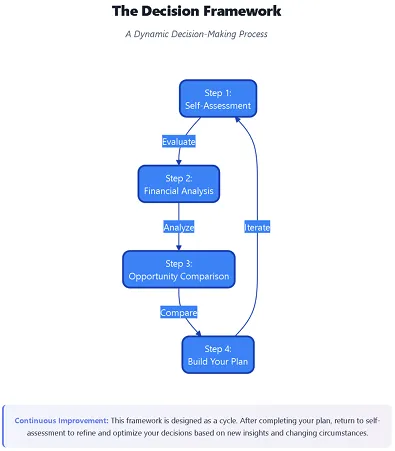
Step 1: Assess Yourself - Are You a "Franchisee" Personality?
This is the starting point for all decisions. If your personality clashes with the franchise model, even the best brand could become a trap for you.
You need to honestly ask yourself:
Am I someone who prefers following rules and systems, or someone who likes breaking conventions and creating my own rules?
Do I enjoy executing a proven successful model, or do I get more satisfaction from the thrill of creating something from scratch?
When my ideas conflict with directives from superiors (in this case, headquarters), am I inclined to comply or to resist?
Generally, successful franchisees are typically excellent "executors." They are disciplined, respect systems, and thrive on executing within established frameworks to perfection. Meanwhile, many creative "disruptors" or natural entrepreneurs often feel constrained and stifled within franchise systems.
Finding it hard to decide? That's okay. It's perfectly normal.
Tool Guide
"Feeling uncertain about your role? Don't worry-your personality traits largely determine your entrepreneurial path. Try our Entrepreneur Assessment tool. This isn't a simple personality quiz. It analyzes your risk tolerance, rule-following tendencies, innovation drive, and more to identify your entrepreneurial type and whether franchising aligns with your nature."
Step 2: Run the Numbers - Can This Opportunity Be Profitable?
Never, ever take profit projections from promotional materials at face value. You must calculate them yourself.
The key data you need to gather includes:
a. Total Initial Investment (from FDD Item 7 and your own local research)
b. Estimated Monthly Revenue (from FDD Item 19, conversations with existing franchisees, and your assessment of the local market)
c. Primary Operating Costs:
Royalty Fee
Marketing Fee
Rent
Labor Cost
Cost of Goods Sold (COGS)
Other Miscellaneous (Utilities, Insurance, etc.)
Only by combining these figures can you arrive at a relatively accurate estimate of monthly/annual pre-tax profit (EBITDA), which then allows you to calculate your Return on Investment (ROI) and Payback Period.
This process is highly tedious and prone to errors.
Tool Guide
"Worried you can't navigate these complex financial calculations? That's precisely why we developed ROI Calculator. Simply follow the prompts to input your collected data (initial investment, projected revenue, cost percentage breakdowns), and our calculator will automatically generate a clear ROI analysis report. It will show you your potential returns under different revenue scenarios and how long it will take to recoup your investment. This provides a realistic financial outlook, not just sales-driven promises."
Step 3: Compare Your Options - How to Choose the Right Brand?
You may be considering several franchise brands simultaneously. How do you make an informed choice between them?
You need to gather intelligence like a detective and compare them across these key dimensions:
Financial Health (FDD Item 19): Which brand discloses more transparent and robust financial data?
Franchisee Satisfaction: This is the most critical metric! You must personally call at least 5-10 franchisees listed in FDD Item 20, including those who have exited. Ask probing questions: "Do you regret joining?" "What's the biggest issue with headquarters?" "If you could do it again, would you choose this brand?"
Support System Quality: Is headquarters' training and operational support substantive, or just going through the motions?
Cost Structure: Which brand offers more reasonable royalties and fees?
Brand Reputation & Growth Potential: Which brand has better market reputation and broader future prospects?
Organizing this information into a table will significantly clarify your decision-making process.
Tool Guide
"Feeling overwhelmed by too much information while weighing different franchise opportunities? Try our Opportunity Comparison Tool free. This tool is designed for exactly this scenario. Create a profile for each brand, input key metrics you've researched (like initial investment, royalty rate, franchisee satisfaction scores), and the tool will display them side-by-side on a clear dashboard. This lets you instantly see the strengths and weaknesses of each option."
Step 4: Build Your Case - Preparing for Success (Step 4: Build Your Case - Preparing for Success)
Once you've narrowed down your target brands through the previous steps, you'll need a professional business plan.
This plan serves two core purposes:
Internally: It acts as your operational roadmap. It forces you to translate all vague ideas into concrete numbers and actionable steps.
Externally: It serves as your key to securing funding. Whether applying for bank loans or attracting investors, a professional business plan is indispensable.
A solid franchise business plan should include: Company Profile, Market Analysis, Organizational & Management Structure, Product & Service Lineup, Marketing & Sales Strategy, and most crucially-Financial Projections (covering P&L statements, cash flow statements, and balance sheets for the next 3-5 years).
Tool Guide
"Ready to take the next step, but overwhelmed by complex business plans? Our Business Plan Generator tool can help. It acts like a personal advisor, guiding you step-by-step through required information and automatically generating a professionally structured, standardized business plan. Focus solely on the content-not the formatting or structure. This will save you valuable time when applying for loans and launching your new venture."
5: Your Actionable Checklist Before You Invest
Before signing any documents or paying any fees, ensure you've completed all items below. Print this checklist and check off each item as you complete it.
[ ] Read the entire FDD, word for word.
[ ] Speak to at least 5-10 existing and former franchisees.
[ ] Hire a specialized franchise lawyer to review all legal documents.
[ ] Hire an accountant to help you verify financial projections.
[ ] Secure your financing.
[ ] Use our tools to complete your self-assessment, ROI calculation, and opportunity comparison.
6: My Personal Viewpoint
Alright, friend. Everything above is an objective analysis based on facts, data, and common experience. But here, I want to chat with you as a friend about some of my personal perspectives.
Honestly, my stance on franchise chains is one of "cautious optimism." I believe it's a powerful tool, but it only suits certain types of people and must be used correctly.
First, passion alone won't put food on the table, but without passion, you're doomed. I've seen too many people choose a franchise brand simply because "they heard it's profitable." They might have zero interest in burgers, bubble tea, or early childhood education itself. This approach might work short-term, but long-term, it's bound to be painful. You'll spend 10-12 hours daily in your chosen business. If you have no passion for what you sell or the customers you serve, the daily grind will quickly wear you down. So my first piece of advice is: Before evaluating whether a franchise is "profitable," ask yourself, "Do I genuinely enjoy this industry? Would I pursue work in this field even without franchising?"
Second, if you're a first-time entrepreneur with low risk tolerance, I strongly recommend starting with "service-based" or "low-initial-investment" franchises. Examples include home cleaning, business consulting, or mobile pet grooming. These franchises typically require far less initial investment than food service or retail, which demand expensive storefronts and equipment. Their models are more flexible, cash flow pressures are lower, and they allow you to learn and experience how the franchise system operates at a relatively low cost. It's like learning to swim-practice in the shallow end first, don't dive straight into the deep end.
Furthermore, I want to stress the extreme importance of "due diligence." My friend Alex's failure stemmed from being swept away by the headquarters' marketing hype and failing to do his homework. He didn't thoroughly read the FDD, didn't consult a lawyer, and certainly didn't speak with franchisees who had already exited the program. He only heard the rosy side of the story. Remember, the franchise headquarters' salespeople are there to sell you the opportunity. Your job, however, is to act like a detective and uncover everything they didn't tell you. Calling existing franchisees is by far the most valuable step in your entire research process. Their offhand comments may reveal more truth than a hundred pages in the FDD.
Finally, I want to say: don't treat franchising as a shortcut to being a "hands-off owner." Many assume that once they join, they can hire a store manager and sit back at home collecting money. This is the biggest misconception. Successful franchisees, almost without exception, roll up their sleeves and get hands-on. Especially in the early stages of starting your business, you must be the first one in the door and the last one to leave. You need to personally serve customers, manage employees, and keep a close eye on every operational detail. Headquarters provides the system and brand, but what truly brings this business to life in your community is your own blood, sweat, and tears.
Franchising isn't an elevator to financial freedom; it's more like a mountaineering kit equipped with safety ropes and a guide. You still have to climb the path step by step yourself, but it does make your ascent steadier and safer.
7: Conclusion & Final Action Steps
So, is franchising good or bad? The answer is: it's neither angel nor devil. It's simply a tool. A skilled carpenter can craft exquisite furniture with a hammer, while an amateur might smash their own hand. The key lies not in the tool itself, but in the person wielding it.
This article aims to help you become a smarter "tool user." Together, we've analyzed the alluring advantages of franchising while candidly revealing the hidden risks and costs lurking beneath. Most importantly, we've provided you with a four-step decision-making framework and a set of practical online tools designed to empower you to make the wisest, most personalized choice tailored to your unique circumstances.
What's your next step?
Re-examine your inner self: Take time to seriously use our Entrepreneur Assessment Tool to understand your core personality traits.
Start your research: If you already have a preferred brand, begin your "detective work." Request the FDD, call franchisees.
Put the numbers in perspective: Don't shy away from calculations. Use our ROI Calculator and Opportunity Comparison tools to transform vague impressions into clear data.
Entrepreneurship is an exciting journey, but it's no game. May you walk this path with greater stability and reach further.
Final Risk Warning:
We reiterate that all business investments carry significant risks, and franchising is no exception. The information and tools provided here are designed to support your decision-making process but cannot replace professional legal or financial advice. Before making any irrevocable decisions, always seek guidance from qualified professionals.
8: Further Reading
Want to learn more about franchising and business opportunities? Here are a few articles you might find interesting:
9: About the Author
I am Qaolase, the founder and lead writer of this site. I'm not some financial titan with countless credentials-I'm just like you, an ordinary entrepreneur driven by curiosity and passion for the business world. Over the past decade, I've immersed myself in the realm of business opportunities and franchising, analyzing hundreds of brands and helping friends like David and countless online readers avoid investment pitfalls to find their own paths. My motivation for creating this site is simple: to share the most valuable business insights in the most authentic and accessible language, helping you navigate fewer detours on your entrepreneurial journey.
10: Join the Conversation!
Now, I want to hear your story.
Which franchise brand are you considering?
What challenges have you encountered during your research?
Do you need assistance researching information about a specific brand or industry?
Share your thoughts, questions, or experiences in the comments below. I promise to personally respond to every comment within 48 hours. Let's exchange ideas and grow together!
11: References
U.S. Small Business Administration (SBA): The SBA provides extensive resources and data on business survival rates, although direct comparisons can vary by industry and time period. General findings often support that established models have advantages.
Federal Trade Commission (FTC): The FTC's "A Consumer's Guide to Buying a Franchise" is the authoritative source on the Franchise Rule and the FDD.
Please be respectful and constructive in your comments. Spam and inappropriate content will be removed.