
Hey there, future entrepreneur.
Ever been stuck in traffic, looked over at a bustling Chick-fil-A or a busy The UPS Store, and thought to yourself, "I could do that. I could run one of those"?
If you have, you're not alone. That thought is the seed of an incredible journey. But it's often followed by a flood of other, more daunting questions: What does it really take? Are all franchises just fast-food joints? How much money do I need? And how do I avoid picking a loser and losing my life savings?
I get it. My name is Qaolase, and I built this website for this exact reason. I've spent years navigating the world of online business and analyzing opportunities, and I've seen too many aspiring entrepreneurs get paralyzed by information overload or, worse, jump into a bad deal because they didn't know what to look for.
This isn't going to be another boring list of "Top 10 Franchises." I promise you that. This is a deep-dive guide, a conversation between you and me.
In this article, we will answer your most pressing questions:
What really is a franchise, beyond the textbook definition?
What are some powerful, real-world franchise examples from different industries (not just food!)?
How can I break down and analyze these examples like a pro?
How do I figure out which franchise is actually right for me personally?
What are the hidden risks and red flags in a franchise agreement that I absolutely must know about?
How can I use free, powerful tools to calculate potential ROI and compare opportunities?
By the end of this, you won't just have a list of examples. You'll have a mental framework and a practical toolkit to confidently evaluate any franchise opportunity that comes your way.
Let's get started.
Investment Risk and Disclaimer:
Before we dive in, let's get the serious stuff out of the way. The information in this article is for educational purposes only. It is not financial, legal, or investment advice. Investing in a franchise is a major financial decision that involves significant risk, up to and including the loss of your entire investment. I strongly urge you to perform your own thorough due diligence and consult with qualified financial and legal professionals before signing any contract or handing over any money. Think of me as your guide, but they are your official advisors.
1: Understanding the Franchise Landscape: More Than Just Fast Food
When most people hear "franchise," their minds immediately jump to golden arches or a certain sandwich artist. And while those are classic examples, the franchise world is so much bigger and more diverse than that. To really get it, you need to understand the core concept and the different flavors it comes in.
1-1: What is a Franchise, Really? (The Core Concept)
At its heart, a franchise is a relationship. It's a legal and commercial partnership between two parties:
The Franchisor: The owner of the brand, the trademarks, and, most importantly, the proven system of doing business (e.g., McDonald's Corporation).
The Franchisee: You! The individual who pays a fee to the franchisor for the right to use that brand and system to open and operate their own business.
Think of it like this: a brilliant chef has spent 20 years perfecting a recipe for the world's best lasagna. He's also perfected the exact oven to cook it in, the most efficient way to serve it, and a marketing plan that gets people lining up. Instead of opening a hundred restaurants himself, he decides to "franchise." He gives you the recipe, the oven specs, the service manual, and the marketing materials. In return, you give him an initial fee and a small percentage of your sales. He gets to expand his brand, and you get to open a restaurant with a massive head start and a much lower risk of failure than if you tried to create a new lasagna recipe from scratch.
That "system" is the magic ingredient. It's the playbook for success. According to the U.S. Small Business Administration (SBA), this established system is one of the key advantages of franchising, as it can significantly reduce the learning curve for a new business owner.
1-2: The Main Types of Franchise Models
Not all franchise relationships are structured the same way. They generally fall into a few key categories, and understanding them will help you see the breadth of opportunities out there.
Business Format Franchise: This is the most common and what we'll focus on most. It's the "whole package" deal I described above. The franchisor provides everything: the brand name, the operating system, training, marketing support, and ongoing guidance. You're not just buying a name; you're buying a comprehensive business-in-a-box.
Examples: McDonald's, The UPS Store, Anytime Fitness, Subway.
Why it's powerful: It's designed for people who may not have experience in a specific industry. The system is the guide. You're in business for yourself, but not by yourself.
Product Distribution Franchise: This model is less about the operating system and more about the right to distribute products. The franchisor licenses its trademark and logo to the franchisees, but the franchisee has more control over the day-to-day operation. Think of car dealerships or beverage distributors.
Examples: Coca-Cola bottlers, Ford or Toyota dealerships.
Who it's for: This often requires larger investments and is geared towards businesses that need to sell a specific, high-profile product.
Manufacturing Franchise: In this setup, the franchisor gives the franchisee the right to produce and sell goods using the franchisor's brand name and trademark. This is common in the food and beverage industry.
Examples: A local bakery that is licensed to produce and sell a famous brand's line of cakes.
For the rest of our discussion, when I say "franchise," I'll primarily be referring to the Business Format Franchise, as it's the most accessible and relevant model for most aspiring entrepreneurs like you.
2: Iconic Franchise Examples: A Deep Dive into Proven Models
Okay, enough with the theory. Let's get to the good stuff. Seeing real-world examples is the best way to understand the power and variety of the franchise model. But I'm not just going to list them. We're going to dissect why they work and who they're best suited for.

2-1: The Food & Beverage Titan: McDonald's
You can't talk about franchising without talking about McDonald's. It's the quintessential example, but the reasons for its success are far deeper than just burgers and fries.
The Analysis: McDonald's isn't really in the burger business; they're in the real estate and systems business. Here's the genius: In many cases, McDonald's Corporation buys the physical land and building and then leases it to the franchisee (often with a markup). This provides them with a massive, stable asset base. But for the franchisee, the real value is the system-what founder Ray Kroc called the "three-legged stool": the franchisor, the franchisees, and the suppliers. This system is legendary. From the precise time a patty is on the grill to the global marketing campaigns funded by franchisee contributions (the OPNAD fund), everything is optimized. Franchisees attend "Hamburger University" to learn this system inside and out. This relentless focus on consistency is why a Big Mac in Ohio tastes just like one in Tokyo.
The Numbers: The barrier to entry is high. According to their corporate site, you'll need at least $500,000 of liquid assets to even be considered. The total investment can range from $1 million to over $2.2 million. The franchise fee is $45,000, but that's just the entry ticket.
Who it's for: McDonald's is for the well-capitalized investor who wants to run a high-volume, high-pressure business and is 100% willing to follow a rigid, proven system. This is not for creative types who want to experiment with the menu. You are executing a world-class playbook, not writing your own.
2-2: The B2B Service Powerhouse: The UPS Store
Let's shift gears completely. The UPS Store is a perfect example of a service-based franchise that's a vital part of its community.
The Analysis: The beauty of The UPS Store is its diversified revenue streams. It's not just about shipping packages. A single customer might come in to ship a gift, get a document notarized, rent a mailbox, print 500 business cards, and shred old documents. This diversification makes the business incredibly resilient. While retail might suffer in a downturn, essential services like shipping, mail, and business printing remain in demand. The brand name itself, UPS, is a synonym for reliability, giving a new owner instant credibility. Their training and support focus on operational efficiency and marketing to other local small businesses, creating a powerful B2B engine.
The Numbers: The initial investment is significantly lower than a major fast-food chain. According to Franchise Direct, the total investment can range from about $140,000 to over $500,000, depending on the location. This puts it within reach for a much broader range of entrepreneurs.
Who it's for: This is ideal for the community-minded entrepreneur who is organized, enjoys customer service, and wants to build a business with multiple income streams. It's for someone who likes the idea of being the go-to problem-solver for other small businesses in their town. It offers more of a 9-to-5 lifestyle compared to the 24/7 nature of fast food.
2-3: The Home-Based, Low-Cost Starter: Cruise Planners
Think you need a six-figure sum to buy a franchise? Think again. This example shatters that myth and showcases the incredible flexibility of the franchise model.
The Analysis: Cruise Planners is a home-based travel advisor network. They are affiliated with American Express, which gives them immense credibility and buying power. As a franchisee, you're not buying a storefront; you're buying access to their technology, marketing tools, and industry relationships. You can sell cruises, land tours, travel insurance, and more, all from your home office. The franchisor provides a robust CRM system, personalized websites, and mobile apps, so you can compete with big online travel agencies. This model is all about low overhead and high flexibility.
The Numbers: This is where it gets exciting for many. The franchise fee is around $10,995, and because there's no required real estate or inventory, the total initial investment is often under $25,000. It's one of the lowest-cost, highest-rated franchises out there.
Who it's for: This is perfect for someone passionate about travel, looking for a low-cost entry into business ownership, or needing a flexible work-from-home lifestyle. It's great for stay-at-home parents, retirees, or anyone wanting to build a business on their own terms without a massive financial risk. It requires self-discipline and a knack for sales and marketing.
3: How to Evaluate Any Franchise Example: Your Personal Toolkit
Seeing these examples is inspiring, right? You can probably already see yourself in one of these models.
But hold on. Inspiration is not a business plan.
I remember a friend of mine, let's call him Mark. A few years ago, Mark was obsessed with opening a trendy new "acai bowl" franchise that was popping up everywhere. The branding was cool, the product was healthy, and the sales pitch was intoxicating. He was ready to drain his savings. I sat him down and we walked through a simple evaluation process, the same one I'm about to share with you. It turned out that while Mark loved the idea of the business, his personality and skills (he was a quiet, analytical B2B sales guy) were a terrible match for a fast-paced, high-energy retail environment. He ended up investing in a B2B consulting franchise and has been happily successful ever since.
That conversation saved him from a costly mistake. This framework is your "Mark-saver."
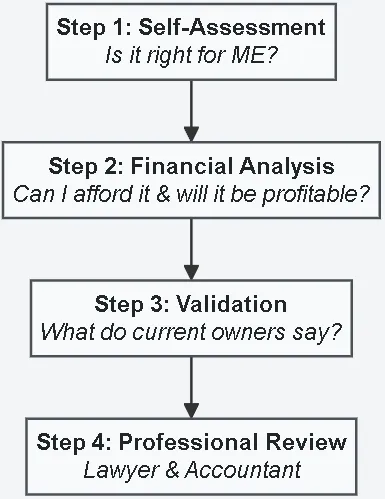
Step 1: Is This Business Right for YOU? (The Entrepreneur Assessment)
This is the most overlooked and most critical step. Before you even look at the numbers, you have to look in the mirror. A franchise is not a passive investment; it's a life-changing commitment. You need to be brutally honest with yourself.
Your Passion & Interests: Do you genuinely have an interest in the industry? You don't have to be obsessed with making pizzas to own a pizza franchise, but you'd better enjoy the process of running a food service business and leading a team.
Your Skills & Strengths: Are you a people person who loves being on the floor (retail/food)? Or are you a systems-and-process person who prefers B2B sales (consulting/commercial services)?
Your Desired Lifestyle: Do you want a 9-to-5 business, or are you prepared for the 24/7 demands of a restaurant that's open nights and weekends? Do you want to manage a team of 20 employees or work by yourself from home?
Your Financial Reality: What is your net worth? How much can you realistically afford to lose?
This self-reflection is hard. That's why we built a tool to help.
Action Step:
Before you go any further, take 5 minutes to complete our Entrepreneur Assessment. It's designed to ask you these tough questions and help you discover your unique entrepreneurial profile. It will give you a personalized report suggesting which industries and business models might be the best fit for your personality and goals. It's the perfect starting point.
Step 2: Crunching the Numbers - What is the Real ROI?
Once you've found a franchise that aligns with your personal goals, it's time to put on your financial hat. Every franchisor is required by law in the U.S. to provide a Franchise Disclosure Document (FDD). This is your treasure map. The Federal Trade Commission (FTC) has a great consumer guide that I recommend everyone read.
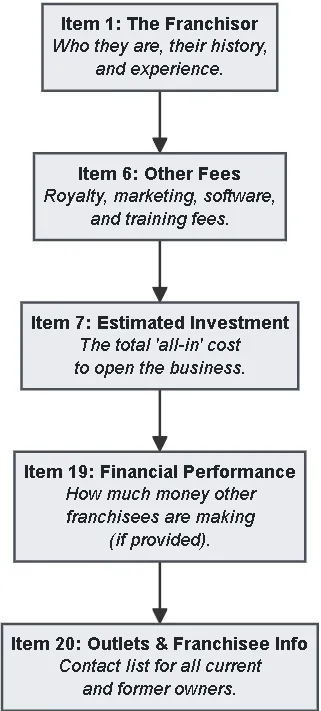
Inside the FDD, "Item 7" will give you a detailed estimate of your initial investment. But that's just the start. You need to understand all the costs.
| Cost Category | What it Includes | Where to Find It |
|---|---|---|
| Initial Investment | Franchise Fee, Real Estate, Equipment, Signage, Initial Inventory | FDD - Item 7 |
| Ongoing Fees | Royalty Fees (e.g., 4-8% of gross sales), Marketing/Ad Fund Fees | FDD - Item 6 |
| Operating Costs | Rent, Payroll, Utilities, Cost of Goods Sold (COGS), Insurance | Your own projections |
This looks intimidating, I know. You're probably thinking, "How on earth do I project my sales and figure out if this will actually be profitable?"
Action Step:
This is exactly why we created our ROI Calculator. You can plug in the numbers directly from the FDD's Item 7 and our tool will help you project your potential revenue, costs, and, most importantly, your Return on Investment (ROI) over time. It helps you turn a confusing document into a clear financial picture.
Step 3: Comparing Your Top Choices Side-by-Side
It's rare that you'll fall in love with just one option. More likely, you'll have two or three promising candidates. A fitness franchise, a senior care business, and a pet grooming service might all look good on paper. How do you choose?
You need to compare them objectively, apples-to-apples. Create a simple scorecard for each one. Rate them on a scale of 1-5 on the factors that matter most to you.
Financials: Initial Investment, Royalty Fees, Reported Average Revenue (from FDD Item 19, if provided).
Brand & Support: Brand Strength, Quality of Training, Marketing Support.
Lifestyle Fit: Alignment with your personal skills and desired work-life balance.
Validation: How happy are the current franchisees? (More on this in a moment).
This process prevents you from making an emotional decision and forces you to look at the data.
Action Step:
Juggling spreadsheets is a pain. To make this easy, use our Opportunity Comparison. You can select up to three different franchise opportunities and it will lay out all the key data points side-by-side, creating an instant, visual scorecard to help you identify the true front-runner.
4: The Legal Deep Dive: Decoding the Franchise Agreement
Okay, let's talk about the scary part: the legal documents. The FDD and the Franchise Agreement can be hundreds of pages long and written in dense legalese. This is where many people's eyes glaze over. Do not let that be you.
This document dictates your entire professional life for the next 5, 10, or 20 years. You MUST understand it. While you absolutely need a qualified franchise lawyer to review it, you should do the first pass yourself.
4-1: What is a Franchise Disclosure Document (FDD)?
The FDD is a comprehensive document that, by law, the franchisor must give you at least 14 days before you sign any contract or pay any money. It's designed to protect you. It contains 23 sections, called "Items," that cover everything from the franchisor's financial health and litigation history to all the fees you'll have to pay.
4-2: A Franchise Agreement Example: 10 Red Flags to Watch For
The Franchise Agreement is the actual, binding contract. It's often included as an exhibit in the FDD. Here are 10 potential red flags I always tell people to look for. If you see them, it doesn't mean "run away," but it does mean "ask very tough questions."
Vague or Non-Existent Territory Rights: Does it clearly state you have an exclusive, protected territory? If not, the franchisor could open another location right across the street from you.
Unfair Termination Clauses: Can the franchisor terminate your agreement for minor, easily-made mistakes? You want a "right to cure," meaning you have time to fix any default.
Restrictions on Selling Your Business: When you want to retire, you'll want to sell your business. Does the franchisor have the right to refuse any potential buyer for any reason?
Forced Purchasing from Designated Suppliers: Are you required to buy all your supplies (from napkins to software) from the franchisor or their affiliates, even if you can find them cheaper elsewhere? This can be a hidden profit center for them.
The Right to Change the System at Will: The franchisor needs to be able to evolve the system, but does the contract give them the right to force you to make major, expensive upgrades (like a complete store remodel) at their whim?
No "Right to Cure": If you're in default (e.g., you're late on a royalty payment), does the agreement allow for immediate termination, or does it give you a reasonable period (e.g., 30 days) to fix the problem?
Personal Guarantees: Most agreements will require you to personally guarantee the obligations of the franchise. This means if the business fails and owes money, they can come after your personal assets, like your house. Be aware of what you're signing.
Restrictions After the Term Ends: What does the non-compete clause look like? Will it prevent you from working in the entire industry in your state for 5 years after you leave? Look for reasonable restrictions.
Lack of Franchisor Obligations: The agreement will have a long list of your obligations. Does it have a similarly clear list of the franchisor's obligations regarding training, support, and marketing?
Unilateral Changes: Can the franchisor change the operations manual (which is part of your contract) at any time without your consent? This is common, but you need to understand the scope of this power.
Reading this is not a substitute for legal advice. But being aware of these points will allow you to have a much more intelligent conversation with your lawyer.
5: Common Mistakes to Avoid When Looking at Franchise Examples
I've seen smart people make simple, avoidable mistakes on their path to franchise ownership. It usually comes down to letting emotion and excitement cloud their judgment. Here are the biggest pitfalls I've seen.
5-1: The Pitfall of "Falling in Love" with the Product
This was my friend Mark's mistake. He loved acai bowls, so he assumed he'd love running an acai bowl shop. But loving a product and loving the business of selling that product are two very different things. The day-to-day reality of a business involves managing inventory, scheduling teenage employees, dealing with leaky pipes, and marketing-not just happily blending fruit. You must evaluate the business model, not just the end product.
5-2: Ignoring the "Validation" Step
This is the single most important piece of advice in this entire article. The FDD's Item 20 lists the names and contact information for all current and former franchisees. You must call them.
Call at least 10-15 of them. Don't just call the happy ones ,the sales guy suggests. Call people from the list. Ask them the tough questions:
"If you could go back in time, would you make this investment again?"
"How accurate were the financial projections in Item 19?"
"Tell me about the support you get from corporate. Is it what was promised?"
"What's the single worst part about running this business?"
"How many hours a week do you really work?"
Their answers are pure gold. They are living the life you are considering. Their insights are more valuable than any sales brochure. If a franchisor has a high number of failed or terminated franchises, or if the franchisees you talk to are consistently unhappy, that is a massive red flag.
5-3: Underestimating the Total Cost and Time Commitment
Many people focus on the initial franchise fee and underestimate the total "all-in" cost. You need capital for the build-out, for inventory, for hiring, and, crucially, for working capital. You need enough cash in the bank to pay your bills (and yourself) for the first 6-12 months before the business becomes profitable. The SBA often recommends having at least this much runway. Running out of cash is a primary reason new businesses fail. Similarly, don't believe you'll be working 20 hours a week from day one. In the beginning, be prepared to be the first one in and the last one out.
6: My Personal Take: The System is More Important Than the Sector
Alright, we've covered a lot of the "what" and "how." Now I want to talk to you, entrepreneur to entrepreneur. After years of analyzing these opportunities, I've developed a core philosophy that I share with everyone who asks for my advice. It's this: For a first-time franchisee, the quality of the franchise system is infinitely more important than the perceived "hotness" of the industry sector.
I see it all the time. People chase trends. A few years ago it was frozen yogurt. Then it was escape rooms. Now it might be IV hydration clinics or pickleball courts. People see a trend and think, "I have to get in on that!" They find a new, flashy franchise in that space and jump in, mesmerized by the growth charts.
That's a recipe for disaster.
A hot sector attracts a lot of competition, including a flood of new, inexperienced franchisors who have a cool concept but have no idea how to support a network of franchisees. They haven't worked out the kinks in the supply chain. Their "marketing plan" is just a slick Instagram page. Their "training" is a 3-day PowerPoint presentation. When the trend cools, or when operational problems hit, these systems crumble, and the franchisees are left holding the bag.
Now, contrast that with a "boring" but proven franchise system, maybe in a sector like commercial cleaning or senior home care. These might not be sexy businesses you brag about at cocktail parties. But a top-tier franchisor in that space has spent 20 years perfecting their system. They know the answer to every problem because they've seen it a hundred times. Their training is rigorous. Their software for scheduling and billing is flawless. They have national contracts that feed you business. They have a community of 500 other franchisees you can call for advice.
In this scenario, you're not buying a "cleaning business." You're buying a finely tuned machine for generating customers, fulfilling services, and collecting revenue. The system is so strong that it almost guarantees a certain level of success if you just follow the playbook. This is what you should be looking for.
So, my advice is to resist the "shiny object syndrome." Instead of starting your search by asking "What's the hottest industry?", start by asking "Who are the most respected franchisors with the happiest franchisees, regardless of industry?" You can find this data from firms like Franchise Business Review, which surveys tens of thousands of actual franchisees about their satisfaction. Find a world-class system first, and then see if their business model aligns with your personal skills and lifestyle. That's the path to long-term, sustainable success, not just a short-term trend.
7: Conclusion: From Dream to Action Plan
We started this conversation with a simple thought: "I could run one of those." My goal was to show you that you absolutely can, but that success isn't about luck; it's about having a process.
We've journeyed from understanding the basic concept of franchising to dissecting real-world examples. Most importantly, we've built your personal evaluation toolkit-a framework to assess yourself, the numbers, and the opportunities, all while avoiding the common pitfalls that trip up so many others.
You are no longer just a dreamer looking at storefronts. You are now an informed evaluator, armed with the right questions to ask and the knowledge of where to find the answers.
The final step is turning that evaluation into a concrete plan.
Final Action Step:
Once you've used our tools to narrow down your choices and have a clear favorite, it's time to make it real. Our Business Plan Generator is designed for this exact moment. It will guide you, step-by-step, through creating a professional business plan for your chosen franchise. This document will be essential for securing financing from a bank or the SBA and will serve as your personal roadmap for a successful launch.
8: Further Reading
Ready to continue your journey? Based on what you've learned here, I recommend you check out these other resources on our site:
9: Let's Talk: What's Your Dream Business?
I've shared my stories and my framework, but this is a two-way conversation. What franchise examples have caught your eye? What's the biggest question or fear that's still on your mind?
Leave a comment below. I read every single one and will do my best to reply within 48 hours. Your questions and experiences help our entire community of entrepreneurs. Let's help each other build something great.
10: About the Author
I am Qaolase, the founder and lead writer of this site. I'm not some financial titan with countless credentials-I'm just like you, an ordinary entrepreneur driven by curiosity and passion for the business world. Over the past decade, I've immersed myself in the realm of business opportunities and franchising, analyzing hundreds of brands and helping friends like David and countless online readers avoid investment pitfalls to find their own paths. My motivation for creating this site is simple: to share the most valuable business insights in the most authentic and accessible language, helping you navigate fewer detours on your entrepreneurial journey.
11: Sources & Citations
U.S. Small Business Administration (SBA). "Franchise business
McDonald's Corporation. "Franchising Costs & Fees
U.S. Federal Trade Commission (FTC). "A Consumer's Guide to Buying a Franchise
Franchise Business Review. "Top Franchises
Please be respectful and constructive in your comments. Spam and inappropriate content will be removed.