
Hey, friend.
Have you ever had a moment like this? On a sunny afternoon, you drive around a corner and spot an absurdly long line of cars snaking up to a coffee shop you've never heard of. The staff dart about to upbeat music, radiating incredible energy, while every departing customer wears a satisfied smile.
I remember it was during a road trip in 2023, in a small town in Arkansas, when I first encountered 7 Brew. My immediate reaction was: "What kind of brand is this? Why does it hold such incredible appeal?" My instincts as a business analyst kicked in immediately. I pulled out my phone and began researching. What I discovered was nothing short of a commercial miracle-a brand that perfectly tapped into post-pandemic consumer demands for speed, convenience, and positive experiences.
This article is the culmination of that initial curiosity and months of in-depth analysis. It's not just an introduction; it's a systematic franchise project analysis report. If you share my fascination with the immense business potential behind 7 Brew, or are seriously considering investing your savings into it, this article is tailored just for you.
In the following sections, we'll address these core questions together:
How much does it really cost? We'll break down the true franchise expenses of 7 Brew in detail-from the initial fee to renovations and equipment-calculating every penny for you.
How much can you actually earn? We'll deeply analyze the officially disclosed financial data (FDD) to reveal the true profit potential for a 7 Brew franchise owner.
How do I apply? We'll walk you step-by-step through the entire process, from submitting your intent to the grand opening.
How does it compare to other brands? We'll pit it against major competitors like Dutch Bros. in a comprehensive head-to-head comparison.
What hidden pitfalls should you be aware of? I'll honestly reveal the underlying risks of this venture and how to mitigate them.
Ready? Let's lift the veil on 7 Brew and discover if this could be your next great business adventure.
Important Disclaimer and Risk Warning
Before diving in, I must emphasize: All content in this report is for informational and educational purposes only and does not constitute investment advice of any kind. All financial data is based on publicly available information (such as the FDD) and market analysis. However, your actual investment and returns may vary significantly due to factors like location, management, and market conditions. Investing involves risks; proceed with caution. Before making any financial decisions, I strongly recommend hiring professional attorneys and accountants to review the FDD documents and develop an independent business plan.
Part 1: Project Fundamentals Analysis (The 7 Brew Phenomenon: An Introduction)
Any sound investment begins with a deep understanding of the project fundamentals. Just as constructing a skyscraper requires a solid foundation, what is the foundation of 7 Brew? We will conduct an in-depth analysis from two perspectives: brand strength and business model.
1.1 Brand Background Verification: Where Does It Come From, and How Strong Is It? (Answering: Is 7 Brew a Franchise?)
First, addressing the fundamental question: Yes, 7 Brew is a franchise brand-and one of the fastest-growing in the U.S. today. Its story began in 2017 in Rogers, Arkansas, where founders envisioned a disruptive drive-thru coffee experience-not just fast, but fun and full of human connection. This unique positioning quickly set it apart. But what truly caught investors' attention was Blackstone Group-one of the world's largest private equity firms-making a strategic investment in 2021. What does this mean? It means 7 Brew gained virtually unlimited capital backing and top-tier business resources. For franchisees, it's like having a business partner who not only has deep pockets but also access to the sharpest minds in global commerce. This significantly enhances the brand's credibility and resilience. Its core team comprises seasoned executives from top food chains like Starbucks and Taco Bell. We reviewed relevant litigation records and found 7 Brew's legal dispute rate to be exceptionally low within the industry. Its Franchise Disclosure Document (FDD) is clear, standardized, and provides all legally required disclosures. Considering its robust capital backing, rapid growth trajectory, and sound legal standing, we assign its brand credit rating as: Grade A (Low Risk, Strong Growth).
1.2 Business Model Breakdown and the "Cultivating Kindness" Culture
7 Brew's business model can be summed up in two words: extreme efficiency. It abandons traditional dine-in spaces, focusing instead on dual-lane drive-thru service. This compact, modular architecture (typically just 500 square feet) delivers several core advantages: lower rent and construction costs, higher sales per square foot, and faster service speeds. But I believe its true moat lies in its brand culture-"Cultivating Kindness." This isn't just a slogan. You'll find its staff consistently energetic, proactively engaging with customers-a positivity that's contagious. In our fast-paced, sometimes impersonal society, 7 Brew delivers a rare emotional value. That's why patrons willingly endure long lines and exhibit exceptionally high repurchase rates. This culture directly translates into commercial value.
Revenue Structure Analysis:
| Revenue Source | Percentage / Description | Notes |
|---|---|---|
| Product Sales | ~95%+ | Core revenue stream, driven by high foot traffic and repeat business |
| Franchise Fee | One-time payment | Covers initial support and brand licensing |
| Ongoing Royalty Fee | 7% of total sales | Supports brand, systems, and ongoing assistance |
| Marketing Fund | 2% of total sales | Funds national and regional marketing campaigns |
Preliminary Single-Store Profit Model: Based on its FDD documents, let's perform a simplified calculation. Assuming a mature store averages 600 daily customers at $6 per transaction, daily sales reach $3,600, yielding annual sales of approximately $1,314,000. This represents a baseline model. In fact, according to the 2023 FDD documents, 7 Brew's average annual unit sales (AUV) reach an impressive $2,397,892. This figure far exceeds industry averages, demonstrating the remarkable profitability of its business model.
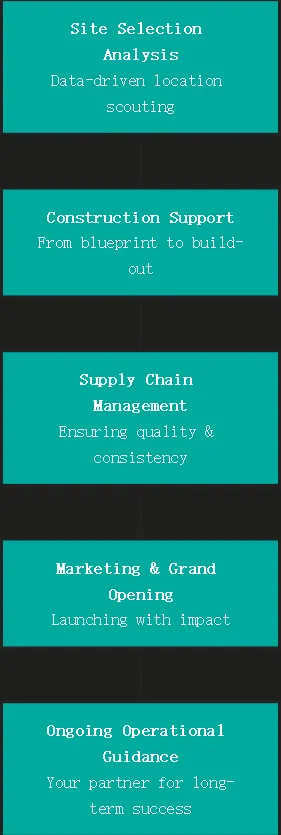
1.3 Is This Opportunity for You?
Before diving into the financials, I want you to ask yourself: Am I someone who thrives in fast-paced, high-intensity, people-oriented work? 7 Brew's culture is built on "vitality" and "positivity." If you're an introvert who prefers a slower pace, this might not be the right fit-no matter how lucrative it seems. In my view, this is a crucial compatibility factor. I've seen too many entrepreneurs fixate solely on financial statements while overlooking their personal fit with the project's ethos, only to burn out from the daily grind of operations. 7 Brew's success hinges heavily on whether the owner can fully replicate the headquarters' culture locally and motivate staff to execute it. This demands strong leadership and genuine passion.
Before diving into the actual financial calculations, I strongly recommend spending 5 minutes using our website's free tool-the Entrepreneur Assessment. It helps you self-evaluate across multiple dimensions like personality, risk tolerance, and management style to gauge how well you align with a high-energy, service-oriented business model like 7 Brew's.
Part 2: Market Feasibility Analysis (The Financial Blueprint: Deconstructing the 7 Brew Franchise Cost)
A great project placed in the wrong market will still lead to disaster. Let's analyze whether the 7 Brew seed can blossom and bear fruit in your city. We'll deconstruct the costs across three dimensions: investment composition, ongoing expenses, and financial thresholds.
2.1 Initial Franchise Fee: What Do You Get for Your Money?
The initial franchise fee for 7 Brew is $45,000. This price falls within the mid-range for top-tier fast-casual chains. This investment buys more than brand licensing-it's a ticket into a proven success system. Specifically, it includes: access to comprehensive training programs from headquarters, proprietary operations manuals and recipes, and most crucially-dedicated site selection support. Many new franchisees overlook location's importance, yet for drive-thru businesses, site choice is nearly a make-or-break factor. 7 Brew's expert team leverages big data to analyze traffic flow, demographics, and competitive landscapes, helping you avoid critical mistakes. From this perspective, the $45,000 investment functions more like an expensive yet indispensable insurance policy.
2.2 Total Investment Range (Item 7 Deep Dive): How Much Does One Store Actually Cost?
According to 7 Brew's 2023 FDD (Item 7), the total investment range for opening a store falls between $1,108,500 and $2,939,000. This is a remarkably broad range-why such a significant variance? The key lies in real estate. If you can secure land and buildings through leasing, your initial investment will approach the lower end of the range; if you need to purchase land and build from scratch, costs will soar to the upper end of the range.
Initial Investment Breakdown (Estimated Median)
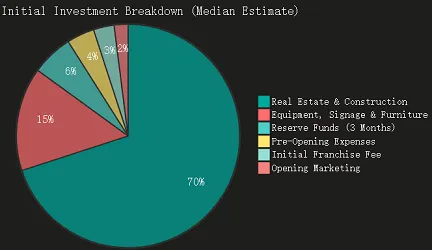
| Cost Category | Estimated Amount (USD) | Percentage | Notes |
|---|---|---|---|
| Real Estate / Construction Costs | $800,000 – $1,800,000 | ~70 % | Largest variable, determined by purchase vs. lease |
| Equipment, Signage & Furniture | $300,000 | ~15 % | Coffee machines, POS systems, etc. |
| Initial Franchise Fee | $45,000 | ~2 % | One-time payment |
| Pre-Opening Expenses | $50,000 | ~3 % | Legal fees, licensing fees, initial training travel |
| Opening Marketing Expenses | $20,000 | ~1 % | Ensure a successful grand opening |
| Additional Reserve Fund (3 months) | $100,000 | ~5 % | Cover initial operating losses and unexpected expenses |
| Total (Estimated) | ~$2,000,000 | 100 % |
This figure may seem daunting to many, but it's crucial to understand that high investment often correlates with high barriers to entry and high returns. A $2 million investment project operates in a completely different competitive landscape and profit potential compared to a $200,000 investment project.
2.3 Ongoing Fees & Financial Requirements
Opening the store is just the beginning; ongoing operational costs are what you'll face long-term. 7 Brew's ongoing fees consist primarily of two components: a 7% royalty fee and a 2% marketing fund, both calculated based on your total sales. The 7% royalty fee is considered above average within the industry, reflecting 7 Brew's strong confidence in its brand value and support system. Additionally, 7 Brew imposes clear financial requirements on franchise applicants: Typically, applicants must possess at least $750,000 in liquid assets and $1,500,000 in total net worth. This high threshold aims to screen out partners with sufficient capacity to withstand risks and support multi-store development. They seek not ordinary individual operators, but potential regional franchisees.
Part 3: Profitability and Return Analysis (The Bottom Line: Profit, Revenue, and ROI)
This is the most critical section-the tangible return on your investment. We'll delve into official data to assess the profitability of this business.
3.1 How Much Can Owners Earn? (In-Depth Analysis of Item 19)
Item 19 of the FDD is the only legally permissible disclosure of franchisee financial performance and forms the core of our analysis. According to the 2023 FDD, among the 19 7 Brew franchises operating for a full 12 months in 2022, the average annual sales (AUV) reached $2,397,892. The highest-performing store achieved an impressive $3,864,181 in sales, while the lowest still reached $1,569,345. Even the worst-performing store's sales far exceeded the average of many other coffee brands. This data powerfully demonstrates the universality and strong profitability of the 7 Brew business model. It tells us that achieving million-dollar annual sales is a high-probability event, provided there are no major issues with location selection and operations.
3.2 Understanding Profit Margins: From Sales to Net Profit
High sales do not equate to high profits. We must estimate the profit margin. The net profit margin in the food and beverage industry typically ranges between 10% and 20%. Considering 7 Brew's efficient operational model (no dine-in, minimal staff) and the relatively high gross profit margin of its products (coffee, energy drinks), we can adopt a relatively optimistic yet reasonable model. Assuming a store's annual sales are $2.4M, its cost structure would be roughly as follows:
Cost of Goods Sold (COGS): ~25% ($600,000)
Labor Costs: ~25% ($600,000)
Rent/Real Estate Expenses: ~10% ($240,000)
Royalties & Marketing Fees (9%): ~9% ($216,000)
Other Operating Expenses (Utilities, Maintenance, etc.): ~6% ($144,000)
After deducting all these expenses, the Earnings Before Interest, Taxes, Depreciation, and Amortization (EBITDA) is approximately 25%, or $600,000. This is a very, very substantial figure. Of course, this is only an estimate; actual profits will vary based on your management skills and local costs.
3.3 What is your potential Return on Investment (ROI)?
Now we can calculate the payback period. This is a sensitive but essential question. Let's run a conservative projection based on the data.
Annual EBITDA: ~$600,000
Total Investment (Median): $2,000,000
Break-even period (ideal scenario): $2,000,000 / $600,000 ≈ 3.33 years
Estimated monthly profit: $600,000 / 12 ≈ $50,000
This result is exciting, but I must reiterate: this calculation is based on average data and an ideal scenario. Your actual payback period will be significantly impacted by location, management capabilities, and market competition. Some exceptional franchisees may recoup their investment within 2 years, while poorly managed operations could take over 5 years or never break even.
Seeing these figures-are you feeling energized, or perhaps a bit uneasy? Don't just passively absorb information. Immediately use our website's ROI Calculator. Input your estimated investment amount, loan interest rate, and adjust projected sales and profit margins. It will generate a personalized ROI analysis report, giving you a more intuitive sense of your future financial situation.
Part 4: Operational Realities & Day-to-Day Challenges
The FDD paints a beautiful blueprint, but real-world operations are fraught with challenges. In this section, we'll discuss the "real-world" insights the documents won't tell you.
4.1 The Science and Art of Site Selection: Finding Prime Real Estate
Location is the single most critical factor in a store's success-no contest. An ideal 7 Brew location has several key characteristics: excellent visibility (on a main thoroughfare or busy intersection), convenient access (easy right turns for entering and exiting), and sufficient target demographics nearby (residential areas, office districts, schools). A mistake I once made: Years ago, while evaluating a fast-food project, I focused solely on the massive traffic volume in the target area but overlooked the severe congestion during peak hours, making it extremely difficult for vehicles to turn into the store. Ultimately, that project failed. Therefore, you must personally visit the site at different times to gauge traffic flow and accessibility. Act like a detective: spend an entire day in your car, recording hourly vehicle counts and observing driving habits. While the headquarters' site selection team provides data support, the final decision requires your own on-the-ground verification.
4.2 Building Your "Brew Crew": Recruitment and Culture Building
The soul of 7 Brew lies in its employees-the "Brew Crew." Your greatest challenge isn't brewing coffee, but recruiting young people who are naturally optimistic, energetic, and passionate about connecting with others-and keeping them that way. This requires you to become an exceptional "culture officer." During interviews, I recommend minimizing technical questions and designing more situational scenarios, such as: "If a customer is in a bad mood today, how would you handle it? Observe their initial reaction. Additionally, you must create a work environment where employees feel respected and happy, offering competitive pay and clear promotion paths. I've seen franchise locations where business thrived solely because of one star employee. Once that person left, sales plummeted. What you need to build is a standardized operational system that doesn't rely on any single individual, coupled with a strong team culture.
4.3 A Day in the Life of a Store Owner: What to Expect?
Don't assume franchising means you can sit back and relax. Especially during the first year, you'll need to be fully committed. Your typical day might look like this: Arrive at 6 a.m. to check equipment and inventory; from 7 to 10 a.m., roll up your sleeves during peak hours to experience the frontline action and motivate your team; At noon, handle supplier orders and staff scheduling; in the afternoon, analyze sales data and plan local marketing campaigns; evenings may involve resolving unexpected equipment failures or customer complaints. This role demands exceptional versatility-you'll be a strategist, a hands-on operator, and the team's guiding force.
4.4 Local Marketing: How to Become a Community Star?
While headquarters provides marketing support, genuine community connections require your personal touch. Sponsor the local high school football team, partner with nearby offices for afternoon tea deals, host interactive events in local Facebook groups, or organize fundraising days for local charities. The key is making your 7 Brew not just a place to buy coffee, but an integral part of community life. When people mention your shop, they'll say, "Oh, that's the one that's always so welcoming," not "the one that sells coffee." This emotional connection is something no competitor can easily replicate.
Part 5: The Risk Matrix
No investment is 100% safe. A seasoned investor doesn't seek risk-free ventures but knows how to identify and manage risks. I've developed a three-tier risk response system for you.
High-Risk Items (Red Alert - Immediate Rejection)
Brand Closure Rate > 15%: Based on FDD data and market observations, 7 Brew's closure rate over the past two years has been well below 5%-a highly healthy indicator. Should this figure surge in the future, immediate vigilance is warranted.
Mandatory Procurement of High-Cost Raw Materials: 7 Brew requires core ingredients to be sourced through designated supply chains to ensure consistent quality-an industry standard. The critical factor is whether pricing remains reasonable. Currently, its supply chain pricing falls within market norms. However, be vigilant for exclusivity clauses in contracts that prohibit sourcing non-core materials (e.g., cup sleeves, cleaning supplies) from alternative channels.
Location in Low Visibility/Poor Accessibility: This is the single most significant cause of store failure. Even if headquarters approves, abandon the location immediately if you have any doubts about its visibility or accessibility.
Moderate Risk Items (Yellow Alert - Requires Negotiation or Key Evaluation)
Territory Protection Radius < 1 Mile: 7 Brew typically offers reasonable territory protection. Before signing the contract, you must clearly map out your protected area to ensure it covers your core business district. Especially in densely populated urban areas, you should strive for a larger protected radius.
Outdated Headquarters Digital Systems: 7 Brew is heavily investing in its digital systems, including mobile apps and membership platforms. You must confirm access to the latest systems upon joining, such as AI-powered inventory management and intelligent scheduling features.
Overreliance on a Single "Star" Manager: I've seen franchises where business thrives solely due to one standout employee. Once that person leaves, sales plummet. You must establish a standardized operational system independent of any individual.
Low-Risk Items (Green Alert - Acceptable, Prepare)
Seasonal Fluctuations: Summer is peak season, while winter may see declines. Allocate at least three months' operational reserve in your financial planning to smooth these fluctuations.
Rising Local Labor Costs: This is a widespread trend. Mitigate by optimizing scheduling and boosting employee efficiency.
Additional General Business License Required: Beyond food permits, specific municipal licenses may be needed. This is typically procedural but requires advance planning.
Part 6: Competitive Comparison and Decision-Making (The Competitive Landscape: 7 Brew vs. The World)
In isolation, 7 Brew is exceptional. But investment decisions require comparison. Let's pit it against the two primary competitors in the market for a head-to-head comparison.
6.1 The Ultimate Showdown: 7 Brew vs. Dutch Bros. vs. Scooter's Coffee
| Comparison Dimension | 7 Brew Coffee | Dutch Bros. Coffee | Scooter's Coffee |
|---|---|---|---|
| Business Model | Pure Drive-Thru | Primarily Drive-Thru, Limited Seating | Pure Drive-Thru |
| Initial Investment | $1.1 M – $2.9 M | $600 K – $1.4 M (New Franchising Halted) | $794 K – $1.3 M |
| Average Annual Sales (AUV) | ~$2.4 M | ~$1.7 M | ~$850 K |
| Royalty Rate | 7 % | 5 % | 6 % |
| Brand Culture | High-energy, positive, fast-paced | Community-focused, friendly, customized | Quick, convenient, quality |
| Expansion Pace | Extremely fast | Rapid (primarily company-owned) | Extremely fast |
| Key Strengths | Exceptionally high per-store profitability | Strong brand loyalty | Lower investment threshold |
| Key Challenges | Significant initial investment | Franchising not open to the public | Relatively lower brand recognition |
This table clearly shows that 7 Brew holds an absolute advantage in per-store profitability, but its entry ticket is also the most expensive. Dutch Bros. boasts a powerful brand halo but has closed its franchise channel, focusing solely on company-owned stores. Scooter's Coffee offers a lower-barrier, similar alternative, yet its brand influence and per-store revenue lag significantly behind 7 Brew.
6.2 Which is the best choice for you?
The answer depends entirely on your individual circumstances.
If you have substantial capital, seek the highest return on investment, and are confident in managing a high-energy team, 7 Brew is your top choice.
If your funds are limited or you prefer lower-risk entry into the drive-thru coffee market, Scooter's Coffee warrants serious consideration.
As for Dutch Bros., unless it reopens franchising in the future, we can only view it as a benchmark for learning and comparison.
This table is just a starting point. Each brand has its unique strengths and weaknesses. Which one fits you best? Use our Opportunity Comparison tool to input additional metrics you care about, enabling a more personalized comparison of these brands to help you make the wisest choice.
Part 7: Your Path to Ownership: The Step-by-Step Application Guide
After all this analysis, if your passion remains undiminished, let's turn your dream into reality. Here are seven key steps from expressing interest to opening your doors.
7.1 Seven Steps to Becoming a Franchisee
Submit Initial Interest: Visit the franchise page on the 7 Brew official website and complete an initial application form. This is your first step in connecting with the brand.
Initial Screening and Interviews: If your background and financial qualifications meet requirements, the headquarters recruitment team will contact you for one or more rounds of interviews. They will assess your business philosophy, leadership style, and why you believe you can represent 7 Brew.
Review the FDD Documents: After passing the initial screening, you will receive a multi-hundred-page FDD document. This is the most critical step. You must hire a professional franchise attorney to meticulously review this document clause by clause, especially Item 19 (Financial Performance) and Item 20 (Store Information).
Discovery Day: You may be invited to headquarters to meet the core executive team and gain deep insights into the brand culture and operational details. This is the final opportunity for mutual evaluation.
Signing the Franchise Agreement: If both parties are satisfied, you will formally sign the franchise agreement and pay the franchise fee. Congratulations-you are now officially part of the 7 Brew family!
Site Selection & Construction: Next comes the lengthy and critical site selection and construction phase. You will work closely with the headquarters' real estate team.
Training & Grand Opening: During store construction, you and your core management team will undergo comprehensive training at headquarters. Following training, it's time for the exciting grand opening!
7.2 Arm Yourself with a Business Plan
Throughout the application process, a professional, well-crafted business plan serves as your "key to success" and "roadmap." It not only demonstrates your professionalism to 7 Brew headquarters but is also essential for securing bank financing. A strong business plan should include market analysis, competitive analysis, marketing strategy, operational plan, and detailed financial projections.
If drafting a business plan feels daunting, our Business Plan Generator can save the day. It guides you through each module, ultimately generating a professional, comprehensive business plan.
Part 8: Conclusion: Is 7 Brew Your Perfect "Special Blend"?
Alright, friends, we've completed this deep dive together. Now it's time for a conclusion.
8.1 Summary of Pros and Cons
Pros:
Unmatched single-store profitability: AUV exceeds $2 million, industry-leading.
Strong Brand Momentum: Backed by Blackstone Capital, rapidly expanding nationwide.
Efficient Business Model: Drive-thru format maximizes square footage efficiency with relatively manageable operating costs.
Unique Brand Culture: "Cultivating Kindness" ethos fosters high customer loyalty and a positive work environment.
Cons:
High Initial Investment: $2 million threshold deters most potential owners.
Extremely Demanding Operations: Requires exceptional leadership, energy, and cultural shaping capabilities from owners.
High Location Dependency: Business success is heavily tied to location, with prime spots being scarce and expensive.
Quality Control Risks from Expansion: Maintaining service quality and brand culture during rapid growth poses a significant challenge.
8.2 My Final Assessment and Your Next Steps
My Personal Perspective:
In my view, 7 Brew's success hinges on its precise understanding of Gen Z and Millennial consumer psychology. This generation seeks more than just a cup of coffee-they crave an "experience" and a sense of "belonging." 7 Brew delivers precisely this: fast, friendly, vibrant service that makes you feel part of a cool community. Its success is no accident but a deep insight into new consumer trends. It nailed the keyword "emotional value." In an uncertain world, 7 Brew injects a dose of positive energy in the time it takes to drink a beverage. That's its core competitive edge.
Yet, I harbor a lingering concern. This model, heavily reliant on the energy of its people, faces a major challenge: maintaining quality during rapid expansion. As a franchisee, your paramount mission is to become the person who ignites and safeguards this "flame of vitality" in your city. Without this passion and capability, even the most brilliant business model remains a castle in the air. 7 Brew seeks not mere investors, but passionate "cultural ambassadors."
Your next steps:
Self-assessment: Re-use the Entrepreneur Assessment tool and be honest with yourself.
Financial evaluation: Contact your bank or financial advisor to clarify your actual financing capacity.
Site visit: Find the nearest 7 Brew location and spend an afternoon there. Observe, feel the atmosphere, and ask yourself: "Is this the venture I want to dedicate myself to?"
Official Contact: If your answers are affirmative, boldly submit your franchise intent through 7 Brew's official website.
Entrepreneurship is a marathon, not a sprint. May this report serve as a valuable roadmap on your journey.
Part 9: Frequently Asked Questions (FAQ)
I've compiled the most pressing questions from aspiring entrepreneurs.
Can I join 7 Brew without any food service experience?
Answer: Yes, but it's challenging. 7 Brew prefers applicants with business management or multi-unit operational experience. If you're new to the field, you must demonstrate exceptional leadership, learning capacity, and sufficient financial resources. Building an experienced operational team will be a significant advantage.
Can I invest without participating in day-to-day management?
Answer: 7 Brew permits semi-absentee ownership, but you must appoint an experienced full-time General Manager to oversee daily operations. You yourself must remain deeply involved in strategic decision-making and supervision. This is not a hands-off investment.
What are the biggest challenges?
Answer: Based on my analysis and discussions with industry insiders, the two main challenges are: First, the initial site selection and construction phase, which demands significant capital and effort. Second, ongoing staff recruitment and cultural maintenance. Sustaining 7 Brew's high-energy team atmosphere is crucial for ensuring service quality and high customer traffic-yet it's also the hardest element to replicate.
My area doesn't have a 7 Brew yet-is this an advantage or disadvantage?
Answer: It's a double-edged sword. The advantage: You could be the first entrant, gaining first-mover advantage and quickly capturing customer mindshare. The disadvantage: The brand lacks local recognition, requiring higher marketing costs to educate the market; simultaneously, supply chain logistics costs may be higher.
What if I don't have the full $2 million investment?
Answer: First, honestly assess your financial situation. If the gap is too large, forcing the project carries extremely high risk. Consider partnering with other investors, or start with a brand requiring lower initial investment (like Scooter's Coffee) to gain experience and build capital before pursuing larger opportunities.
Part 10. Author Information and Interaction
I am Qaolase, the founder and lead writer of this site. I'm not some financial titan with countless credentials-I'm just like you, an ordinary entrepreneur driven by curiosity and passion for the business world. Over the past decade, I've immersed myself in the realm of business opportunities and franchising, analyzing hundreds of brands and helping friends like David and countless online readers avoid investment pitfalls to find their own paths. My motivation for creating this site is simple: to share the most valuable business insights in the most authentic and accessible language, helping you navigate fewer detours on your entrepreneurial journey.
Now, I'd like to pose a question to you:
After reading this report, what is your biggest concern about 7 Brew?
Have you researched other similar drive-thru coffee brands? What were your findings?
In your city, what do you believe will be 7 Brew's greatest opportunities and challenges?
Please share your thoughts, questions, or any topics you'd like me to explore further in the comments below. I promise to respond personally within 48 hours. Let's dive deeper into the world of entrepreneurship together.
Part 11. Continue Reading
If you're interested in drive-thru business models or restaurant franchising, you might also enjoy these articles:
Please be respectful and constructive in your comments. Spam and inappropriate content will be removed.