
Have you ever driven to work early in the morning, seen the long line forming outside Dunkin' Donuts, and silently wondered: "How much does it cost to open a store like this? How much could you earn in a year?"
You're not alone. Every year, thousands of aspiring entrepreneurs like you are drawn to that iconic orange-and-pink sign. But when you finally start Googling, you're flooded with fragmented, even contradictory information. Some sites claim it requires millions in investment, while others say hundreds of thousands suffice; some tout owners raking in gold, while others complain it's just "buying yourself a job."
Don't worry-this article is written just for you. I'm Qaolase, a business consultant with over 11 years of experience. Throughout my career, I've helped countless investors like you analyze and evaluate business opportunities. With this report, I'll put an end to your information overload once and for all.
This article will clearly answer your most pressing questions:
What is the true cost of opening a Dunkin' Donuts? (Breakdown of every single expense)
What is the realistic "salary" (net profit) you can expect as an owner?
Beyond money, what "hidden qualifications" do you need?
What "hidden pitfalls" must you be wary of in this venture?
Compared to Starbucks or McDonald's, what are Dunkin' Donutss unique strengths and weaknesses?
More importantly, this isn't just a static report to read. In the key sections, you'll access our website's exclusive tools: the ROI Calculator, Entrepreneur Assessment, Opportunity Comparison, and Business Plan Generator. We don't just give you information-we empower you to make informed decisions.
Important Investment Warning
The information provided herein is based on publicly available data and industry analysis as of January 2026. It is for reference only and does not constitute investment advice. Franchising with Dunkin' Donuts involves significant financial risks, and past performance does not guarantee future returns. Before making any decisions, you must obtain and carefully review the latest Franchise Disclosure Document (FDD) and consult independent legal and financial advisors.
1. Why a Dunkin' Donuts Franchise Could Be Your Next Big Move (Fundamental Analysis: Brand Strength and Business Model)
In my view, evaluating a franchise opportunity starts with its fundamentals-much like assessing a stock by examining the company behind it. Dunkin' Donuts boasts exceptionally solid fundamentals, which is the core reason it continues to attract investors.
1-1. Brand Background and Legal Risk Assessment
Dunkin' Donuts is more than just a doughnut company. Founded in 1950, it now stands as a core brand under Inspire Brands-a $30+ billion annual revenue food service giant also owning Arby's, Buffalo Wild Wings, and other renowned brands. This robust parent company background translates to a more stable supply chain, stronger capital backing, and enhanced risk resilience. My verification through business databases confirms that Inspire Brands' core team consists largely of industry veterans with decades of experience, providing assurance for the brand's long-term development.
Legally, Dunkin' Donutss franchise system is highly mature. They annually publish a comprehensive Franchise Disclosure Document (FDD). This hundreds-of-pages-long document serves as your "treasure map" and "pitfall guide." I once helped a client named David analyze his first FDD. He initially felt like he was "reading a foreign language." But after we broke it down item by item, he discovered it detailed the company's litigation history, franchisee closure rates, and a breakdown of all fees. Our analysis showed Dunkin' Donutss recent lawsuits primarily involved labor disputes and isolated contract disputes, with no systemic legal risks that could undermine the entire franchise system. Their "Dunkin' Donuts" trademark is effectively registered and protected in all major global markets.
1-2. Business Model Breakdown: How Dunkin' Donuts Makes Money, and How You Make Money
Dunkin' Donutss revenue primarily comes from three sources:
Initial Franchise Fee: A one-time payment covering new franchisee screening, training, and startup support costs.
Ongoing Fees: Dunkin' Donutss main revenue stream, including a 5.9% royalty on gross sales and a 5% advertising fee.
Supply Chain Margins: While Dunkin' Donuts doesn't mandate purchasing everything from designated suppliers, core products like coffee beans and donut mixes are typically sold through its certified supply chain system, which incorporates their profit margins.
As a franchisee, your profit model is more straightforward: Single-Store Profit = (Average Daily Customers × Average Transaction Value × 365 Days) - Total Operating Costs.
According to QSR Magazine, a typical Dunkin' Donuts location can achieve annual sales exceeding $1 million. Assuming an average transaction value of $6, this translates to serving approximately 450 customers daily. Its gross profit margin ranks in the upper-middle range for the quick-service restaurant industry, hovering between 60%–65%, largely driven by high-margin beverage sales like coffee.
1-3. Franchise Support System: You're Not Fighting Alone
Dunkin' Donuts offers a comprehensive support system that's practically "nanny-level." New franchisees undergo a multi-week training program covering everything from crafting the perfect latte to using backend systems for inventory management and staff scheduling. For site selection, Dunkin' Donutss real estate team leverages big data models to analyze foot traffic, vehicle flow, and consumer potential at potential locations, significantly reducing the risk of poor site choices. The 5% annual advertising fee pooled from all franchisees fuels a powerful national marketing campaign. Those celebrity ads you frequently see on TV and social media? Your contribution plays a part behind the scenes.
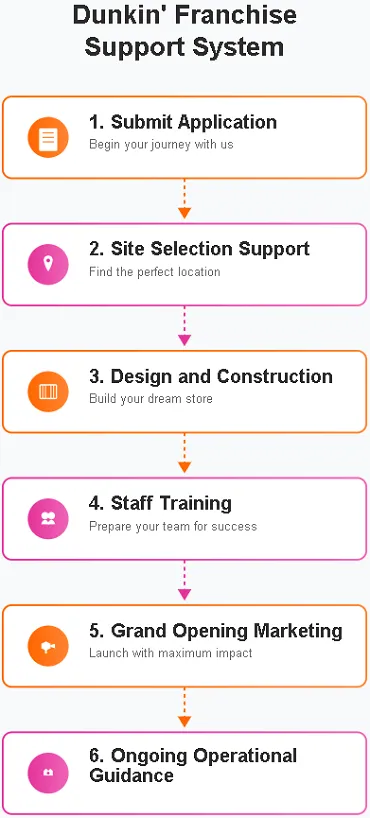
In summary, Dunkin' Donutss brand strength and proven business model provide investors with a high-certainty starting point. But that's only half the story. Next, let's crunch the actual numbers.
2. The Real Numbers: A Deep Dive into the Dunkin' Donuts Franchise Cost (Operational Feasibility Analysis: Implementation Costs)
"Don't give me the theory-just tell me how much money I need to prepare." That was the first thing my client David said when he sat down. I completely understand that feeling. Below, I'll break down every investment required to open a Dunkin' Donuts location, giving you a clear picture of the capital needed.
2-1. The Initial Dunkin' Donuts Franchise Fee Explained
First up is the franchise fee. This ranges from $40,000 to $90,000. Why such a wide range? It mainly depends on your market and the store format you choose. In a highly competitive, saturated market like a major city (e.g., New York), the fee may be higher. Additionally, if you sign a Multi-Unit Development Agreement, Dunkin' Donuts may offer a discount on the single-unit franchise fee, as they prefer franchisees with the capability and desire to open multiple locations. This is a one-time payment that grants you the right to use the Dunkin' Donuts brand, along with the comprehensive training and startup support mentioned earlier.
2-2. Your Total Estimated Investment: A Detailed Breakdown
The franchise fee is just the tip of the iceberg. According to Dunkin' Donutss 2024 FDD, the total investment for opening a new, traditional Dunkin' Donuts location ranges from **$526,900 to $1,787,700**. This figure may seem daunting, but it encompasses everything required to open your store. Let's break it down in a table:
| Cost Item | Estimated Cost | Notes |
|---|---|---|
| Initial Franchise Fee | $40,000 – $90,000 | One-time expense |
| Real Estate / Lease | $100,000 – $500,000+ | Largest variable; depends on leasing vs. purchasing and location |
| Construction & Remodeling | $250,000 – $700,000 | Transforming a shell space into a standard Dunkin' store |
| Equipment | $80,000 – $150,000 | Coffee machines, ovens, ice makers, POS systems, etc. |
| Signage | $15,000 – $40,000 | All interior and exterior brand signage |
| Opening Inventory | $10,000 – $20,000 | Coffee beans, milk, syrups, packaging materials, etc. |
| Grand Opening Marketing | $10,000 – $25,000 | To attract local customers during initial launch |
| Licenses & Misc. Expenses | $5,000 – $20,000 | Legal fees, accounting fees, various business permits |
| Additional Funds – 3 Months | $16,900 – $142,700 | "Lifeline funds" to cover operational losses and expenses during the first three months |
| Total Estimated Investment | $526,900 – $1,787,700 |
As shown in this table, the largest expenses are "Real Estate" and "Construction & Renovation." If you can secure a location with good foot traffic that was previously a restaurant, your renovation costs could be significantly reduced. This explains the wide range in total investment.
2-3. The Financial Bar You Must Clear: Net Worth & Liquid Capital
Dunkin' Donuts doesn't want franchisees to invest their entire life savings only to face cash flow problems at the slightest setback. Therefore, they've established clear financial thresholds:
Minimum Net Worth: $500,000
Minimum Liquid Capital: $250,000
Net worth refers to the net value of all your assets (real estate, stocks, savings, etc.) minus all liabilities (mortgages, car loans, etc.). Liquid capital refers to cash or equivalents (like stocks) you can access at any time. They need to ensure you have sufficient funds to sustain store operations even in the worst-case scenario.
2-4. Ongoing Fees: The Cost of Being Part of the System
After opening your store, you'll need to pay two core fees to headquarters on an ongoing basis:
Royalty Fee: 5.9% of your store's total sales.
Advertising Fee: 5% of your store's total sales.
This means that for every $100 you earn, approximately $10.90 goes to headquarters. This may seem high, but remember: this payment grants you brand usage rights, ongoing operational guidance, and nationwide advertising exposure.
Tool Integration
By now, you likely have a general understanding of the costs. But what do these "average figures" mean for you personally? How long will it take for your investment to pay off?
Stop guessing! Open our ROI Calculator now. Enter your estimated total investment based on local rent levels, then input a conservative annual sales projection based on your market assessment. The calculator instantly generates a personalized ROI analysis, giving you a clear picture of your future returns.
3. The Million-Dollar Question: Decoding the Dunkin' Donuts Franchise Owner Salary
Now let's get to the most exciting part: How much can you actually earn? First, let's clarify a concept: Franchisees don't receive a "salary." Your income is the store's net profit.
3-1. From Gross Sales to Net Profit: What Can You Realistically Earn?
According to Franchise Business Review, the average annual income (pre-tax net profit) for Dunkin' Donuts franchisees is approximately **$124,000**. Of course, this is merely an average. Experienced multi-unit operators may achieve significantly higher profits per location, while underperforming stores or those in unfavorable locations may struggle near the break-even point.
Let's perform a simple calculation. Assuming a store generates $1,000,000 in annual sales:
Cost of Goods Sold (COGS): Approximately 28% ($280,000), including coffee beans, ingredients, packaging, etc.
Labor Cost: Approximately 30% ($300,000), one of the largest variable costs.
Franchise Fees: 10.9% ($109,000).
Rent: Assumed at 8% ($80,000).
Other Expenses: Utilities, maintenance, insurance, marketing, etc., assumed at 10% ($100,000).
Calculating this, the pre-tax net profit is approximately: $1,000,000 - $280,000 - $300,000 - $109,000 - $80,000 - $100,000 = $131,000.
This figure aligns with industry report data. This implies that with an initial investment of $800,000, the theoretical static payback period is approximately 6 years. Of course, this is a highly simplified model.
3-2. Profitability Drivers: What Separates a Good Store from a Great One?
Why do some owners earn $200,000 annually while others make only $50,000? The answer lies in these three "profit drivers":
Key Factor 1: Drive-Thru. This is Dunkin' Donutss "secret weapon" for profitability. According to Dunkin' Donutss own data, stores with drive-thru lanes typically generate 40% higher sales-or even more-than those without. It dramatically boosts service efficiency during peak hours-especially mornings. If you have the option, always prioritize locations with a drive-thru.
Key Factor 2: Location, Location, Location. This real estate mantra holds true in the food service industry too. Stores near major thoroughfares, office buildings, or large community entrances naturally attract guaranteed foot traffic.
Key Factor 3: Operational Excellence. This is where franchisees' core competencies are truly tested. Can you control labor costs through efficient scheduling? Minimize ingredient waste with precise ordering? Boost customer loyalty through exceptional service? These operational nuances ultimately translate directly to your bottom line.
3-3. A Tale of Two Stores: A Hypothetical Profit Scenario Analysis
To illustrate this more vividly, let's compare two hypothetical cases:
Case A: Downtown Walker Store
Owner: Sarah, first-time entrepreneur.
Investment: $750,000 (high rent, but lower renovation costs).
Features: Small footprint, no drive-thru, primarily serves nearby office workers and tourists.
Annual Sales: $800,000.
Estimated Annual Net Profit: $800,000 × 10% (low net profit margin) = $80,000.
Case B: Suburban Drive-Thru Store
Owner: Michael, with food service management experience.
Investment: $1,200,000 (high construction costs, but relatively low rent).
Features: Standard store format with dual-lane drive-thru, serving commuters and local residents.
Annual Sales: $1,500,000.
Estimated Annual Net Profit: $1,500,000 × 13% (High operational efficiency, higher net profit margin) = $195,000.
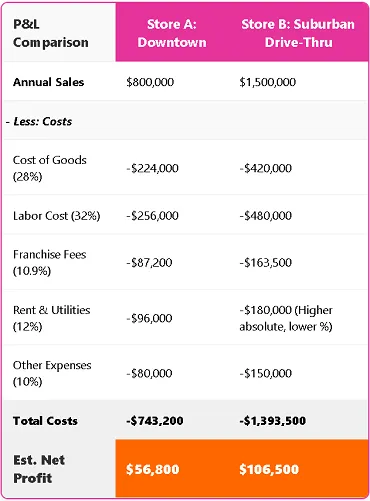
This comparison clearly demonstrates that higher initial investment (especially in drive-thru locations) often yields disproportionately higher returns.
4. Beyond the Numbers: Are YOU the Right Fit for Dunkin' Donuts? (Market Viability & Operational Fit Analysis)
With the financial aspect addressed, let's now discuss the "people" factor. Dunkin' Donuts seeks not merely investors, but crucially, operators.
4-1. Dunkin' Donutss Ideal Candidate Profile
I've spoken with Dunkin' Donutss Regional Development Managers, who emphasize the following criteria beyond financial strength when evaluating candidates:
Multi-Unit Management Experience: This is the most significant advantage. They want you to have the potential to open 3-5 or more locations within your territory, not just one. Experience managing chain retail stores or restaurants is a significant advantage.
Food Service or Retail Background: You don't need to be a chef, but understanding inventory management, cost control, and employee motivation puts you halfway to success.
Community Ties: Are you familiar with the community where you plan to open? Are you willing to participate in community events and make your Dunkin' Donuts a part of the neighborhood? This local connection builds strong customer loyalty.
4-2. A Day in the Life of a Franchisee
Before committing millions of dollars, you must clearly understand what this job entails. This is absolutely not a "set-it-and-forget-it" money-making scheme.
Here's what my client David's life looked like during the early days of opening his store:
5:00 AM: Arrive at the store, prepare for opening with the morning shift, check equipment, and greet the first rays of sunlight and the first customers.
7:00 AM - 10:00 AM: Peak rush hour. He shuttled between front-of-house and kitchen, sometimes brewing coffee himself, handling special customer requests, and ensuring the drive-thru line moved efficiently.
Noon: Process morning accounts and adjust afternoon orders based on sales data.
2:00 PM: Call suppliers and interview new part-time staff.
4:00 PM: Manage employee scheduling and troubleshoot a sudden coffee machine malfunction.
7:00 PM: Only after the evening manager arrives for handover can he drag his weary body home.
This demands immense energy and passion. If you're seeking a relaxed 9-to-5 job, joining Dunkin' Donuts might not be for you.
Tool Integration
By now, you might be asking yourself: "Can I really handle this?"
Instead of agonizing alone, let data guide you. Our specially designed Entrepreneur Assessment tool provides a comprehensive evaluation of your entrepreneurial traits across multiple dimensions-including leadership, risk tolerance, operational management, and customer service awareness-in just 5 minutes. It generates a personalized competency radar chart, clearly highlighting your strengths and areas for improvement.
5. Your Action Plan: From Dreamer to Owner (Deliverable: Your Action Plan)
If, after careful consideration, your passion remains undiminished, congratulations-you're ready to move into the action phase. Below, I provide a clear roadmap for your next steps.
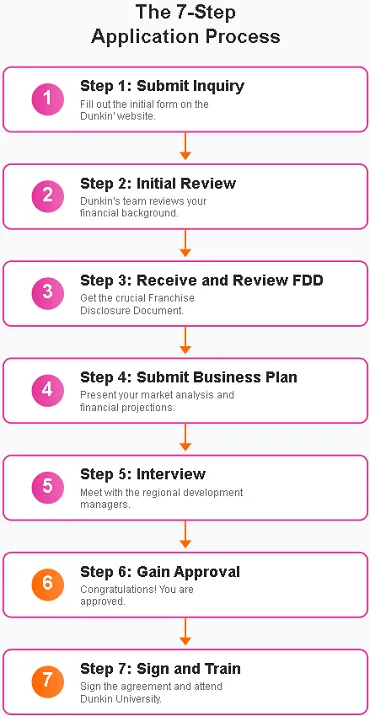
5-1. The Official 7-Step Application Process
Submit Inquiry: Complete a preliminary application form on Dunkin' Donutss official franchise website.
Initial Review: Dunkin' Donutss team will assess your financial standing and background.
Receive & Review FDD: Upon passing the initial review, you will receive the critical FDD document. I strongly recommend hiring a professional franchise attorney to help you understand its terms.
Submit Business Plan: You must submit a detailed business plan outlining your market analysis, operational strategy, and financial projections.
Interview: Participate in multiple rounds of interviews with the Regional Development Manager.
Gain Approval: Congratulations!
Sign Agreement & Attend Training: Pay the franchise fee, sign the formal contract, and attend comprehensive training at Dunkin' Donuts University.
5-2. How to Find a Dunkin' Donuts Donuts Franchise for Sale
Beyond opening a new location, purchasing an existing Dunkin' Donuts store is another viable option.
Advantages: Bypasses the most challenging site selection and construction phases, inherits existing staff and customer traffic, and achieves faster cash flow.
Disadvantages: Purchase price is typically higher (includes goodwill value), and you may inherit legacy issues (e.g., outdated equipment, poor employee culture). You can find such opportunities on Dunkin' Donutss official resale section or commercial brokerage websites. Before purchasing, conduct thorough due diligence and carefully review the past three years of financial statements.
5-3. Crafting Your Winning Business Plan
A compelling business plan is your key to securing Dunkin' Donuts franchise approval and bank financing. It must include:
Executive Summary: Your business vision.
Market Analysis: In-depth assessment of local competition and target customers.
Marketing Plan: How you will attract and retain customers.
Operations Plan: Staffing structure and daily management processes.
Financial Projections: Sales, cost, and profit forecasts for the next 3-5 years.
Tool Integration
Feeling overwhelmed by the complexity of writing a business plan?
No worries-our Business Plan Generator is designed for this purpose. Simply follow the prompts and input key data you've gathered (e.g., investment amount, projected sales), and it will automatically generate a fully structured, professionally formatted business plan framework. You can then refine and customize it, saving at least 80% of your time.
6. The Competitive Landscape: Dunkin' Donuts vs. The World
Though Dunkin' Donuts is formidable, it's not without rivals. Before deciding to open your store, you must have a clear understanding of the competitive environment within a 3-kilometer radius.
| Comparison Dimension | Dunkin' Donuts | Starbucks | McDonald's (McCafé) | Local Specialty Coffee Shops |
|---|---|---|---|---|
| Target Customers | Mass-market consumers & commuters | Middle-class & business professionals | Families & value-conscious guests | Young people & coffee enthusiasts |
| Core Strengths | Speed, value, strong brand recognition | "Third-place" experience, premium image | Massive foot traffic, burger-plus-coffee combo | Distinctive flavors, highly personalized service |
| Product Pricing | Moderate | Slightly high | Low | High |
| Investment Threshold | High (≈ $500 k +) | Individual franchising not offered (most regions) | Extremely high (≈ $1 M +) | Low–moderate (≈ $100 k +) |
| Operating Model | Efficiency-first, highly standardized | Experience-first, customizable | Ultra-standardized, peak efficiency | Flexible, owner-dependent |
| Profit Margin | Moderate | High | Moderate | High (but foot traffic can be volatile) |
My Perspective: Dunkin' Donutss positioning is remarkably astute. It avoids Starbucks' niche appeal and McDonald's fast-food mentality, precisely targeting the mass coffee market with "high quality, high efficiency, and high value." Its greatest threat isn't Starbucks, but rather McCafe-which also emphasizes value and convenience-alongside emerging, more flexible local chains.
Tool Integration
If you're still torn between Dunkin' Donuts and other business opportunities, our Opportunity Comparison Tool can help. Input key metrics (investment amount, franchise fee, projected profit) for your shortlisted projects (whether another franchise brand or an independent shop), and it generates a clear side-by-side comparison report to eliminate choice paralysis.
7. The Hidden Traps: 7 Risks Every Potential Dunkin' Donuts Franchisee Must Know (Risk Control Matrix)
I always tell my clients: successful investing isn't just about spotting opportunities-it's about anticipating risks. Below is my "Three-Tier Risk Matrix" for Dunkin' Donuts franchising, compiled from the FDD and real franchisee feedback.
7-1. High-Risk Items (High Risk - May Require Immediate Rejection):
Mandatory Purchase of High-Priced Raw Materials: While Dunkin' Donuts claims no mandatory requirements, the FDD lists "exclusively designated" suppliers. If you find these suppliers' quotes significantly exceed market prices, it will severely erode your profits. (Risk Level: High)
Store closure rate > 15% in the past 2 years: This is a critical indicator of brand health. Massive closures during non-economic crises signal major trouble. (Per latest data, Dunkin' Donutss closure rate is well below this threshold and within healthy ranges). (Risk Level: High)
7-2. Medium Risk Items (Requires negotiation or preparation):
Lack of strict territorial protection: Dunkin' Donutss FDD typically does not grant very large exclusive territories (e.g., radius < 1 km). This means headquarters may approve a new store near your location in the future, creating a "cannibalization" scenario. You must clarify this with headquarters before signing the agreement. (Risk Level: Medium)
Mandatory Store Renovations: Headquarters may require all locations to undergo costly renovations every 5-7 years (potentially $50,000-$150,000) to maintain brand consistency. This represents a future expense you must budget for in advance. (Risk Level: Medium)
Labor market challenges: The fast-food industry commonly faces recruitment difficulties, high employee turnover, and rising minimum wages. This will be one of your most persistent operational headaches. (Risk Level: Medium)
7-3. Low Risk - Acceptable or Manageable:
Supply chain disruptions: Any large chain may encounter temporary supply chain issues (e.g., a syrup shortage). These are usually short-term, but you must have contingency plans. (Risk Level: Low)
Stringent Contract Terms: Franchise agreements are typically lengthy and heavily favor headquarters. Examples include strict breach clauses and difficult exit mechanisms. This is common industry practice; you need a lawyer to review terms and ensure no unacceptable "unfair clauses" exist. (Risk Level: Low)
8. Conclusion: Is a Dunkin' Donuts Franchise Your Golden Ticket? (Conclusion and My Personal View)
Having thoroughly examined Dunkin' Donuts from brand, cost, profit, and risk perspectives, let me share my candid personal view as an analyst with 15 years of experience.
In my view, Dunkin' Donuts remains an excellent franchise opportunity in 2026, but it is by no means a "golden ticket" suitable for everyone. It's more like a high-performance F1 race car: equipped with a powerful engine and top-tier logistics team, yet demanding exceptionally skilled drivers.
Who is it for? It suits ambitious, experienced, and capital-rich "serial entrepreneurs." If your goal extends beyond owning a single store, if you aim to build a "mini business empire" with multiple locations within 5-10 years, then Dunkin' Donuts' mature system and powerful brand will be your best accelerator.
Who is it not for? It's not for investors seeking a "side hustle," "passive income," or "easy entrepreneurship." If you're not prepared to work long hours, roll up your sleeves, and handle countless details daily, this business will likely drag you down rather than lift you up.
My most crucial reminder: Don't be fooled by "average profit margins." Your ultimate success hinges 90% on your operational prowess. I've seen countless franchisees operating under the same brand and menu yet achieving vastly different outcomes. The difference lies in whether you can manage costs more meticulously, serve customers with greater passion, and motivate staff more effectively than your competitors.
Final Actionable Recommendations:
Self-Assessment: Honestly use our Entrepreneur Assessment tool to see if your DNA aligns with this industry.
Financial Projection: Play around with our ROI Calculator to develop a rational expectation for your return on investment.
Field Research: Visit at least 5 different Dunkin' Donuts locations in your area. Observe customer flow, service quality, and operational details during varying time periods. Chat with staff and even managers.
Contact Franchisees: This is the most crucial step. The FDD document provides contact information for existing franchisees. Call them to hear their honest experiences and advice.
Seek Professional Help: Before signing any documents, make lawyers and accountants your trusted advisors.
This process may be lengthy and complex, but trust me, compared to the risk of investing millions, this thorough preparation is the best investment you can make in your future.
Final Compliance Notice
This report provides informational and analytical frameworks. All investment decisions must be based on your own independent due diligence and professional advice. The franchise market is constantly evolving. Always obtain the latest version of Dunkin' Donutss FDD document, officially released by Dunkin' Donuts, as the basis for your final decision.
9. Frequently Asked Questions (FAQ)
Q1: I have no food service experience. Can I still join Dunkin' Donuts?
A: Theoretically yes, as Dunkin' Donuts provides comprehensive training. However, in practice, they highly value candidates with relevant management experience. If you're a complete novice, your business plan and personal capabilities must be exceptionally compelling. Alternatively, consider seeking an experienced operating partner.
Q2: Can I open just one store as a side business?
A: Strongly discouraged. Dunkin' Donuts operations are extremely demanding, especially during the first year, requiring your full commitment. Treating it as a side business will likely lead to poor management and ultimately investment failure.
Q3: If my store consistently loses money, will headquarters provide assistance?
A: Headquarters will assign an operations consultant to help analyze issues and improve management, but they will not provide financial subsidies for your losses. The ultimate operational risk rests solely with the franchisee.
Q4: Can I innovate the menu and sell local specialty products?
A: Generally not. To maintain brand consistency, all franchise menus must strictly adhere to headquarters' specifications. Headquarters regularly introduces new items, but franchisees have minimal room for independent innovation.
Q5: Which is better: franchising with Dunkin' Donuts or opening an independent coffee shop?
A: These represent two entirely distinct paths. Franchising with Dunkin' Donuts is "walking a paved road"-lower risk with relatively fixed upside potential. Independent ownership is "blazing your own trail"-extremely high risk, but if successful, you retain 100% of the brand equity and profits with greater room for imagination. You can use our Opportunity Comparison Tool to quantitatively analyze the pros and cons of each option.
10. About the Author and Interaction
I am Qaolase, the founder and lead writer of this site. I'm not some financial titan with countless credentials-I'm just like you, an ordinary entrepreneur driven by curiosity and passion for the business world. Over the past decade, I've immersed myself in the realm of business opportunities and franchising, analyzing hundreds of brands and helping friends like David and countless online readers avoid investment pitfalls to find their own paths. My motivation for creating this site is simple: to share the most valuable business insights in the most authentic and accessible language, helping you navigate fewer detours on your entrepreneurial journey.
My goal in creating this website is to use my experience and the tools we've developed to help you navigate your entrepreneurial path more steadily and go further.
Now, I'd like to pose some questions to you:
What's the biggest challenge you've encountered while considering a Dunkin' Donuts franchise?
Besides Dunkin' Donuts, what other business opportunities are you exploring?
Which franchise brand would you like me to analyze in depth next?
Share your thoughts and questions in the comments below-I promise to respond personally within 48 hours. Together, let's turn your entrepreneurial dreams into actionable plans.
11. Continue Reading
12. References
Franchise Direct. (2025). Dunkin' Donuts Franchise Cost & Opportunities.
Please be respectful and constructive in your comments. Spam and inappropriate content will be removed.