
Part 1: Introduction - Your Journey Starts Here
FDD Items Explained: A Guide to Item 7, Item 19 & More
1) Decoding the FDD: The Key to Smarter Franchise Due Diligence
If you're holding a thick document filled with legal jargon called the FDD (Franchise Disclosure Document), you're not alone. Most first-time buyers feel a mix of excitement and overwhelm: excited because it's a real step toward ownership, overwhelmed because it can feel like gibberish-so you're not sure where to start or what the "gotchas" are.
Here's the most important mindset shift: the FDD isn't your enemy-it's one of your strongest decision tools. Under the FTC's Franchise Rule (as explained in the FTC's consumer guidance), you must receive the FDD at least 14 days before you sign a contract or pay any money to the franchisor (or its affiliate). The point is to give you time to read, validate, and ask questions. (FTC: A Consumer's Guide to Buying a Franchise)
This article is not a dry legal outline. It's a practical walkthrough:
A clear overview of all 23 FDD items (what they mean and why they matter).
A deeper dive into the two items that usually hit your wallet the hardest: Item 7 (Estimated Initial Investment) and Item 19 (Financial Performance Representations).
How to turn FDD information into action using our free tools: ROI Calculator, Opportunity Comparison, and Business Plan Generator.
Ready? Let's demystify the FDD and turn doubt into confidence.
Disclaimer:
This article provides general information and educational content about the Franchise Disclosure Document (FDD) and is not a substitute for professional legal, accounting, or financial advice. Franchise investment involves significant risks. Before making any investment decision, you should conduct your own thorough due diligence and consult qualified franchise attorneys and accountants.
Affiliate / Lead / Sponsorship Disclosure: None.
Part 2: The 23 FDD Items - Item-by-Item Overview
2) The 23 FDD Items: What Each Item Means, Why It Matters, and What to Watch
The FDD is standardized. Whether you're evaluating a coffee franchise or a gym franchise, the 23 items follow the same sequence. Once you learn to read one FDD, you learn a repeatable skill for evaluating nearly any franchise opportunity.
2-1) Item 1: The Franchisor, and any Parents, Predecessors, and Affiliates
What It Is: The franchisor's "family tree." It outlines the legal entities, history, and any parent companies/affiliates involved in the system.
Why It Matters: You need to know exactly who you're contracting with and who actually operates the system. Complex structures aren't automatically bad, but they can create accountability confusion if problems arise.
[Deep Dive] Red Flags to Watch For:
Very short operating history (e.g., under ~5 years) without credible backing.
Frequent ownership or legal-entity changes in a short period.
The entity collecting your fees is not the entity providing support (increases dispute risk).
[Deep Dive] Key Questions to Ask:
"Can you share your company's development timeline and key milestones?"
"What role do parent/affiliate entities play in daily operations and franchise support?"
2-2) Item 2: Business Experience
What It Is: The "resume section" of the franchisor's leadership team. You'll see the last five years of experience for key executives (CEO/COO/CMO, etc.).
Why It Matters: You're trusting this team with your capital and your future. Do they have franchise operations experience? Do they have experience in the specific industry? A mismatch (for example, leadership with zero relevant operations background) can show up later as weak training, weak support, or unrealistic operational expectations.
[Deep Dive] Red Flags to Watch For:
Core leadership lacks meaningful franchise experience.
High executive turnover ("revolving door" leadership).
Resumes that look polished but don't check out (cross-check on LinkedIn and prior employer history).
[Deep Dive] Key Questions to Ask:
"What's your most valuable experience helping franchisees succeed?"
"Who will be my day-to-day operational contact, and what is their background?"
2-3) Item 3: Litigation
What It Is: Major lawsuits involving the franchisor (and certain related parties) over the past decade.
Why It Matters: Litigation can signal how the franchisor treats franchisees and partners. One lawsuit isn't automatically a deal-breaker, but patterns matter-especially franchisee lawsuits alleging fraud, misrepresentation, or lack of support.
[Deep Dive] Red Flags to Watch For:
Many franchisee-filed lawsuits (especially about site selection, support, training, or earnings claims).
Fraud allegations involving core executives.
Frequent disputes with suppliers or landlords (can reflect credibility or payment issues).
[Deep Dive] Key Questions to Ask:
"For the disputes described in Item 3, what changes did the company make to prevent recurrence?"
"Are there current disputes that may escalate into litigation?"
2-4) Item 4: Bankruptcy
What It Is: Bankruptcy history for the franchisor (and certain related parties) over the past decade.
Why It Matters: Bankruptcy can indicate financial instability or prior mismanagement. Some companies recover and become stronger, but you deserve a clear explanation and strong evidence of current stability (Item 21 financials matter here).
[Deep Dive] Red Flags to Watch For:
Recent bankruptcy events (e.g., within the past 1–3 years).
Bankruptcy tied to mismanagement or fraud rather than external shocks.
Key executives with multiple personal bankruptcy records.
[Deep Dive] Key Questions to Ask:
"What were the root causes of the bankruptcy, and what controls were implemented to prevent recurrence?"
"Can you walk me through Item 21 and show how the company is financially stable today?"
2-5) Item 5: Initial Fees
What It Is: Upfront fees you must pay to the franchisor when signing (especially the initial franchise fee).
Why It Matters: This is your "entry ticket." You must understand what it covers (training, launch support, etc.). It's commonly non-refundable, so do not pay until you're ready.
[Deep Dive] Red Flags to Watch For:
Initial fee is high relative to brand strength and support.
Complex add-on fees that effectively increase the "true" initial fee.
Vague refund language.
[Deep Dive] Key Questions to Ask:
"What exactly is included in the initial franchise fee?"
"Under what circumstances (if any) could any portion be refunded?"
"Are there discounts (veterans, multi-unit, conversions)?"
2-6) Item 6: Other Fees
What It Is: Your ongoing fee checklist-royalties, marketing fund, software fees, training fees, transfer/renewal fees, penalties, and more.
Why It Matters: Item 6 is often the difference between "looks profitable" and "actually profitable." Small percentages add up quickly.
Royalty Fee: Often a percentage of gross sales (commonly 4%–8%, but varies).
Advertising / Marketing Fee: Often 1%–3% of sales (varies), plus additional local marketing expectations.
Other Fees: Software, tech support, extra training, audits, renewals, transfers, late fees, penalties.
[Deep Dive] Red Flags to Watch For:
High royalty rates that squeeze unit economics.
Marketing fund spending is unclear and reports are unavailable.
Lots of punitive fees for minor violations.
[Deep Dive] Key Questions to Ask:
"Is the royalty fixed or could it change?"
"How is the marketing fund used-and can franchisees see reports?"
"What 'surprise costs' do franchisees commonly discover after opening?"
Part 3: Deep Dive into the Most Critical Items
3) Deep Dive: The Clauses That Most Directly Impact Your Wallet (Item 7 & Item 19)
Now we're diving into two items that usually matter most to your real-world decision: Item 7 (how much you actually need) and Item 19 (what earnings data-if any-can legally be provided).
3-1) Item 7 (Estimated Initial Investment): Plan Your Financial Launchpad
What It Is: Item 7 is a table estimating the initial investment required to open and operate your franchise for the first few months (commonly the first 3 months). It goes beyond Item 5 by including rent, buildout, equipment, inventory, working capital, and more.
Why It Matters: Item 7 is foundational for your business plan and financing. It's your startup checklist and your "how much cash do I really need?" reality check.
I recall coaching an entrepreneur, Mr. Li, who was considering a trendy frozen yogurt franchise. He focused only on the $50,000 franchise fee-until we walked Item 7 line-by-line.
A typical Item 7 table might look like this:
| Fee Item (Item) | Amount (Amount) | Payment Method (Method of Payment) | Due Date (When Due) | Payee (To Whom Payment is to be Made) |
|---|---|---|---|---|
| Initial Franchise Fee | $50,000 | Lump Sum | At Signing | Franchisor |
| Real Estate/Rent (3 months) | $15,000 - $30,000 | As Incurred | Before Opening | Landlord |
| Leasehold Improvements | $80,000 - $150,000 | As Incurred | Before Opening | Contractors |
| Equipment, Fixtures, Signage | $60,000 - $90,000 | As Incurred | Before Opening | Approved Suppliers |
| Opening Inventory | $5,000 - $8,000 | As Incurred | Before Opening | Approved Suppliers |
| Grand Opening Advertising | $5,000 - $10,000 | As Incurred | Before Opening | Vendors |
| Additional Funds (3 months) | $20,000 - $40,000 | As Incurred | After Opening | Employees, Suppliers, Utilities |
| TOTAL | $235,000 - $378,000 |
Mr. Li gasped when he saw the TOTAL. He realized the real investment could approach $400,000-not the $50,000 he'd imagined. The "Additional Funds" line is often overlooked, but it can be the lifeblood that keeps payroll and bills paid while revenue stabilizes.
[Deep Dive] Red Flags to Watch For:
A very wide low-to-high range (could signal weak cost predictability or wide market variability).
Working capital that seems too low for the business reality (often leads to early cash crises).
Missing "soft costs" like legal/accounting, travel, licenses/permits, insurance deposits, etc.
[Deep Dive] Key Questions to Ask:
"What store types/markets does this Item 7 range reflect? In my city, should I plan near the high end?"
"What sales assumptions support the working capital estimate? If sales ramp slower, how long does it last?"
"What costs do franchisees commonly pay out-of-pocket that don't show up in Item 7?"
[Tool Integration] Action Point:
Step 1: Build a real budget based on Item 7 using local pricing (rent, labor, buildout, permits). For planning, it's usually safer to start near the high end.
Step 2: Input your Item 7 TOTAL into our ROI Calculator. Then combine it with Item 19 data (if provided) to estimate payback period and profitability under conservative assumptions.
Step 3: Use this budget as the core of your business plan in our Business Plan Generator.
3-2) Item 19 (Financial Performance Representations): Decoding the Profit Code
What It Is: Item 19 (often called FPR) is where a franchisor may provide financial performance representations. Importantly, franchisors are not required to include Item 19, but if they choose to make earnings claims, Item 19 is where those representations belong under the FTC's Franchise Rule framework. (FTC: Franchise Rule)
Why It Matters: If Item 7 is "how much you invest," Item 19 is the closest thing to an official "earnings picture" you may get-if it exists. But you must read it like a detective.
Gross Sales: Common but often misleading without costs.
COGS / Cost of Goods Sold: Helps you understand unit economics, especially in food/retail.
Gross Profit: Sales minus COGS (still not net profit).
Net Profit / EBITDA: Most valuable, but less commonly disclosed.
Back to Mr. Li. The yogurt brand's Item 19 said the top 25% of stores averaged $1M+ in annual gross sales. He was thrilled-until we read the details:
Who is the sample? All franchise locations-or only a subset (or company-owned stores)?
What exactly is the metric? If it's gross sales, what's the margin? Many food-service concepts can have modest net margins after labor, rent, royalties, marketing, and waste-so $1M sales does not equal $1M profit.
What do the footnotes exclude? Footnotes can exclude royalties, ad fees, rent, and labor-meaning the "profit" number may not reflect real take-home profit.
[Deep Dive] What if there is NO Item 19? If a franchisor does not provide Item 19, be careful about "off-the-record" earnings talk. If someone tries to sell you the opportunity with unofficial earnings claims, treat it as a serious due diligence warning sign. In that scenario, your best path is to use Item 20 to contact current and former franchisees and learn what performance looks like in real life.
[Deep Dive] Red Flags to Watch For:
Only gross sales are provided with no cost context.
Very small samples or only top performers included.
Footnotes exclude major expenses, making the numbers hard to interpret.
Salespeople push "unofficial" numbers instead of documented representations.
[Deep Dive] Key Questions to Ask:
"Is Item 19 based on franchised units, company-owned units, or both? How many locations are included?"
"Can you walk me through a realistic pro forma P&L (even if it's illustrative) from gross sales to net profit?"
(If Item 19 is absent) "What operational metrics drive success (conversion, retention, labor %, ticket size, etc.)?"
[Tool Integration] Action Point:
Input conservative Item 19 revenue data and your Item 7 investment assumptions into our ROI Calculator. Then run best/base/worst scenarios.
Comparing multiple brands? Use our Opportunity Comparison tool to compare Item 7 (investment), Item 6 (fees), and Item 19 (earnings-if provided) side-by-side.
4) Quick Overview of Remaining FDD Sections (Items 8–18, 20–23)
You've covered the hardest parts. The remaining items still matter, but they're often easier to interpret once you understand the "money items."
4-1) Item 8: Restrictions on Sources of Products and Services
Do you have to buy from approved suppliers? Supplier restrictions can impact margins and flexibility.
4-2) Item 9: Franchisee's Obligations
A practical "obligations checklist" summarizing key duties in table form.
4-3) Item 10: Financing
Whether the franchisor offers financing or has lender relationships that may streamline funding.
4-4) Item 11: Franchisor's Assistance, Advertising, Computer Systems, and Training
The support you're buying. Specific commitments (hours, locations, programs) are more valuable than vague promises.
4-5) Item 12: Territory
Territory protection (or lack of it) can shape your entire competitive environment-read closely for carve-outs.
4-6) Item 13: Trademarks
Confirms the trademarks are registered and protected for your use.
4-7) Item 14: Patents, Copyrights, and Proprietary Information
Addresses proprietary manuals, software, or patented systems you'll rely on.
4-8) Item 15: Obligation to Participate in the Actual Operation
Important if you want semi-absentee ownership-some systems require owner-operator involvement.
4-9) Item 16: Restrictions on What the Franchisee May Sell
Limits product/service changes and protects brand consistency (but reduces flexibility).
4-10) Item 17: Renewal, Termination, Transfer, and Dispute Resolution
One of the most binding sections. Review with your franchise attorney clause-by-clause.
4-11) Item 18: Public Figures
Discloses celebrity endorsers and related arrangements (if any).
4-12) Item 20: Outlets and Franchisee Information
A treasure trove: openings/closures/transfers and franchisee contacts for validation calls.
4-13) Item 21: Financial Statements
Audited financial statements-have your accountant evaluate HQ stability.
4-14) Item 22: Contracts
Contains the agreements you'll sign. Treat this as required reading.
4-15) Item 23: Receipt
Your signed receipt proves you received the FDD. It is not the same as signing the franchise agreement.
Part 4: From Information to Action
5) You've read the FDD. What's next?
Reading is step one. The real value comes from action. Here's a simple three-step plan.
Step 1: Validate Everything - Talk to Existing Franchisees
This is one of the highest-leverage steps in your due diligence. Item 20 gives you a starting list-use it. Many franchisees will share honest insights because they remember being in your shoes.
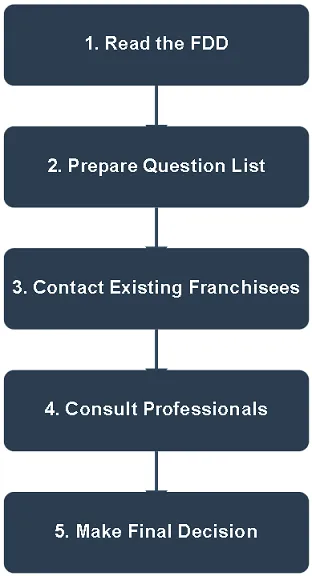
1) Read the FDD → 2) Prepare your question list → 3) Contact franchisees → 4) Consult your lawyer/CPA → 5) Decide
What should you ask?
"Was HQ training and startup support as strong as Item 11 implies?"
"Was your real total investment higher or lower than Item 7? What surprised you?"
"If Item 19 exists, does it match reality? If not, what drove the gap?"
"Were the royalty and ad fees (Item 6) worth it?"
"When issues happen, does HQ actually resolve them?"
The key question: "If you could choose again, would you still buy this franchise?"
Try to speak with at least 5–10 franchisees, including long-tenured operators and (if possible) former operators for balanced perspective.
Step 2: Assess Your Fit
Before you get swept up in the opportunity, ask: is this right for your skills, lifestyle, and risk tolerance?
Are you an owner-operator or more of a strategic manager? (Item 15 can matter.)
Can you tolerate a multi-year payback horizon?
Do your skills match the industry (sales, ops, staffing, compliance)?
[Tool Integration] Action Point:
To get a more structured view of your fit, try our Entrepreneur Assessment. It takes about 5 minutes and helps you think through risk tolerance, management style, and fit for franchising.
Step 3: Consult the Professionals
Before you invest, you should consult:
Franchise Attorney: Reviews the FDD and agreements (Item 22), flags unfavorable terms, and helps you understand negotiation options.
Accountant/CPA: Reviews Item 7 budgets, Item 19 data (if any), and Item 21 financial statements for sustainability.
Yes, professional review costs money-but compared to the size of a typical franchise investment, it's often one of the smartest "insurance policies" you can buy.
Part 5: Conclusion - Your Path to a Confident Decision
6) My personal perspective and final recommendations
In my view, an FDD is not just a legal document-it's the brand's "autobiography," written for you. Between the lines, you can often see how a franchisor thinks, how it treats franchisees, and whether its system is built for long-term stability.
Ultimately, your due diligence answers three questions:
Can this business be profitable? (Items 7, 19, 21)
Is the franchisor trustworthy and supportive? (Items 2, 3, 11, 20)
Is this opportunity right for me? (Self-assessment + family + advisors)
Only when all three answers are clearly "yes" should you move forward.
7) Summary and action recommendations
Read the full FDD, then re-read Items 7, 19 (if present), 20, 21, and 22.
Use tools to turn numbers into scenarios: ROI Calculator, Opportunity Comparison, Business Plan Generator.
Call franchisees listed in Item 20 and validate real-world experience.
Confirm your fit with the Entrepreneur Assessment.
Consult a franchise attorney and CPA before signing.
Further reading: What is an FDD? Your Ultimate Guide to the Franchise Disclosure Document
8) Final risk warning
All investments involve risk, including franchising. No FDD can guarantee success. Outcomes depend on brand strength, location, funding, execution, and your operational discipline. This article and our tools aim to support your analysis, but the final decision and responsibility are yours.
9) References
Federal Trade Commission - A Consumer's Guide to Buying a Franchise
Federal Trade Commission - Franchise Rule
Please be respectful and constructive in your comments. Spam and inappropriate content will be removed.