
Low-Cost Medical Franchises (2026): This guide is designed for entrepreneurs evaluating healthcare and healthcare-adjacent franchise opportunities—especially models that may cost less than building a traditional clinic from scratch.
Important: “Medical franchise” is a broad term. Some concepts are truly clinical and require licensed medical professionals and facility compliance. Others (like senior placement or non-medical home care) are healthcare-adjacent and may have different licensing requirements. Always verify requirements with your state health department and your franchise attorney before investing.
Legal / Medical Disclaimer: This article is for educational purposes only and does not constitute medical, legal, or investment advice. Franchise investments involve risk. Do not rely on marketing claims—validate everything in the Franchise Disclosure Document (FDD), especially Item 7 (investment), Item 19 (financial performance, if provided), and Item 20 (system outlets, closures, transfers).
Ⅰ. Why is 2026 a strong moment for healthcare & senior-care franchises?
1. Demographic demand + reimbursement realities = durable tailwinds (not hype)
Aging population (global): The share of people aged 65+ worldwide was about 10.3% in 2024, and is projected to keep rising over time (UN population projections summarized by UNFPA). Source
Aging population (healthcare demand): WHO notes the proportion of the world’s population over 60 is projected to rise substantially (e.g., from 12% to 22% between 2015 and 2050). Source
U.S. long-term care capacity & stress signals: As of July 2025, there were 14,742 CMS-certified nursing facilities in the U.S. (KFF). Source
Policy & reimbursement example (U.S.): CMS finalized a net 4.2% increase (about $1.4B) in Medicare Part A payments to Skilled Nursing Facilities for FY 2025 (SNF PPS Final Rule fact sheet). Source
Bottom line: healthcare-related demand is real, but it’s not “free money.” Reimbursement, labor, and compliance constraints are exactly why many operators prefer proven systems—or at least proven playbooks.
2. Challenges faced by independent clinics vs. advantages of the franchise model (illustrative)
| Comparison Dimensions | Independent Clinics | Franchise-Based Model (CarePatrol example) |
|---|---|---|
| Startup Costs | Often higher and highly variable (clinic buildout, equipment, licensing, staffing) | Often lower for home-based / referral models. Example: CarePatrol estimates $64,920–$135,770 total initial investment (verify the latest FDD Item 7). |
| Go-to-market (referrals & trust) | You build brand trust, referral relationships, and SOPs from scratch | Brand, training, and established positioning can accelerate trust-building (still requires local execution) |
| Regulatory & licensing complexity | Often complex (depends on specialty, payor model, and state rules) | Varies by concept. Many senior placement / non-medical home care models differ from clinical licensure requirements |
| How to sanity-check “stability” | No standardized disclosure; you rely on general market statistics and local diligence | Use FDD Item 20 (outlets opened/closed/transferred) + owner calls to validate stability |
Data sources for this section: UNFPA (global aging), WHO (aging & health), KFF (U.S. nursing facilities), CMS (SNF PPS FY 2025), and the franchisor’s published investment ranges and FDD.
II. In-Depth Analysis of the Top 10 Low-Cost Medical Franchise Brands in 2026
1. Core selection criteria (practical, not promotional)
Budget reality: “Low-cost” is relative. Compared to building a traditional clinic, many home-based senior care and certain retail testing concepts can be more accessible—but still may exceed $100k.
Support that matters: Training, compliance guidance, sales/referral playbooks, recruiting processes (where applicable), and local marketing support.
Financial discipline: Prefer brands that provide Item 19 (if available), and always run best/base/worst scenarios using a calculator—never accept “guaranteed ROI” claims.
2. TOP 3 Brand Recommendations Table (with verified investment ranges)
| Brand Name | Core Area | Investment Threshold | Technical / System Advantages (verifiable) | Profit Cycle |
|---|---|---|---|---|
| CarePatrol | Senior care placement / referral (healthcare-adjacent) | $64,920–$135,770 (published range; confirm latest FDD) | Home-based model + established senior placement system. CarePatrol is part of Best Life Brands’ senior-focused portfolio (brand scale & ecosystem context). Source | Investment source | Varies by market; validate via Item 19 (if provided) + owner calls + ROI scenarios |
| BrightStar Care | Home healthcare / senior care (licensing varies by services offered) | $132,499–$235,038 (Item 7 range cited by franchisor) | Published Item 7 investment breakdown and franchisor support structure (review the latest FDD). Source | Varies by market; validate via Item 19 (if provided) + staffing plan + payer mix |
| ARCpoint Labs | Medical testing / lab services (higher compliance burden) | ~$175,300–$342,220 (published ranges; confirm latest FDD) | Franchisor-published startup cost guidance; lab buildout + working capital considerations. Source | Varies; validate via Item 19 (if provided), local demand, and compliance timeline |
Note: All investment figures above are ranges published by franchisors (or their disclosures) and can change. Always confirm the most recent numbers in the latest FDD (especially Item 7).
2B. The full Top 10 list (so this article actually delivers “Top 10”)
Below are 7 additional healthcare / senior-care franchise concepts commonly considered by investors looking for more accessible entry points than building a clinic from scratch. These are not “endorsements”—they are a structured starting list for due diligence.
| # | Brand | Category | Published / Reported Initial Investment Range | Where to Verify |
|---|---|---|---|---|
| 4 | Any Lab Test Now | Retail lab testing | $166,900–$293,900 (single unit); micro-market options can differ | Franchisor FAQ |
| 5 | Visiting Angels | Non-medical home care | $125,460–$171,150 (reported ranges) | IFA listing |
| 6 | Right at Home | In-home care (services vary) | ~$92,100–$165,309 (reported ranges) | Forbes Advisor summary |
| 7 | Seniors Helping Seniors | Senior companionship / care services | ~$94,715–$154,590+ (reported first-year investment range) | Franchisor site |
| 8 | Nurse Next Door | Home care | $115,115–$212,600 (U.S. published range) | Franchisor site |
| 9 | HomeWell Care Services | Non-medical home care | $54,401–$233,912 (reported range) | Forbes Advisor review |
| 10 | Home Helpers Home Care | Non-medical home care | $114,250–$162,500 (reported range) | Franchise.com summary |
3. Avoid pitfalls alert (updated: no unverifiable lawsuits, only actionable checks)
⚠️ Watch out for these high-risk patterns:
1) Unverifiable “AI replaces clinicians” marketing: If a concept involves diagnostics, testing, or medical devices, verify what is actually being offered and whether your operations require licensed professionals, CLIA processes, or FDA-related compliance. Don’t operate on “it’s fine” assumptions.
2) Side letters / “dual contracts” that change economics: If a franchisor introduces material fee or territory changes late in the process, make sure they are properly disclosed and you have time to review final agreements. (FTC guidance also addresses review periods when material terms change.) FTC source
3) “No experience required” without a compliance plan: Many healthcare-adjacent models are fine for non-clinicians, but you still need a real plan for licensing, background checks, insurance, privacy, documentation, and vendor oversight. “No experience” is not the same as “no compliance.”
Ⅲ. Four-Step Profit & Risk Lockdown: A Practical Guide from Site Selection to Exit
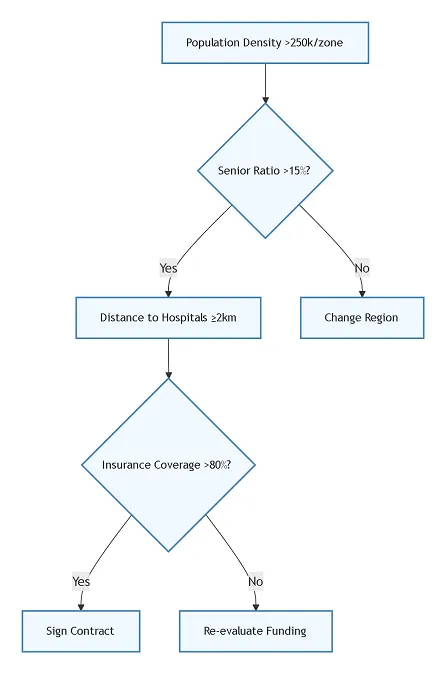
Step 1: Scientific Site Selection Model (Avoiding Pitfalls with Data)
Step 2: Three leverage points for cost control (updated to realistic, defensible guidance)
Labor model: In many care businesses, labor is the #1 cost. Build a recruiting + retention plan, understand local wage pressure, and model coverage requirements conservatively.
Supply chain / vendor discipline: For testing or clinical-adjacent concepts, vendor costs and compliance requirements can drive margin. Ask what is mandatory vs optional, and what pricing power you truly have.
Customer acquisition (referrals & partnerships): In senior care and healthcare-adjacent services, referral relationships often matter more than ads. Make sure the franchisor’s “lead support” claims are specific and verifiable (what channels, what volume, what quality, what costs).
Step 3: Pre-designed exit mechanism (negotiation targets, not guarantees)
Liquidated damages target: ≤ 20% of initial investment (varies; negotiate and verify in agreements)
Equipment disposition: clarify buyback or resale terms (if equipment-heavy)
Non-compete: keep scope/time reasonable where possible (state law varies)
Ⅳ. Why do investors trust our data?
E‑E‑A‑T trust system (practical version):
1. Authoritative traceability (updated: no broken 404 “reports”)
Demographics: UNFPA and WHO sources are linked where used.
U.S. policy / reimbursement example: CMS SNF PPS FY 2025 fact sheet is linked where used.
U.S. facility landscape: KFF nursing facility characteristics (2025) is linked where used.
State policy documents: we link directly to official sites when referenced (example: California DHCS).
2. Tool validation (corrected: no “FDA depreciation parameters” claim)
ROI Calculator: Use it to run best/base/worst scenarios. Default assumptions are generic and must be customized to your local wages, rent, staffing, and compliance costs. For depreciation and tax treatment, consult a CPA.
Opportunity Comparison: Use it to compare investment ranges, fees, and qualitative risk factors side-by-side. Always verify final numbers in the latest FDD.
Ⅴ. Your next steps checklist
1. Immediate eligibility assessment
Open the Entrepreneur Assessment, answer the questions, and get a practical “fit” starting point (risk tolerance, management style, and capital readiness).
2. Calculate state-by-state scenarios (don’t assume one ROI fits all)
Use the ROI Calculator to model your state and city assumptions (wages, rent, staffing). Keep a conservative cash buffer and validate any subsidy claims on official state websites.
3. Legal Disclaimer
The data in this article is for reference only and does not constitute investment advice. Healthcare-related businesses may require clinical oversight, licensure, and compliance with state and federal rules. Consult your franchise attorney, CPA, and relevant state health authorities before investing. Investing involves risks; proceed with caution.
Ⅵ. Content Compliance Statement
We aim to follow FTC disclosure principles and publish people-first, source-backed content. We do not accept payment in exchange for positive coverage. If any link is affiliate or lead-generating, it should be clearly disclosed on the page.
Please be respectful and constructive in your comments. Spam and inappropriate content will be removed.