
Last updated:
If you're searching "how much is a 7-Eleven franchise", you're usually not looking for trivia. You're trying to avoid an expensive mistake. This report is designed to give you decision-grade clarity on cost, fees, profit, requirements, process, financing, resale risks, and compliance.
This report answers
What is the real 7-Eleven franchise cost range, and what drives it up or down?
What is the franchise fee 7-Eleven charges, and how is 7-Eleven different from a normal royalty model?
How much do 7-Eleven franchise owners make (realistically), and what variables swing profit the most?
What are the 7-Eleven franchise requirements, and is absentee ownership allowed?
How to open a 7-Eleven franchise: application steps, timeline, and what to request (FDD, store financials).
Should you buy a 7-Eleven franchise for sale (resale) vs signing for a new/assigned store?
What are the top risks (legal, operational, market), and what is the risk-control matrix to manage them?
What should you enter into the ROI Calculator / Business Plan Generator, and what not to assume?
Executive Summary
Cost range
Across major franchise directories, the total initial investment is commonly shown in the mid-six-figures up to low-seven-figures. For example, Entrepreneur lists an initial investment range of about $141,650 to $1,370,850. Franchise Direct also shows a wide estimated initial investment range and highlights that the initial franchise fee can vary dramatically by store.
Sources: Entrepreneur - 7-Eleven franchise directory, Franchise Direct - 7-Eleven franchise page
Fee structure
7-Eleven is unusual because many summaries describe it as a "gross profit sharing" model rather than a classic straight royalty on gross sales. Entrepreneur explicitly notes that 7-Eleven shares gross profits with franchise owners (sales receipts minus cost of merchandise sold), rather than charging a traditional royalty the same way many franchises do. Franchise Direct describes the "7-Eleven Charge (Royalty)" as a variable percentage of gross profit.
Who it's for / not for
Best fit: hands-on operators who can run a high-frequency retail business with long hours, tight labor control, strong inventory discipline, and a systems-first mindset.
Not a fit: anyone looking for a part-time, home-based, or semi-absentee franchise. Entrepreneur lists "absentee ownership allowed: No" and "part time: No".
Key risks
Underestimating operating costs (labor, shrink, compliance) and confusing gross profit with net profit.
Buying a "franchise for sale" without validating the unit-level economics and lease realities.
Market shifts: store optimization/closures are real. Seven & i disclosed plans to close 444 underperforming North American stores (roughly ~3% of ~13,000 U.S./Canada stores), tied to traffic and sales pressures.
Legal/compliance: you must get the FDD at least 14 days before you sign or pay.
Sources: FTC - Franchise fundamentals and the FDD, FTC - Franchise Rule Compliance Guide (PDF), Retail Dive - 7-Eleven closures report
Quick Answers
"How much is a 7-Eleven franchise?" Usually mid-six figures to 7 figures total investment depending on the store, format, and market.
"What is the franchise fee for 7-Eleven?" Official FAQ describes a franchise fee range (and notes financing up to 65% of the initial franchise fee for qualified applicants).
"Is 7-Eleven a franchise?" Yes, it operates and franchises stores, and it's part of Seven & i's global retail group.
"How much do 7-Eleven franchise owners make?" There's no single honest number. Net depends on gross profit, labor, shrink, and local rent dynamics. This report provides a scenario model instead of a hype figure.
"Can I buy a 7-Eleven franchise for sale?" Yes, but resale economics require a different due diligence checklist (lease, goodwill, historical gross profit, shrink, staffing).
"What are the requirements?" Expect meaningful liquid assets and full operational involvement (not passive).
"How long does it take to open?" It varies; the Philippines official franchising page cites about 4-6 months for its process.
1) Project Fundamentals (Brand strength + business model)
1.1 Brand background verification (who owns what, and why it matters)
7-Eleven's U.S. operating company is commonly referred to as 7-Eleven, Inc., with corporate contact information listed publicly on its corporate pages. Third-party business databases like Crunchbase also list 7-Eleven, Inc. and connect it to the broader Seven & i ecosystem.
From a franchise-risk standpoint, the most important practical point is this: you're not just investing in a corner store brand. You're tying your cash flow to a global retail group's strategy, capital allocation, and optimization cycles. Seven & i has publicly discussed major transformation initiatives in recent years, and the company has also disclosed store optimization actions (including closures of underperforming locations). That doesn't automatically mean the model is "bad." It means the winners and losers can diverge sharply, and you have to underwrite the specific store economics—not the logo.
Verification links: Crunchbase - 7-Eleven, Retail Dive - store closures report
1.2 Legal risk scan
No franchise brand at this scale is litigation-free. The point isn't to panic. The point is to look for patterns that affect unit economics, franchisee control, wage-and-hour practices, disclosure discipline, and dispute dynamics.
Two public examples you can verify:
The U.S. Department of Labor announced a lawsuit (2023) involving alleged inaccurate pay records connected to a 7-Eleven owners association president in Michigan.
In Massachusetts, a long-running franchisee status dispute reached the Massachusetts Supreme Judicial Court. In Patel v. 7-Eleven, Inc. (decision dated September 5, 2024), the SJC held (in the posture presented) that the franchisees did not "perform any service" for 7-Eleven under the relevant independent contractor statute.
Sources: U.S. Department of Labor - release, Justia - Massachusetts SJC decision page
1.3 Business model breakdown (how money moves)
Most franchise content online hand-waves the business model. But for 7-Eleven, the economics are the whole game. Your outcome is shaped by the flow of money across: (1) upfront costs, (2) ongoing charges, and (3) how well you run labor and inventory.
Upfront typically includes: franchise fee, inventory down payment, cash register funds, plus any improvements required. The official 7-Eleven FAQ tells you to refer to the FDD for complete initial investment costs and emphasizes that actual fees depend on the store you select.
Ongoing, multiple directories describe a gross-profit-based structure rather than a traditional straight royalty on sales. In plain English: this isn't a "pay 6% royalty and keep the rest" franchise. If you're weak operationally, the model won't save you. That's why large directories also describe 7-Eleven as not absentee-friendly.
Sources: 7-Eleven official Franchise FAQ, Entrepreneur - 7-Eleven listing, Franchise Direct - fees summary
1.4 Output: Brand Credit Rating Report (editorial, decision-grade)
Below is an internal "credit-style" score. It is not a Moody's rating. It's a practical operator's rating designed to prevent self-delusion. Use it as a structured lens, then validate everything with the current FDD and store-level facts.
| Dimension | What we checked | Evidence type | Score (1-5) | Notes |
|---|---|---|---|---|
| Brand scale + demand | Store footprint + customer behavior | Industry + company reporting | 5 | NACS Top 100 ranks 7-Eleven #1 by store count. |
| Customer satisfaction | Independent benchmark | ACSI study | 3 | ACSI shows 7-Eleven at 75/100 in 2024 and 2025 convenience store satisfaction. |
| Store optimization risk | Closures/underperformance | News + disclosures | 3 | 444 store closures signal active pruning and market pressure. |
| Legal/compliance complexity | FDD rules + litigation signals | FTC + court | 3 | Disclosure discipline and wage/compliance tracking matter. |
| Franchisee relationship volatility | Historic association signals | Trade assoc. | 2-3 | Use as a question list, not as a verdict. |
Overall editorial credit rating: BBB+ (Strong brand, but unit economics and compliance discipline decide your outcome.)
Sources: NACS - Top 100 Convenience Retailers of 2025, ACSI - Convenience stores, ACSI - 2024 study press release
2) Market Feasibility (Target market fit + latest market logic)
2.1 Market characteristics: the U.S. convenience-store battlefield is big and crowded
To judge feasibility, you need two reality anchors. First, the U.S. market is huge: NACS reports 152,396 convenience stores operating in the U.S. as of Dec 31, 2023 (2024 store count reporting). Second, the industry isn't sleepy: foodservice is increasingly the profit engine. NACS reports foodservice accounted for 27.7% of in-store sales and 38.6% of in-store gross margin dollars in 2024.
For 7-Eleven, that means the modern success equation isn't just "good location." It's also: can the store execute foodservice and beverage consistently, maintain speed and cleanliness, and use systems to control shrink and labor? In many markets, "average execution" is getting more expensive every year, because wages rise, theft risk rises, and customer expectations rise.
Sources: NACS - U.S. Convenience Store Census/Count, NACS - Foodservice gross margin contribution
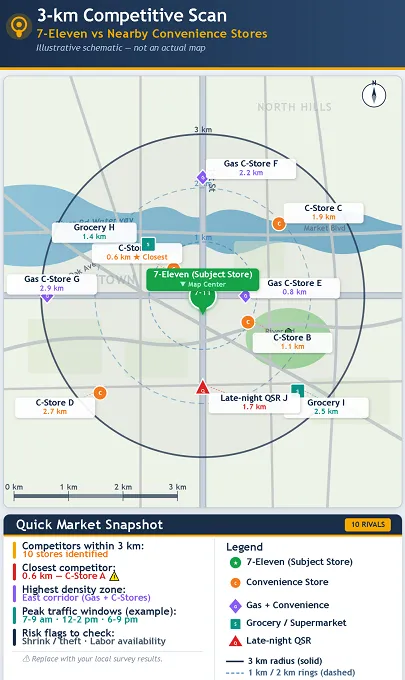
2.2 Localization fit model (your 3-km reality check)
Here's a simple operator-friendly model you can run before you fall in love with a site. In a convenience store, the micro-market matters more than the metro. Your real competition isn't "other franchises." It's whoever is the easiest stop at the exact moment the customer needs something.
3-km scan: what to count
Number of direct competitors (c-stores, gas station convenience stores, quick-service food with late hours).
Price band: coffee, fountain drinks, hot food, and the local "basket drivers".
Traffic peaks: commuter hours, late-night, weekend spikes.
Risk friction: theft incidents, loitering issues, local enforcement patterns.
Why I'm strict about 3 km: c-stores are frequency businesses. If you're not the easiest stop, you become the last resort. And last resort is a weak place to build a high-capex investment.
2.3 Policy and permitting feasibility (don't ignore boring permits)
Even if corporate handles some real estate elements in certain formats, local compliance can still delay or derail openings. Practical examples that routinely slow openings include alcohol licensing, signage approvals, fire suppression inspections, and "24/7 operation" expectations colliding with local rules or neighborhood restrictions.
Your market feasibility score should penalize any location where operating hours are restricted in a way that breaks the model. Convenience retail is not forgiving if you lose peak windows (late night, commute, weekend). If your site can't legally do what the model requires, the brand won't rescue you.
2.4 Demand quant: turn population into a conservative customer estimate
This is the boring math that saves you. You don't need perfect data. You need a conservative range you can defend. Start with:
(1) who lives nearby,
(2) who works nearby,
(3) who passes through, and then estimate the stop probability and repeat frequency.
Then model basket size and gross margin assumptions by category. The key is to treat this as a range, not a point estimate.
In a c-store, you should also model category shifts. NACS data about foodservice contributing a large share of gross margin dollars is a clear signal: if you can execute foodservice well, you may have more margin resilience. If you can't, you're competing with stores that can.
2.5 Tools: Google Trends + Statista (how to use without fooling yourself)
Google Trends: Use it to validate whether interest in "7-Eleven franchise cost" and "7-Eleven franchise for sale" is steady or spiking in your target state. Treat it as directional, not predictive.
Statista: Statista offers dashboards and breakdowns for convenience-store sales by format, but some details may be behind paywalls. Use Statista to triangulate and confirm direction, then rely on accessible sources like NACS for key public benchmarks.
Helpful starting pages: Statista (homepage), IBISWorld - Convenience Stores in the US (industry page)
2.6 Output: Market Potential Scorecard (and a starter "city shortlist")
Below is a scoring card you can reuse for your franchise database. The point is consistency: if you score 10 opportunities with the same rubric, patterns emerge fast. This is how you avoid being seduced by a single shiny store listing.
| Category | Weight | What "good" looks like | Your score (1-5) |
|---|---|---|---|
| Traffic + access | 25% | Commuter + evening + weekend flow | |
| Competitive density | 20% | Not oversaturated within 3 km | |
| Labor availability | 15% | Stable hiring pool, manageable wages | |
| Safety/shrink risk | 20% | Low theft + manageable security cost | |
| Regulatory friction | 10% | Permitting predictable | |
| Foodservice upside | 10% | Strong prepared food demand |
City shortlist logic (starting point, not a promise): begin with large metros with proven c-store density and demand. NACS reports Texas has the most convenience stores (16,304). High density also means high competition, so the site-selection bar must be higher.
Source: NACS - store count report
Starter shortlist (research starting points): Dallas-Fort Worth, Houston, Austin, Phoenix, Atlanta, Charlotte, Tampa, Nashville, Raleigh-Durham, Orlando.
3) What 7-Eleven Is (and what "franchise" means here)
3.1 Is 7-Eleven a franchise?
Yes. In the U.S., 7-Eleven is widely listed as franchising and also operating/franchising thousands of stores. NACS' Top 100 convenience retailers list 7-Eleven as #1 by store count. AP has also reported that the North American business operates and franchises about 13,000 stores in the U.S. and Canada.
Sources: NACS - Top 100 (2025)
3.2 Franchise vs license vs "store assignment."
Most people use "franchise" as a catch-all, but your contract reality can look different depending on whether you're taking over an existing unit, converting an existing site (BCP), or joining a particular program structure. The practical takeaway is simple: don't debate vocabulary. Demand the right documents: the current FDD, the exact franchise agreement you'll sign, and unit-level financials for the store you're evaluating (especially if it's a resale).
3.3 Why 7-Eleven is different: gross-profit-based charges
If you remember only one thing from this whole report, make it this: gross profit is not net profit. Many summaries explain 7-Eleven as sharing gross profits with franchise owners rather than charging a standard royalty on sales. Entrepreneur describes it as sharing gross profits (sales receipts less cost of merchandise sold). Franchise Direct describes a variable gross-profit-based 7-Eleven Charge.
That structure changes how you should model ROI: you must forecast the cost of goods correctly (product mix matters), and you must control shrink and labor (because those sit below gross profit and can erase your take-home).
Sources: Entrepreneur - gross profit sharing description, Franchise Direct - 7-Eleven Charge summary
4) 7-Eleven Franchise Cost (Total initial investment)
4.1 Typical initial investment range (Item 7 logic)
Most serious franchise cost pages ultimately trace back to FDD Item 7 (Estimated Initial Investment). While we do not publish the full FDD here, major directories provide ranges. Entrepreneur lists roughly $141,650-$1,370,850. Franchise Direct shows a broad estimated range and highlights that the initial franchise fee can reach very high levels depending on store selection. The official 7-Eleven FAQ also emphasizes that the store you select is a major driver.
Sources: Entrepreneur, Franchise Direct, 7-Eleven FAQ
4.2 What's included vs what's not included (what people miss)
A lot of content lists the franchise fee and stops. Real openings fail because of underestimated working capital, underestimated labor ramp, and "surprise" compliance upgrades. If you're evaluating a 7-Eleven convenience store franchise vs a 7-Eleven gas station franchise, your line items can shift. The official FAQ also makes clear that in certain conversion contexts, the model relates to in-store sales and gross profits rather than fuel sales, so you should separate fuel economics from in-store economics in your model.
Source: 7-Eleven Franchise FAQ
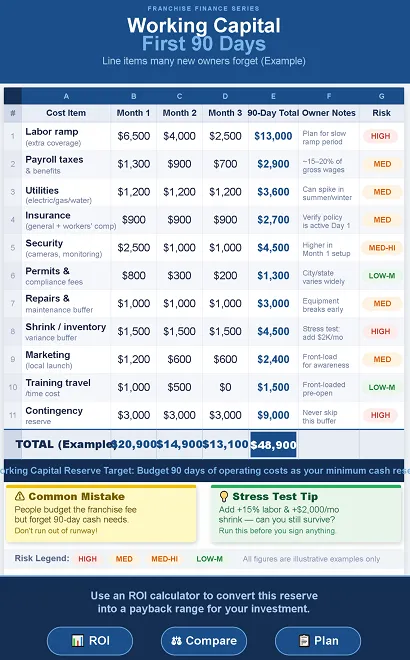
4.3 Working capital ("additional funds first 3 months"): the silent killer
Many people forget that the first 90 days are fragile. You're hiring, training, stabilizing inventory routines, and learning shrink control in real time. If your model only works when everything goes right, it doesn't work. Your plan needs a buffer: extra staffing hours, security measures (if needed), and enough cash to survive the learning curve.
4.4 Embed ROI Calculator (first use): cost + working capital → payback range
Use our ROI Calculator like this:
(1) enter your total initial cash outlay (not just the franchise fee),
(2) add a separate working-capital reserve line, and
(3) run conservative monthly net profit first, then upside.
Tool: ROI Calculator
5) Franchise Fee vs Ongoing Fees (How you actually pay)
5.1 Initial franchise fee range (and why it varies)
The official 7-Eleven franchising FAQ states the franchise fee varies by the store you select and provides a fee range. It also states 7-Eleven can provide up to 65% financing on the initial franchise fee for qualified applicants. The entrepreneur's directory page also lists an initial franchise fee range up to $1,000,000.
That is why the keyword "7-Eleven franchise price" can be misleading. You're not buying a standardized "box." You're stepping into a store-level economic engine, and the entry fee can reflect store performance, market demand, and the program format.
Sources: 7-Eleven FAQ - franchise fee and financing, Entrepreneur - fee range
5.2 7-Eleven Charge (royalty-like), based on gross profit
Franchise Direct frames the "7-Eleven Charge (Royalty)" as a variable percentage of gross profit. This is the core mechanism you must understand before you ask, "How much does a 7-Eleven franchise owner make?" If someone tells you "royalty is low" but can't explain the gross-profit base, they're not teaching you. They're selling you.
Source: Franchise Direct - charge description
5.3 Advertising fee and other fees
Directories often list advertising contributions. For example, Entrepreneur lists an ad royalty fee of 1% in its directory summary. But the real cost question is: what is the total ongoing burden as a percentage of your gross profit after you include the charge/royalty equivalent, advertising contributions, tech/system requirements, audits/mystery shops, and training/renewal costs?
Action: during FDD review, build a single "ongoing fees dashboard" and plug those into your ROI model.
Source: Entrepreneur - fees summary
6) Profit (What franchise owners make): a reality-based model
6.1 Profit ≠ revenue ≠ gross profit (the most important correction)
When you see the keyword "7-Eleven franchise profit" online, you'll often see numbers thrown around without definitions. Here's the clean ladder: revenue (sales) is the total money collected. COGS is the cost of merchandise sold. Gross profit is revenue minus COGS. Net profit is gross profit minus operating expenses (labor, utilities, insurance, shrinkage), minus franchisor charges and fees, minus taxes, minus debt service.
Because 7-Eleven is commonly described in terms of gross profit sharing/charges, it's even easier for beginners to confuse gross profit with what they keep. Don't.
Sources: Entrepreneur - gross profit framing, Franchise Direct - gross profit charge
6.2 A simple unit economics model (3 scenarios you can actually use)
Because franchisors may or may not publish Item 19 financial performance representations, you should not trust random "owner income" blog figures. A safer approach is scenario modeling anchored to industry benchmarks.
Two benchmark signals we use (directional): NACS reports foodservice accounted for 38.6% of in-store gross margin dollars in 2024, and BLS tables help you benchmark wage pressure in retail convenience categories.
Sources: NACS - foodservice margin contribution, BLS - employment and earnings table
| Scenario | Monthly sales | Gross margin assumption | Monthly gross profit | Labor + payroll burden | Other opex + shrink | Estimated net (before debt + tax) |
|---|---|---|---|---|---|---|
| Conservative | $120,000 | 28% | $33,600 | $18,000 | $12,000 | $3,600 |
| Base case | $160,000 | 30% | $48,000 | $22,000 | $15,000 | $11,000 |
| Upside | $220,000 | 32% | $70,400 | $28,000 | $18,000 | $24,400 |
Important:
this table is an illustrative model, not a promise. It does not include every store-specific franchisor charge detail because terms vary by store and agreement. Use it to understand sensitivity and what "good" even looks like.
6.3 Sensitivity analysis (labor, shrink, gross margin)
If you want to know "how much do 7-Eleven franchise owners make," the better question is: which variable can destroy my net profit fastest? Usually, it's labor creep (wage inflation, overtime, turnover), shrink (theft, spoilage, inventory mismatch), and gross margin compression (mix changes, promo pressure).
Practical stress test: reduce gross margin by 2 points, increase labor by 15%, and add $2,000/month in shrinkage. If the store still survives with acceptable owner pay, your model is finally realistic.
6.4 Embed ROI Calculator (second use): make "profit" interactive
Don't stop at reading. Plug your numbers into the calculator and let the model tell you what has to be true for the deal to work.
Tool: ROI Calculator
7) Requirements (Who qualifies)
7.1 Financial requirements (liquid assets, net worth)
7-Eleven's franchise application page states a minimum liquid assets figure to apply and notes it varies by region (and that some regions typically have higher fees). Entrepreneur also lists a cash requirement in its directory summary. Translation: if you're barely scraping together the minimum, you're not "qualified." You're fragile. And fragile operators get pushed into bad decisions like under-staffing, under-insuring, or ignoring shrink until the business bites back.
Sources: 7-Eleven - Apply Now / requirements, Entrepreneur - requirements summary
7.2 Operational requirements (not absentee; real operator mentality)
Entrepreneur's listing is blunt: absentee ownership allowed: no, and part-time: no. That aligns with the operational reality of high-frequency retail. If your plan is "hire a manager and check in twice a week," you're describing a different business model.
Source: Entrepreneur - absentee / part-time flags
7.3 Background, citizenship, age (jurisdiction-specific)
Requirements can differ by region and program. Don't rely on generic blogs. Use official application requirements and your FDD. The operational lesson is to keep a "requirements tracker" in your database: minimum liquid assets, minimum net worth, background expectations, and whether multi-unit is available.
8) How to open / Application process (step-by-step)
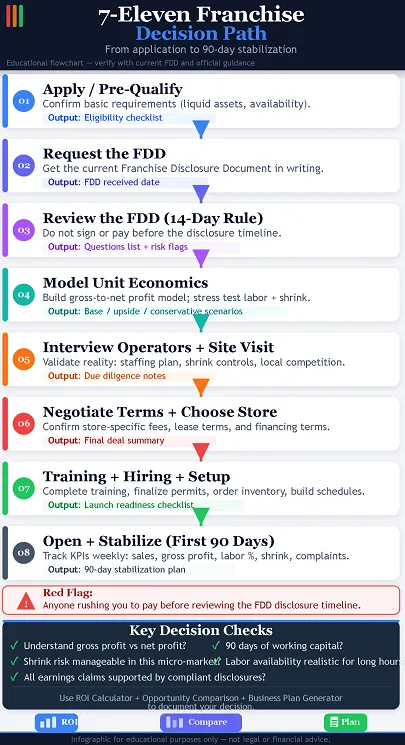
Step 1: Pre-qualification and screening
Start with the official application portal and treat it like a serious test, not a commitment. Your goal at this stage is to qualify your profile and understand what program path you're actually eligible for.
Official start: 7-Eleven - Apply Now
Step 2: Request the FDD and review it on a timeline (FTC rules)
FTC guidance is clear: you must receive the Franchise Disclosure Document (FDD) at least 14 days before you sign any contract or pay any money. If anyone tries to rush you, that isn't "sales energy." It's a red flag.
Sources: FTC - FDD deep dive, FTC - compliance guide (PDF)
Step 3: Training overview
Training isn't a checkbox. It's a cost, a time commitment, and a predictor of whether you can run the system under stress. Entrepreneur lists training hours in its directory summary (example: 240 hours on-the-job + 24 classroom). Use this to estimate time cost and ramp planning.
Source: Entrepreneur - training summary
Step 4: Store selection/assignment logic
The official FAQ stresses that fees depend on the store you select. So your process should be: understand store types, model unit economics, validate risks, and only then move into negotiation and final selection.
Source: 7-Eleven FAQ
Embed Entrepreneur Assessment (fit check)
Before you go deeper, take 5 minutes to check fit. If you're not aligned with long hours, high operational tempo, and strict inventory discipline, a different business model may be smarter.
Tool: Entrepreneur Assessment
Decision path flow
9) Franchise for sale (Buying an existing 7-Eleven)
9.1 What "goodwill" may mean in resales
Franchise Direct notes that goodwill is applicable when buying a current franchisee's interest (resale context). In real deals, goodwill is where dreams and overpayment happen. Your rule: don't pay goodwill for hope. Pay goodwill only for verified, transferable cash flow.
Source: Franchise Direct - goodwill note
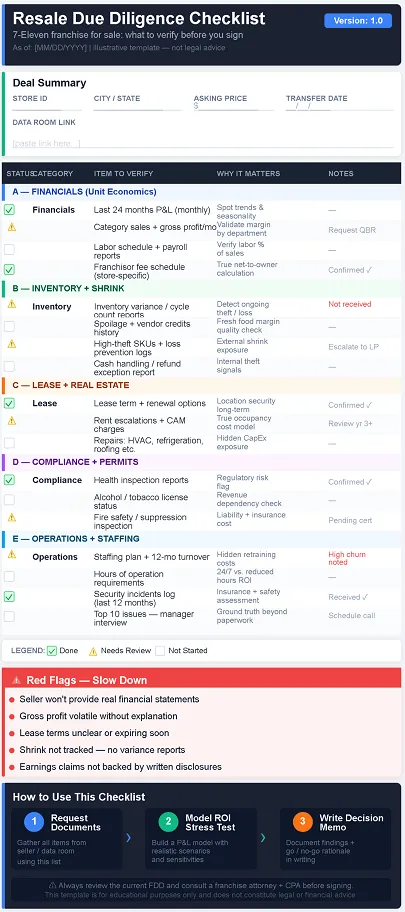
9.2 Due diligence checklist (financial, inventory, lease, compliance)
If you're searching for "7-Eleven franchise for sale" or "7-Eleven franchise for sale," you need a resale-specific checklist. Ask for: last 24 months category-level sales and gross profit, labor schedules by shift (not just monthly payroll), shrink/variance indicators, lease term and escalations, and compliance history (health inspections, alcohol license status, security incidents).
This is where most buyers cut corners, then act surprised when the first 60 days feel chaotic. A resale isn't "buying a store." It's buying a set of habits, a local risk profile, and a lease structure you may not fully control. Treat it like underwriting, not shopping.
9.3 Deal structure and red flags
Red flags that should slow you down: seller won't provide real statements, unusually volatile monthly gross profit, "staffing is the problem" as a blanket explanation, lease renewals unclear, and abnormal inventory adjustments. None of these automatically kills a deal. But each one is a signal you must validate with hard documents.
10) Store types: Convenience store vs gas/fuel locations
10.1 Fuel vs non-fuel economics
NACS notes that convenience stores sell an estimated 80% of the fuel purchased by consumers in the U.S. But 7-Eleven's official franchising FAQ (conversion context) also stresses their business model, which, relative to gasoline stores, focuses on in-store sales and gross profits, not fuel sales. The takeaway: separate fuel economics from in-store economics in your model. A fuel canopy may bring traffic. It doesn't automatically create net profit for you.
Sources: NACS - fuel/stat context, 7-Eleven FAQ - in-store focus note
10.2 Operational complexity differences
Fuel stores often add more compliance, more equipment maintenance, and potentially higher security and safety exposure. If you're new, you may prefer lower complexity unless your location's economics clearly justify the fuel complexity. Don't choose complexity because it sounds bigger. Choose it because the numbers force you to.
11) Business Conversion Program (BCP) vs traditional
11.1 What BCP is (and the $25,000 signal)
7-Eleven's official FAQ explicitly references the Business Conversion Program (BCP) and states that the initial conversion investment includes an initial franchise fee of $25,000 plus other components, with improvements varying by site. This is a major signal that the cost structure and entry path can differ based on whether you're converting an existing location.
Source: 7-Eleven FAQ - BCP details
11.2 Who BCP fits/doesn't fit
BCP tends to fit operators who already control or have a site and are prepared for improvement capex and compliance upgrades. It tends not to fit candidates who want a simple plug-and-play experience without real estate and upgrade complexity. The point isn't to "pick the cheaper path." It's to pick the path that matches your real capabilities and risk tolerance.
11.3 Risk: real estate responsibility differences
Even if some models include 7-Eleven paying certain real estate costs in some arrangements, your lease and site obligations can still create real risk. So your BCP due diligence should be real-estate-heavy, not just store-operations-heavy. In conversion deals, real estate can quietly become the biggest variable in your risk profile.
12) Financing (How people pay for it)
12.1 Internal financing mention (verify with official sources)
7-Eleven's official franchising FAQ states it has an internal financing program that can provide up to 65% financing on the initial franchise fee for qualified applicants. Entrepreneurs also reference in-house financing coverage categories. Treat this as a starting point, then verify terms, eligibility, and actual debt service impacts in writing.
Sources: 7-Eleven FAQ - internal financing mention, Entrepreneur - financing summary
12.2 Working capital planning (don't get underfunded)
Underfunding is the most common silent failure mode. You can't hire enough people, standards slip, shrink grows, customer experience drops, and then the business spirals. In convenience retail, a small decline in execution can quickly become a big decline in cash flow. Your working capital plan isn't optional. It's the difference between learning and drowning.
12.3 "Don't get underfunded" checklist
Reserve at least 3 months of operating costs (wages, utilities, insurance).
Budget for security and loss prevention if your area requires it.
Assume at least one surprise compliance upgrade.
If you finance the franchise fee, model debt service under conservative profit.
13) Legal & Compliance (Read this before you sign anything)
13.1 FTC: You must receive the FDD at least 14 days before signing/paying
FTC guidance says you must receive the FDD at least 14 days before you sign any contract or pay any money. This isn't a technicality. It's a built-in pause button designed to protect you from emotional, rushed decisions. Use it.
Sources: FTC - FDD deep dive, FTC - compliance guide (PDF)
13.2 Item 19: what can/can't be claimed, and how to treat earnings talk
Financial performance representations must be handled carefully. As a practical rule, never rely on verbal earnings claims. Always request the current FDD and check Item 19 (if provided). If an FDD does not include Item 19 representations, treat any earnings talk as non-actionable marketing and rely on unit-level data for a specific store (where available), plus conservative modeling.
Helpful FTC framing: FTC - Franchise Rule resources
13.3 Legal risk notes you should track
Two legal/compliance items worth tracking as part of your ongoing risk monitoring: (1) the Massachusetts SJC decision in Patel v. 7-Eleven, and (2) Department of Labor enforcement actions like the 2023 filing. You don't need to become a lawyer. You need to understand that compliance posture is part of operational risk, and it can affect costs and contract dynamics.
Sources: Patel v. 7-Eleven (Justia), U.S. DOL - release
13.4 Compliance & investment disclaimer
Compliance & Investment Disclaimer:
This content is for educational purposes only and is not legal, financial, or investment advice. Franchise outcomes vary widely by location, operator skill, costs, and local market conditions. Always request and review the current Franchise Disclosure Document (FDD) and consult a qualified franchise attorney and CPA before signing any agreement or paying any fees. Never rely on verbal earnings claims; only rely on written disclosures permitted under applicable franchise laws and regulations.
14) Opportunity Comparison (Is 7-Eleven the best option for you?)
14.1 Compare against: independent c-store, other retail franchises, semi-absentee concepts
This is where most franchise content fails. People compare franchise fees and ignore the life cost. A serious comparison includes labor intensity, hours, shrink risk, complexity, and whether the business can be run semi-absentee. If you compare only the entry price, you are basically asking to be surprised later.
Tool: Opportunity Comparison
14.2 Quick comparison table (starter)
| Option | Upfront cost | Operator hours | Labor complexity | Shrink risk | Cash flow stability |
|---|---|---|---|---|---|
| 7-Eleven | High | High | High | Medium-High | Medium |
| Independent c-store | Medium | High | High | Medium-High | Medium |
| Semi-absentee service franchise | Medium | Medium | Medium | Low | Medium-High |
15) Generate your Business Plan (Next step)
If you're serious, stop reading and start producing artifacts: a plan, a model, a due diligence log, and a decision memo. A business plan isn't a school assignment. It's a tool to force reality into your decision.
Tool: Business Plan Generator
16) Risk Control Matrix (Dynamic early-warning system)
16.1 Three-level risk response framework
High risk (immediate veto): confirmed store churn pattern implying structural failure, margin-trap contract terms, or inability to obtain the FDD properly (FTC compliance red flag).
Medium risk (negotiate or mitigate): weak territory protection, old systems that can't manage inventory and shrink, high-crime micro-market without a clear loss-prevention plan.
Low risk (acceptable with planning): routine permits, seasonal demand swings (mitigate with a 3-month reserve).
16.2 Risk matrix table
| Risk | Level | Trigger | Early warning KPI | Mitigation |
|---|---|---|---|---|
| Underfunding | High | Cash reserve < 90 days | Payroll stress, vendor delays | Increase reserve, reduce debt load |
| Shrink | Medium-High | Inventory variance rising | Cycle count variance | Cameras, training, tighter receiving |
| Labor turnover | Medium | >10% monthly churn | OT hours, service complaints | Wage strategy, scheduling discipline |
| Regulatory delays | Medium | Permits > 60 days | Missed construction milestones | Permit specialist, buffer timeline |
| Market traffic decline | Medium | Sales down 10% YoY | Transactions/day | Product mix pivot, promotions |
17) Deliverables (what you get from this report)
17.1 One-page decision memo (template)
Investment range (with source year)
Liquid asset requirement (region-specific)
Model assumptions
Base-case net profit estimate
Payback range
Risk rating
Go / No-go decision
17.2 Competitor comparison sheet
Use the output of Opportunity Comparison, then add a human summary: "why 7-Eleven wins," "why 7-Eleven loses," and "who should choose something else." This is how you avoid being anchored by brand name alone.
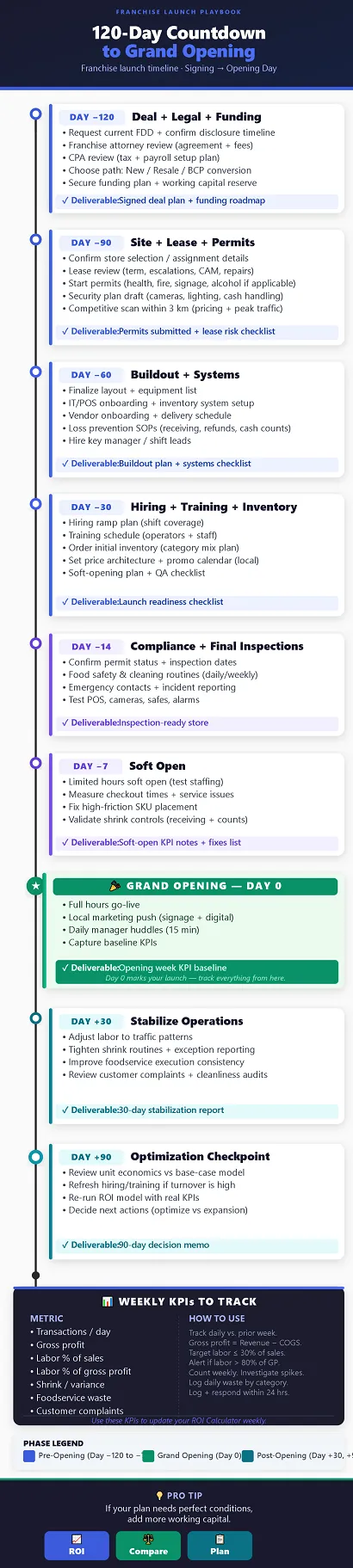
17.3 Local execution checklist (120-day countdown)
18) International notes: Philippines and Thailand
18.1 7-Eleven franchise Philippines
The Philippines has a dedicated official franchising page describing support, process steps, and training, and it states the process can take around 4-6 months. The Philippine Franchise Association listing also provides a published capital investment range and franchise fee figure for 7-Eleven Philippines. If you're writing for international investors, link to the local operator's official page and keep U.S. economics separate from the Philippines economics.
Sources: 7-Eleven Philippines - Franchising, Philippine Franchise Association - 7-Eleven listing
18.2 7-Eleven franchise Thailand
In Thailand, 7-Eleven is operated under CP ALL. Practical guidance: treat Thailand as a different corporate ecosystem with local operator rules, and verify franchising availability directly with the local operator. Do not assume U.S. fee structures apply.
Source: CP ALL annual report (PDF)
19) FAQ (entrepreneur-focused, objective)
How much is a 7-Eleven franchise cost, all-in?
Expect a wide range depending on the store and market. Use directory ranges as a starting point, then validate with the current FDD and the specific unit you're evaluating.
What is the franchise fee 7 eleven charges, and can I finance it?
Official FAQ states a franchise fee range and notes internal financing up to 65% of the initial franchise fee for qualified applicants.
How much do 7 eleven franchise owners make per month?
There is no single valid number. Net profit depends on gross profit, labor, shrink, and local conditions. Use scenario modeling and do sensitivity analysis; don't rely on unsupported blog earnings claims.
Is 7-Eleven a semi-absentee franchise or a side business?
Not typically. Major directories list absentee ownership as not allowed and part-time as not allowed.
Can I buy a 7 eleven franchise for sale instead of starting new?
Yes, but resale requires deeper due diligence: goodwill logic, lease terms, and unit-level economics verification.
How long does it take to open?
Varies by country and process. For the Philippines, the official page cites about 4-6 months. For the U.S., timing depends heavily on store availability, training, and approvals.
20) A realistic case vignette
Here's a scenario that shows up again and again in franchise underwriting. This is a composite example built from common due diligence patterns, not a specific real person.
Scenario: a buyer finds a "7 eleven franchise for sale" listing, sees strong top-line sales, and assumes profit must be great. They build a model using revenue, but they don't request category gross profit, labor schedules, or shrink history.
What goes wrong:
Sales are real, but gross profit is thin because the product mix is low-margin.
Labor is higher than expected because the micro-market requires more staffing for safety and service.
Shrink isn't tracked properly, so losses show up only after closing.
Result: the buyer learns too late that a gross-profit-based structure doesn't protect them if operating expenses eat the remainder.
How to fix it (what I'd do every time):
Rebuild the model from gross profit, not revenue.
Ask for labor by shift, not just monthly payroll.
Demand an inventory variance report (or equivalent shrink indicators).
Stress test: what happens if traffic falls 5% and wages rise 10%?
21) Tool guidance: what to watch when using our calculators
ROI Calculator
Don't input gross profit as net profit. If you do, your payback will be fantasy.
Always run 3 scenarios (conservative/base/upside).
Add a working capital reserve line item.
Entrepreneur Assessment
If you score low on consistency, operations discipline, and long-hours tolerance, don't force it. Choose a business model that matches your real operating style.
Opportunity Comparison
Compare life cost (hours, staffing stress, shrink risk) not just cash cost.
Business Plan Generator
Use it after you’ve reviewed fees and store-level economics.
Don't publish earnings claims unless supported by compliant disclosures (Item 19 rules).
22) Personal viewpoints and hard-earned insights
Here's my honest take: the internet’s obsession with "how much is a 7-Eleven franchise" is understandable, but it's also a trap. Cost is easy to ask, easy to rank on Google, and easy for content farms to answer with a wide range. But cost rarely determines success in convenience retail. Behavior does.
If you're the kind of operator who can show up every day, follow a system, and still think clearly when your first staffing plan collapses, you're already ahead. Convenience retail punishes wishful thinking because it's a thousand tiny decisions: inventory ordering, shift coverage, cleanliness, food safety habits, how you handle shrink, whether you train your team to scan correctly, and whether you take vendor credits and receiving routines seriously.
The second thing I believe is misunderstood: a famous brand doesn't eliminate risk. It changes the shape of risk. The brand can bring traffic and trust, but it also brings strict standards and fee mechanics you can't out-hustle. And if the industry is shifting (wages rising, customer expectations rising, foodservice becoming more important), being average gets more expensive every year. NACS data about foodservice's growing share of gross margin dollars is a neon sign telling you where the fight is going.
Third: store selection is the hidden franchise fee. The wrong site makes every fee feel higher, and every operational issue feel personal. The right site makes the same system feel like leverage. That's why I like 3-km competitive scans and why I want your first model to be conservative. If your base-case assumes perfect staffing and zero shrink, you're not modeling. You're daydreaming.
Finally, trust is earned by process. The FTC's 14-day FDD timing rule isn't bureaucratic trivia. It's the pause button. Use it. If anyone tries to bypass it, that is a signal you should take seriously.
Conclusion: what to do next (action plan)
Decide which path you're evaluating: new/assigned store, BCP conversion, or franchise for sale.
Request the current FDD and respect the 14-day clock.
Build your model from gross profit down to net, then stress test.
Run your assumptions through:
If buying a store for sale, do resale-grade due diligence (lease, shrink, staffing, goodwill logic).
Risk warning
Franchising is a high-stakes investment. Even strong brands can have underperforming locations, and store optimization including closures of underperforming North American locations has been publicly reported. Never invest money you can't afford to have tied up longer than expected. Never rely on verbal earnings claims. Always consult a franchise attorney and a CPA before you sign.
Invite comments
What's the single hardest part of evaluating a convenience store franchise in your market: labor, shrink, site selection, or financing? Share your situation in the comments. If you include your country/state and whether you're looking at a new store vs a 7 eleven franchise for sale, we'll reply within 48 hours with a focused research checklist and benchmarking suggestions.
Please be respectful and constructive in your comments. Spam and inappropriate content will be removed.